“I think it’s exactly the same thing, but it’s on steroids.”
That was Ford Motor Company CEO Jim Farley, comparing t Chinese carmakers in the global electric vehicles (EV) race with Japanese carmakers in their heyday in the 1980s (which really says it all).
A year on — in a time when one year is the new 10 — global carmakers have more or less admitted an inability to compete with China on technology and prices. Instead, some are turning
“I think it’s exactly the same thing, but it’s on steroids.”
That was Ford Motor Company CEO Jim Farley, comparing t Chinese carmakers in the global electric vehicles (EV) race with Japanese carmakers in their heyday in the 1980s (which really says it all).
A year on — in a time when one year is the new 10 — global carmakers have more or less admitted an inability to compete with China on technology and prices. Instead, some are turning to them as tech partners. (Volkswagen, for instance, has developed its first all-electric full-SUV with Chinese company XPeng.)
What is all the fuss about? Well, over there, some EV batteries now charge in about as long (five minutes) as it would take to fill a tank with petrol.
Consumer-electronics giants are building vehicles from scratch, packing into them all kinds of new capabilities. In certain Xiaomi models, as a result, seats feel like luxury recliners, and offer massages too. Certain electric SUVs by BYD also float on water.
The sense of shock at what Chinese EVs can do is still rippling through other countries. Because markets are responding.
According to data from the International Energy Agency (IEA), Chinese EV makers exported about 2.5 million electric cars in 2025.
China’s biggest EV maker, BYD, is in the process of outselling the US’s biggest EV maker, Tesla, for the second year in a row. BYD delivered 557,090 vehicles, exceeding Tesla’s 480,126 deliveries by 16%. And Tesla’s Q2 numbers were its best ever for a single quarter.
Chinese companies now produce close to 75% of the world’s electric vehicles and, according to IEA data, is on track to account for roughly 57% of global sales volume this year. These figures have held more or less steady since 2023.
What Farley was trying to say is reflected in these numbers: No country but Japan has ever dominated the global vehicles market in this way.
GRAND TECH AUTO
How did China make this giant leap?
First, it built a vast home market. Years of purchase incentives and tax concessions allowed carmakers to invest in improving products and expanding demand.
Scale allowed companies to invest more heavily in research and development and try newer experiments, while still lowering costs. Alongside, there were incentives to build faster charging capabilities, more charging stations, and battery-swap technology.
These key elements would help turn China into the world’s largest EV exporter too (a position it has held since 2023; more than 13 million electric cars were sold in China in 2025 alone).
China also built up the supply chain around the car. It produced more than 80% of the world’s EV battery cells, for instance, in 2025. (It helps, of course, that the country is home to the world’s largest deposits of the rare earth elements needed for these batteries, accounting for nearly 48% of total global stores.)
Amid it all, Chinese manufacturers have also quietly been rethinking what a car can be, and do. Take a look.
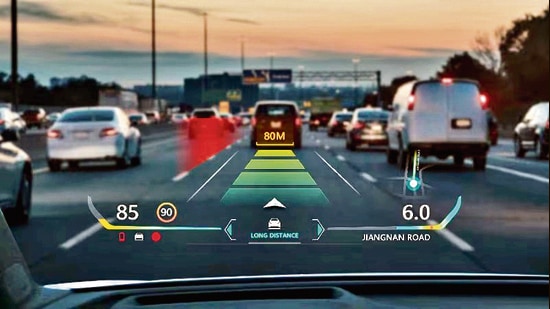
What’s on the windshield?: Huawei has devised technology that allows carmakers to offer Augmented Reality Head-Up (AR-HUD) displays. This system uses the windscreen to place virtual graphics in the driver’s view, allowing navigation arrows to appear aligned with the road and warnings to draw attention to potential hazards. The feature is currently available in cars by Rising Auto, Aito and XPeng.
Did I leave the oven on?: Xiaomi, a carmaker as well since 2024, is building vehicles as part of its “Human × Car × Home” ecosystem. They respond to voice commands and gestures, and are seamlessly integrated with the company’s phones. The SU7 EV, for instance, uses the HyperOS to allow users to control home appliances from the driver’s seat, and parts of the car’s dashboard from their living room.
The dancing EV: The BYD DiSus-X’s intelligent body-control system, launched in 2023, has a “dance mode” that lets user access an app to rhythmically sway or rock the car from side to side, and pump its chassis up and down, to the beat of music playing within.
This isn’t just a party trick, though. The underlying engineering involved serves critical real-world functions, including as the foundation of a suspension system that softens impact at high speeds and renders the car safer if a tire blows.
Robo-taxis and flying cars: In May, XPeng rolled out its first mass-produced robo-taxi. Public-road testing has begun, with pilot operations planned for the second half of 2026 and commercial operations on track for early 2027.
Unlike firms such as the US-based Waymo (owned by Alphabet), XPeng will make its own self-driving vehicles and use its own proprietary AI models and software. (Waymo has the software, but the cars currently come via Jaguar.)
Rapid recharge: BYD says its Super e-Platform, introduced in March 2025, allows some of its EVs to charge enough in five minutes to add 400 km of driving range, using its megawatt charging system.
Meanwhile, carmaker Nio has been setting up automated power swap stations, and now has a network of over 4,000 depots, as of August, where one can swap a depleted Nio battery for a charged one in about three minutes.
These are the kinds of developments, in other words, that encourage more motorists to adopt EVs, and encourage them to think of Chinese carmakers when they do.
One Subscription.
Get 360° coverage—from daily headlines
to 100 year archives.
Archives
HT App & Website