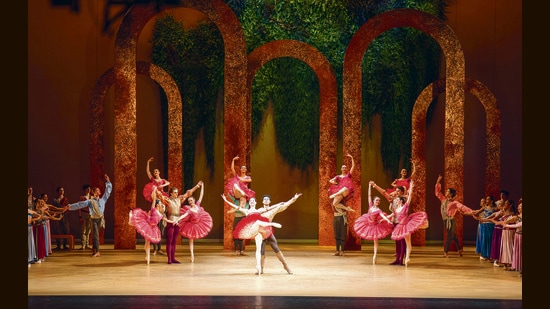
Few classical ballets carry as much beauty, and baggage, as La Bayadere (The Temple Dancer).
For nearly 150 years, this classic created by French choreographer Marius Petipa for the Russian Ballet has told the story of a temple dancer and a warrior who fall in love in India.
This is, however, an India of colonial stereotype: half-naked sadhus represented by Whites in blackface dance around fires; scheming priests and kings abound; and the elaborate sets are a mishmash of indistinguishable
Few classical ballets carry as much beauty, and baggage, as La Bayadere (The Temple Dancer).
For nearly 150 years, this classic created by French choreographer Marius Petipa for the Russian Ballet has told the story of a temple dancer and a warrior who fall in love in India.
This is, however, an India of colonial stereotype: half-naked sadhus represented by Whites in blackface dance around fires; scheming priests and kings abound; and the elaborate sets are a mishmash of indistinguishable arched and domed architecture.
The choreography is exquisite, though. As is the music, the grand scale and dramatic tension. How does one contend with a work from 1877 that is both essential and problematic?
This year, the Dutch National Ballet (DNB) in Amsterdam decided to find a way.
It chose neither to preserve the fantasy nor ignore the ballet. Instead, it debuted a reimagined version earlier this year. The reframed La Bayadere alters the plot, recasts some of the characters, and situates the tale in real locations in Dutch colonial India.
In doing so, it subtly nudges its largely European audiences to engage with their own problematic past.
This La Bayadere is co-directed by Dutch-Indian dancer, choreographer and anthropologist Kalpana Raghuraman and Australian-Indian dancer, choreographer and researcher Priya Srinivasan, alongside DNB director Ted Brandsen and associate artistic director Rachel Beaujean. It is now set in 17th-century Sadras, the Dutch East India Company’s fortified settlement in coastal Tamil Nadu.
While preserving much of Petipa’s choreography, the new ballet tips its hat to marginalised Indian musicians and dancers, with a montage of stills and short clips paying tribute and finally entering them into the historical record. Chennai-based musician and visual artist Tenma, co-founder of the band Casteless Collective, orchestrated this element of the production, curating images of Dalit, Bahujan and Adivasi performers from across decades.
“We wanted to turn the colonial mirror the other way, and imagine what La Bayadere could have looked like if it was created with all of the information and awareness available today,” says Srinivasan.
The original story follows Solor, a warrior, and Nikiya, a temple dancer, whose love is doomed from the start. To begin with, a character named High Brahmin, a priest, is in love with her too. Then, the raja of Golconda commands Solor to marry his daughter Gamzatti, and Solor decides to obey.
As preparations for the wedding begin, the High Brahmin tells the king about Nikiya and Solor’s relationship. Gamzatti tries to beg, bribe and bully the dancer into ending it. Nikiya, meanwhile, is commissioned to perform at the celebrations, where she is killed by a venomous snake planted by Gamzatti. Solor, consumed by grief, dreams of reuniting with her in the afterlife. Then, as Solor and Gamzatti are about to be married, divine forces set the kingdom ablaze.
Over the past couple of decades, controversy over the exoticised representations of India had seen the ballet avoided by many companies, Raghuraman says.
When DNB reached out, she adds, “they asked whether I thought it should be cancelled or could be reimagined in some way. I roped in Priya, and together we started discussing a decolonised approach that would reimagine the piece as something more equitable, based on historical evidence.”
BACKSTAGE PASSES
Research led Srinivasan to Fort Sadras, where she found the graves of Dutch colonial officers and soldiers. “This allowed us to use actual historical figures as sources of inspiration,” she says.
In the revitalised ballet, Solor is accordingly a captain in the Dutch army; the high priest has been replaced by a corrupt Dutch merchant. The raja is a half-Japanese-half-Dutch governor.
Because DNB has a diverse cast, and 17th century South India was so cosmopolitan, different races and nationalities can be represented in the characters and dancers. Nikiya, for instance, is in this version a mixed-race dancer (abandoned as a child and given to the temple to raise).
In place of the original opening sequence, of sadhus in blackface dancing around a fire, this ballet opens with the tribute to marginalised classical and folk artists such as Karagattam dancers S Thanganila, S Poovizhi and Priyadharshni, Devarattam dancer Mukesh Amaran, and yazh player Tharun Sekar. Some are shown performing; others simply stare into the audience. “S Thanganila looking at the audience is meant to be a haunting moment,” Tenma says. “Like the ghost of the dancers and musicians who never got to write their names into history.”
In addition to the historical context, elaborate sets have been replaced by footage of real places, and simplified hero-villain hierarchies have been fleshed out. But one of the issues they couldn’t fix, Raghuraman says, was the death of Nikiya. “Why do women always have to die? We debated this a lot. We unfortunately couldn’t change it. But we have reframed it in a way where her death is a foreshadowing of the larger destruction. We had also talked about including a few Indian dancers in the ballet, and that hasn’t worked out so far.”
This kind of project still marks a new direction, Raghuraman adds. “It remains incredibly difficult to represent Indian dance forms and dancers on the international stage without cliche or exoticisation rearing their heads. But every small thing that we changed opens up new possibilities for future practitioners and projects.”
One Subscription.
Get 360° coverage—from daily headlines
to 100 year archives.
Archives
HT App & Website