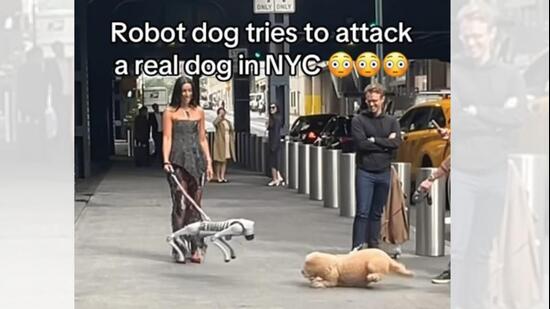
So much happens in the world of robotics that the World Humanoid Robot Games held in Beijing in August already feels like a lifetime ago. What we remember though are the LOLs. A humanoid robot lifts a barbell. Seconds later, it lurches forward unsteadily and goes down face-first like a house of cards, its hands flailing helplessly. Two officials scoop it up by the arms and legs and carry it off the exact way you’d carry a person on a stretcher.
Another robot busts some genuinely impressive dance moves — it has the rhythm down, the swagger en pointe. Until it just collapses like dead weight. It’s all fun and games until the bot gets hurt. Then it’s hilarious.
We don’t laugh when the toaster breaks down. So, why do failing robots give us so much joy?
Serves it right
“Robots are associated with precision, knowledge, and consistency,” says Abhit Kumar, CEO of Integra Robotics. Walking, reading a gesture, reacting to a stranger — it’s trivial for us, but genuinely hard for a machine. “When a robot fails in performing something natural and effortless for us... it creates inherent humour.”
{{/usCountry}}“Robots are associated with precision, knowledge, and consistency,” says Abhit Kumar, CEO of Integra Robotics. Walking, reading a gesture, reacting to a stranger — it’s trivial for us, but genuinely hard for a machine. “When a robot fails in performing something natural and effortless for us... it creates inherent humour.”
{{/usCountry}}Nikhil Narendran, partner at law firm Trilegal, who works at the crossroads of technology, law and commerce, doesn’t see a joke so much as a broken deal. “We have largely had a master-servant relationship with machines,” he says. AI wrecks that arrangement — machines now interpret, judge and communicate. “A technical failure starts to feel personal because we are bringing both sets of expectations to the same interaction.”
Anthropomorphism, our tendency to give human-like qualities to inanimate objects, makes this worse, not better. The toaster can break down, but when a bot does, it feels like a human fumble. And as Dr Deepak Hujare, who heads mechanical engineering at Maharashtra Institute of Technology World Peace University, puts it: “The failure of a humanoid is compelling to watch as it establishes that we are still superior.”
Wait and watch
Humans learn fast. We change direction mid-stride, we pivot mid-career, we avoid the dimly lit park from seeing the news about someone else, we watch two Reels about trans people and decide to never deadname, we say that pandan tastes like wet socks without ever having tasted wet socks. For robots, it takes longer to “detect the change, comprehend the implications of that, choose a course of action, and implement it.”
It won’t last. “As humanoids start behaving more like humans, perhaps we may not be that comfortable if it makes silly mistakes,” Dr Hujare warns. We might just yearn for the time when we watched them fumble, secure in our superiority.
Perhaps, when the bots get smarter, but still slip up, we won’t laugh, but get upset. Narendran points out that in human relationships, when one person makes a mistake, the other tends to respond with disappointment. “I believe that will carry over to our relationships with machines.”
Getting there
Do we even know what we’re laughing at? “Some of the most difficult behaviours to reproduce are the ones that humans don’t even realise that they are doing themselves,” says Kumar. His go-to example: Passing someone an object. It requires the person to work out the speed, angle and grip to match the other person’s readiness without a second thought. For a robot to do the same thing calls for “very fast integration of perception, motion planning, control, and adaptation to a changing environment”. We only notice when it goes wrong. Perhaps that’s why the laugh.
The risk isn’t the robot failing. It’s the robot succeeding, unsupervised. He uses the example of Bhasmasura, the demon in Indian mythology, who was handed a boon so powerful he turned on the god who granted it. Robots need a manual override to keep them in check – even while they fumble now.
Or, we should just stop trying to make robots more human. Kumar says that robot design should be less concerned about making robots seem human, and focus more on doing their assigned tasks more efficiently. On his factory floor, the machine tells you what it’s about to do before it does it. Nobody needs their cobot to have main character energy. They just need it to not surprise them.
From HT Brunch, October 3, 2026
Follow us on www.instagram.com/htbrunch