For the past few months, 23-year-old Urvashi Gormat has been chatting with a new friend. They discuss the kind of boys Gormat likes, what makes her heart flutter, her favourite singers, and what concerts she’s planning to attend. The friend has been trying to set her up with a few guys. “She really gets me”, says Gormat, a content strategist and marketer in Bengaluru. “She knows exactly the things I like in a person. It’s fun to talk and even lowkey rant to her.”
Gormat’s “friend”, though, isn’t human. It’s Wave, an AI companion built by the dating app Wavelength, which launched in April this year. Wavelength, like other bot-based dating apps, is hoping to serve as a digital version of the viral matchmaker Sima Taparia. “Wave asks me more questions than Sima does,” Gormat says. Thus far, Wave has suggested over 30 profiles to her. “I’ve not found my person yet.”
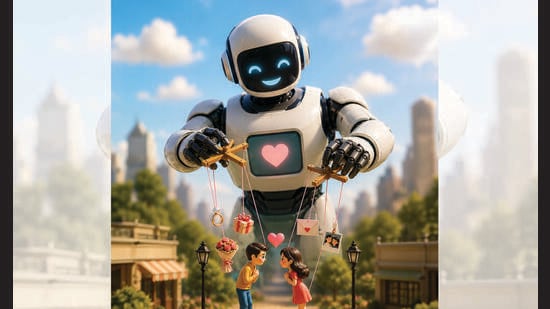
It’s a rough time to want to date. Around the world, more young people are choosing to remain single. In news articles, the term of choice is Relationship Recession. Dating lingo is being expanded to include Swipe fatigue (burnout from constantly rejecting profiles) and Microcheating (when a partner crosses boundaries in tiny ways that add up to a betrayal). Dating apps are struggling to retain paid customers. Tinder, Bumble and Hinge are moving to AI-based matchmaking. Bots, for the most part, are objective, tireless and easy to retrain. Could they set singles up with someone who matches their freak?
Wires crossed
{{/usCountry}}Wires crossed
{{/usCountry}}Dating apps were already using some form of back-end AI to sort profiles, study swiping behaviour and suggest partners based on customers’ preferences.“A decade ago, the goal was to expand your options beyond your circle of friends and acquaintances,” says Karima Ben Abdelmalek, the CEO and president of dating service, happn. “Now, people don’t want a buffet of options. They want to choose from three or four people they can see themselves connecting with.”
Apps are hoping AI can also pitch in with the initial flirting and vibe-check. On most new apps, there are digital matchmakers, dating coaches, assistants or avatars to take over the pesky task of assessing a potential partner. Bumble’s assistant is called Bee. Overtone a new app run by the Hinge founder, will launch later this year. On Tinder, Chemistry and Learning Mode are operational in Australia and New Zealand. UK-based platform Romeo & Juliet, which launches in India soon , aims to shortlist partners for clients.
Here’s how the free-for-now service works: Clients have a five-minute conversation with the AI Juliet, who asks them how they spent their weekend, how they’d resolve conflict in a relationship, what their love languages are, and what kind of support they’d want from a partner after a difficult day. Clients then list their non-negotiables: Political opinions, educational levels expected from a partner. Then, Romeo, the second AI, looks through the system and matches them to someone that seems to be the most compatible.
Wavelength and Knot.Dating work in similar ways. On Flutrr, it’s possible to tighten filters: Bengali girl, 5’5, loves to travel, has long hair. It even lets an AI avatar of one client chat with AI avatars of potential partners endlessly, saving humans the effort of rejecting and being rejected. “Most people aren’t aware of what they want from a relationship, or even the kind of partner they actually need,” says Vinit Sarode, 27, Wavelength’s co-founder and COO. “They need a third person, a go-between, to introduce them and help them build their relationship in the first few months.” He’s hoping that AI is that connector.
Jasveer Singh, co-founder of Knot.Dating, has added detailed questions for AIs to ask clients, down to Netflix favs, how they like to spend time on a weekend, and the last book they read. Subscription feels start at ₹50,000. “It’s for people looking for serious relationships that lead to marriage,” says Singh. The 15-minute AI call also covers hypothetical questions: How would you spend your days if you were alone on a deserted island? How would you react when your boss disagrees with you? “We don’t just look at the information; we pay attention to your tone, how fast or slow you speak, to get a fuller picture of who you are as a person.”
Rejection rate
It works, in theory. Even Sima Aunty, well-meaning parents, and besties can get it wrong when they try to set two people up. Because humans are really good at presenting the best version of themselves – on a first date, to a fiancée’s family, to a bot. AI isn’t primed to spot psychoses, bigotry, if someone is violent or secretly married.
Bengaluru-based matchmaker Radhika Mohta sweeps these AI questions away. What a relationship boils down to, she believes, is respect and trust, which algorithms can’t predict. “Nobody has ever come up to me and said, ‘On an ideal Sunday in my future life, I want to be with a six-foot-tall guy with blue eyes’,” Mohta says. “What they want is someone who’ll show up for plans without flaking, whose words match their actions, whom they can count on to be there for them.”
Kaushik Banerjee, co-founder and CEO of Flutrr, admits that even with AI shortlisting potential partners, clients still have to do the talking, flirting and dating on their own. Bots are trained to connect commonalities – hikers match with hikers, extroverts match with social butterflies. So, the connections they suggest tend to be the safest ones.
Safe bets work well when you’re hiring for a job. But love? Love is complicated. AI could never predict that Vicky Kaushal or Katrina Kaif could have got together. Or why Lana Del Rey sings, “When you know you know”. Bots don’t account for the thrill of meeting someone exciting and different; the uncertainty of not knowing what you’re falling into. “The recommendations that I get ticks everything on my list,” says Gormat. “But no one really falls in love with lists, do they?”
Besides, as most longtime singles know, every app draws from the same pool of actual humans. Bots can do all the filtering they can, but if shirtless biker Ayaan from Delhi has profiles on multiple platforms, they can’t invent a whole other person.
Holding hands
One issue, at least, seems to be somewhat solved. Wavelength says it has 35% women users and 65% men, Knot.Dating has a user base of 60% women and 40% men. The gender gap may be closing.
Wavelength and Flutrr’s AI matchmakers also double as dating coaches, encouraging users to give a date another shot or suggest ways to keep the conversation going. “It’s particularly useful for users from smaller towns, who have not been taught how to interact in a romantic setting,” says Banerjee. Being an interesting person, however, is all on you. “Even with prompts, people’s conversations are so dry,” says Ankush Dharkar, a 36-year-old entrepreneur from Bengaluru who has tried both Wavelength and Knot.Dating and hasn’t gone on any dates yet. “The larger issue is that people don’t want to put in the effort to date anymore.”
Apps are trying to fix that, too. happn’s AI feature, Perfect Date,holds events and mixers for singles. Wavelength is planning to roll out a paid feature that curates dates. Users just have to show up and have a good time.
So, AI or no AI, singles are just going to have to make sense of the messy dating scene themselves. Gormat is still hoping she’ll bump into her person in the real world, “like an old-school meet-cute at a museum or a karaoke session”. It’s the best-case scenario. Because who wants to thank a bot during someone’s wedding toast?
From HT Brunch, July 25, 2026
Follow us on www.instagram.com/htbrunch