When people say, with a twinge of frustration, that they “don’t get modern art”, they’re probably referring to abstract work. Jackson Pollock’s splotches, Piet Mondrian’s geometrics, SH Raza’s Bindu, Nasreen Mohamedi’s grid patterns. There’s no story playing out (or is there?). Is there a focus, or is it just some tricky Rorschach test you didn’t prepare for?
The art world refers to abstraction as the quality of existing as, or representing, an idea or feeling. It’s not meant to be realistic. And Indian artists have played with that idea with rich results. Look through abstract art over the decades, and you’ll see styles emerge, just like with figurative art and photography. There’s no single, fixed language – and yet it’s representative of the moment. Perhaps this is what keeps abstraction alive.
Perhaps this is also what drew me towards abstraction – that hint of mystery, the idea that reality and meaning can exist even when it’s not immediately obvious. Yet, I’m always curious to know what an abstract artist actually sees.
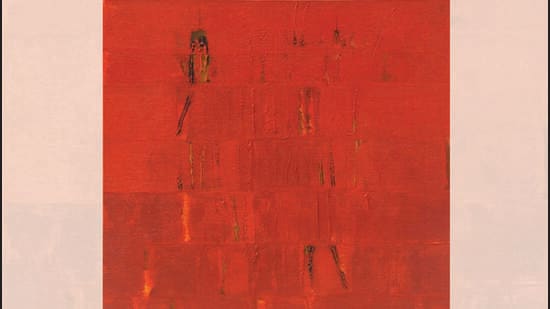
It’s why Prakash Waghmare’s work hits the mark for me. Born in Roha, Maharashtra, in 1966, and educated at Mumbai’s Sir JJ School of Art, Waghmare built two distinct artistic practices over his decades-long career. He’s been an abstract painter and a realist photographer.
The paintings are all untitled, created using bright and bold colours, broad lines and strokes. There’s a variety of shapes in interesting positions. Light breathes through the surface, creating subtle variations in atmosphere, depth and perception. It imbues his paintings with life. There is also a musical quality to his art, with pauses, intervals, tonal shifts and restrained movements creating a visual rhythm.
{{/usCountry}}The paintings are all untitled, created using bright and bold colours, broad lines and strokes. There’s a variety of shapes in interesting positions. Light breathes through the surface, creating subtle variations in atmosphere, depth and perception. It imbues his paintings with life. There is also a musical quality to his art, with pauses, intervals, tonal shifts and restrained movements creating a visual rhythm.
{{/usCountry}}Waghmare has said he’s inspired by what he sees and imagines: Folk art, his childhood, earth, water, air, fire and sky. But people don’t exactly see the world in abstract elements and formless globs. To be able to view reality, and filter from it a palette, a mix of the objective eye and the mind’s eye – that’s what sets an abstractionist apart.
In a culture saturated with visual noise, Waghmare does not need to shout. His work directs the gaze inward, it’s almost meditative. And yet, there’s always drama in his strokes, and subtle shifts of hue.
Most people who are familiar with his paintings will inevitably think of his photographs as well. Whether he captures a skyscraper against a city skyline at night, the silhouette of a tree with a hint of the setting sun reflected in a pond, or a closely rendered shot of grass and wildflowers, Waghmare is noticing the microcosm. His photos draw attention to small, self-contained worlds that exist quietly within the larger whole.
Abstraction and realism, therefore, aren’t two separate languages in Waghmare’s universe. They are two directions of looking – one inward, one outward – held together by the same fundamental impulse to hold the viewer’s attention. To share with them a glimpse of what he sees.
Artist bio: Jyotee Kolte’s mixed-media works are made using pans, pinewood, steel, test tubes, bottles, resin, soil, natural pigments and text.
Jyotee Kolte spoke to Noor Anand Chawla
From HT Brunch, August 22, 2026
Follow us on www.instagram.com/htbrunch