
 E-Paper



Drawing Room: Why Samyukta Madhu sees herself in G Ravinder Reddy’s art

 Prefer HTon Google


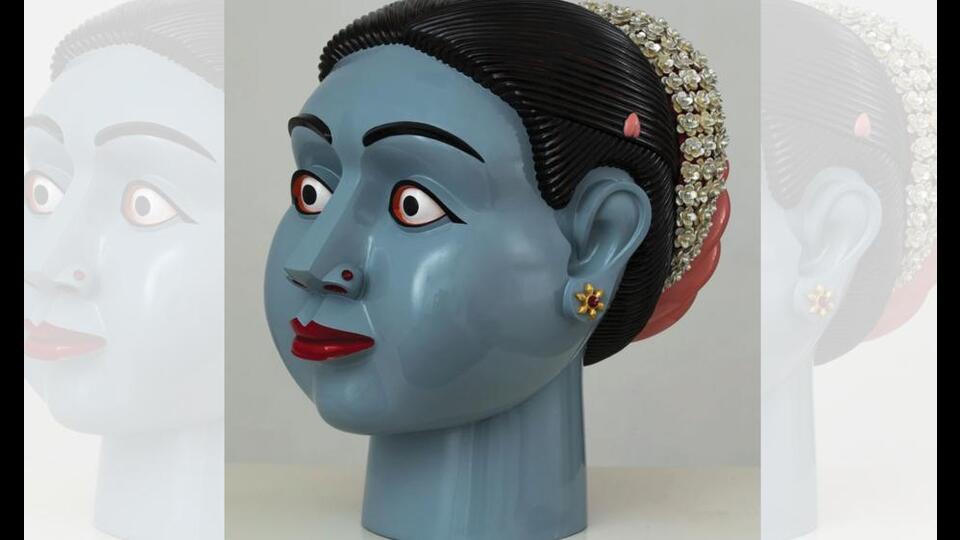
Curves, rolls of fat, and strong features are on full display in G Ravinder Reddy’s work. It celebrates the real female form
Artist bio: Digital artist Samyukta Madhu’s work plays on themes of feminism, futurism, and South Asian culture.
You’re probably familiar with G Ravinder Reddy’s work even if you think you aren’t. His monumental fiberglass heads of women have been displayed at Ambience Mall in Delhi, at Bengaluru’s RMZ Ecoworld, at Phoenix Marketcity in Chennai, and for years, at the entrance to Bangkok’s Central World shopping complex. Reddy’s sculptures are captivating. They fill the space they occupy. So, even if you haven’t been to an art gallery, a biennale, or an art fair, you’ve seen the sculptures; they’ve likely seen you too.
In particular, I’m impressed by two of his works: Sitting Woman (1997) and Head (2010). I saw the first piece while walking through Bengaluru’s Museum of Art and Photography. She was nestled in a corner, almost hidden among the other works, her flash of deep blue, an unexpected reward reserved for those paying attention.
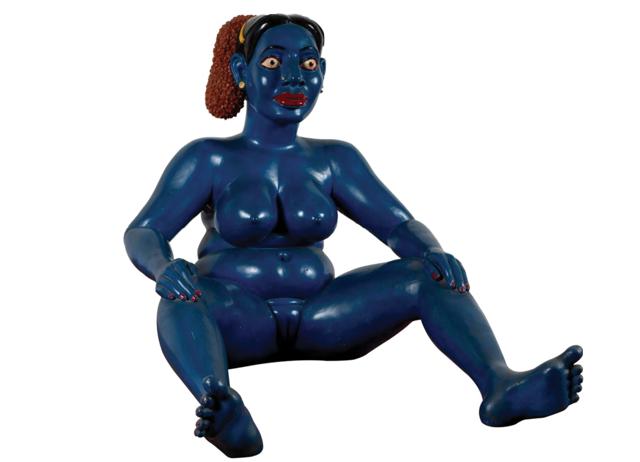
Sitting Woman sits on the floor, her legs wide open, unashamed and fierce. Her nude figure is polished to perfection. Light bounces off her lustrous blue skin. Her hair, tied in a bun, is decorated traditionally with flowers, in what seems an almost comical disparity with her undressed body. The smooth, glossy finish of her skin, the curves of her belly fat, and her deep, unyielding kohl-rimmed eyes drew me in.
Most importantly, her body mirrored mine. Her fat was located in the same places as mine! Where I spent years trying to hide my curves behind large hoodies and baggy jeans, here was a representation of me as a South Indian woman. It felt like our bodies, too, were made to be seen and admired.
I saw Head at the Chennai mall, where it was surrounded by neon logos and signs. Like many of the artist’s other busts, it’s massive, imposing and powerful. Head, however is painted a rich gold and towers over the shops and eateries surrounding it. Its features are strong – large, deep-set eyes, elegant sculpted lips that hold a slight hint of condescension. It stands there like a mighty ship in the middle of an ocean of commerce. You risk forgetting yourself, your life, your shopping list, as you give in to the artwork.
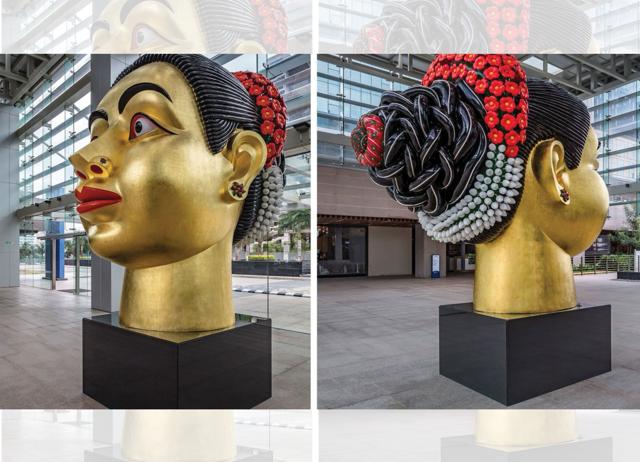
For me, Reddy’s works represent power, femininity and South Indian identity. It’s rare to find art that does justice to these subjects simultaneously. I have always wondered about my place in the world as a South Indian woman, about the kind of impact I make. The sculptures provide me with answers to these questions.
When I first saw these works, I wasn’t interested in Indian fine art. As a digital artist, and someone who grew up online, I typically looked to the West for my definition of good art. It’s only after I moved abroad that I realised how crucial my Indian identity was for my work.
I’m greatly inspired by art that plays with scale; works that forcefully take up space, command you to look upwards, or inwards. You feel consumed, and transported into another dimension. Reddy’s work reminds me of the Venus of Willendorf figurine, discovered at a Palaeolithic site in Austria, and estimated to have been made 30,000 years ago. The Venus is smaller, but among the earliest depictions of feminine power, with her chiselled folds of fat frozen in time forever. She and Reddy’s women, are empowering images in a world where Photoshop and Ozempic seem to dictate standards of beauty.
From HT Brunch, January 11, 2025
Follow us on www.instagram.com/htbrunch


