
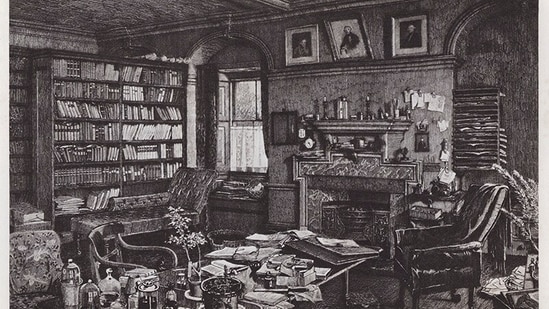
“That everlasting Origin,” Charles Darwin complained in 1868 as he was readying yet another version of “On the Origin of Species,” first published in 1859. “I am sick of correcting.” Yet he went on correcting, as he had done for several previous editions, cutting and replacing words, rearranging sentences, even adding a new chapter to the sixth edition. It was as if the message Darwin hoped to convey—that life was a constant process of loss, change and renewal—was also
“That everlasting Origin,” Charles Darwin complained in 1868 as he was readying yet another version of “On the Origin of Species,” first published in 1859. “I am sick of correcting.” Yet he went on correcting, as he had done for several previous editions, cutting and replacing words, rearranging sentences, even adding a new chapter to the sixth edition. It was as if the message Darwin hoped to convey—that life was a constant process of loss, change and renewal—was also true of the book that has come to define him.
Grab a copy
Darwin: A Biography
By Janet Browne
Princeton University Press, 624 pages
If Darwin (1809-82) was a committed reviser, it appears that his biographer Janet Browne, an emeritus professor of scientific history at Harvard, has taken some inspiration from her subject. Ms. Browne’s magnificent life of the naturalist, originally published in two volumes in 1995 and 2002, is now available in a shortened and updated version. Her original opus didn’t cry out for a makeover. The unassumingly titled “Darwin: A Biography” isn’t so much a revamp as a new book entirely.
Ms. Browne’s earlier biography bulged with the kind of satisfying detail one finds in the long Victorian novels Darwin favored (provided they had a happy ending). Take the consequential months after Darwin’s return to England in October 1836 after his nearly five-year voyage around the world on HMS Beagle, when his theory of evolution was a flicker in his mind. Ms. Browne’s original account of that period proceeded accordingly, as if in slow motion. We learned that Darwin celebrated New Year’s Eve 1836 with a snowball fight in Cambridge. We found out that the daughters of the geologist Leonard Horner invited Darwin to come over for a visit—in Maōri, which they thought would impress the world traveler. And we looked over Darwin’s shoulder as he filled his notebooks, sized “just right for slipping into a pocket,” and sorted through the maze in his mind as he met with people who helped him make sense of the specimens he had brought back.
In the new version, stripped of detours and detail, the same period occupies only a few pages. Ms. Browne’s prose takes on a balletic quality as she captures the excitement Darwin felt on the cusp of discovery: “Daringly, Darwin began to dance with the notion of transmutation as he had never danced before.” Ms. Browne recounts how Darwin experimented with “cascades of ideas” and “oscillated between recording things he had read or heard and tackling on his own the deepest themes of metaphysics.”
Buffered by wealth and social position, Darwin was able to reconcile, like few of his peers, the secluded life of a country squire with the exacting demands of scientific work. Down House, his home in Kent, became his refuge as well as his lab. “Where does your father do his barnacles?” one of Darwin’s boys innocently asked when visiting a friend’s house. The eight years Darwin spent dismembering these tiny invertebrates at home took up more than 20 pages in Ms. Browne’s old version; they now receive barely four.
What we gain is a concise reminder of why barnacles—and the many forms they take—were so important to Darwin. He loved the rudimentary males he found embedded in the females of one particular species—precisely the kind of weird transitional form his theory of evolution would depend upon. In Ms. Browne’s compression, the reader immediately understands how Darwin’s diverse interests came to fit together like the pieces of a puzzle.
There are other benefits to Ms. Browne’s winnowing. “After this, Darwin turned back to barnacles with a heavy heart,” she had written previously about his attempt to come to terms with the death of his 10-year-old daughter, Annie, in 1851. The sentence is now pared down to a simpler but rhythmically effective line mimicking the weight that was on Darwin: “With a heavy heart he buried himself in barnacles.”
Late in life, Darwin became infatuated with earthworms, a fitting preoccupation for an aging naturalist. In the original biography, Ms. Browne gave us a memorable image of him following the progress of the worms in his backyard: “Darwin became at the end what he had always been in his heart, almost part of nature himself, a man with time to lean on a spade and think, a gardener.” Yet the notion of a working gardener suggests continuous activity, watering down the image of a man slowing down. Ms. Browne now cuts the word, leaving the reader with a pithier portrait of Darwin (almost) at rest, a man finally permitted to be a leaner and loafer, the Walt Whitman of natural science.
Admittedly, Ms. Browne’s culling and slimming at times curtails crucial information. It is harder to grasp Alexander von Humboldt’s profound influence on Darwin—the “union of poetry with science” he had found in the Prussian scientist’s travel accounts—if the reader gets little more than the flip (and inaccurate) caveat that Humboldt was a representative of Western imperialist science. And the truncated references to the Harvard scientist Louis Agassiz, Darwin’s lifelong nemesis, create the impression that it was Agassiz’s racism and not his scientific inflexibility that sent some of his students running for Darwin’s camp.
Still, Ms. Browne’s reimagined “Darwin” is a marvel of economy, an example of how revisions, judiciously applied, may yield something quite different from the original. I confess to a lingering fondness for the Victorian expansiveness of Ms. Browne’s earlier work, and the many anecdotes now chopped: how the children of the botanist Joseph Dalton Hooker caused a panic when they scribbled over a draft chapter of “Origin” sent to their father for review; how a neighbor once passed a strange old man wrapped in a cape, belatedly realizing it was Darwin himself, “a shy and nervous man.”
Not someone, in other words, who will submit easily to a biographer’s scrutiny. That Ms. Browne has risen to that difficult task twice, expertly revising her earlier effort, would have pleased Darwin, that master of rewrites.
Mr. Irmscher, a Guggenheim Fellow, is the author of “The Poetics of Natural History” and other books.
One Subscription.
Get 360° coverage—from daily headlines
to 100 year archives.
Archives
HT App & Website