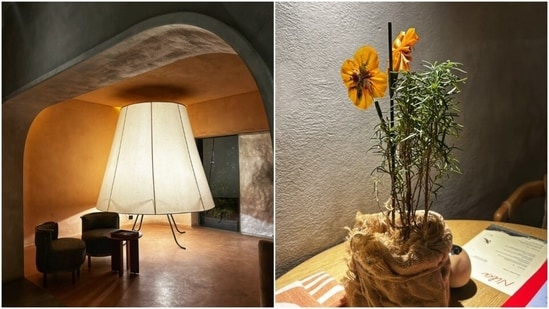
I'll be honest, I walked into Nila expecting to be impressed. I did not expect I'd be plucking edible flowers off a plant on my table. Bengaluru has no shortage of tasting menus, but Nila is on a different frequency. Also read | I went for a 10-course Meghalayan feast in Bengaluru and ended up dining with royalty, discovering the culinary soul of the northeast
It's chef Rahul Sharma's intimate, moon-obsessed, quarterly-shapeshifting restaurant — 24 seats, no paintings, one open kitchen, and a 12-course menu that rewired my brain about what regional Indian food can actually be.
Nila isn't trying to impress you: it's trying to slow you down
At Nila, you pluck your appetiser off a plant on the table. You eat tamarind as ice cream. You realise black pepper ice cream should have always existed. It's deliberate, hyper-local, story-driven storytelling — the opposite of every tasting menu that tries too hard. That intent makes sense when you meet the chef.
{{/usCountry}}At Nila, you pluck your appetiser off a plant on the table. You eat tamarind as ice cream. You realise black pepper ice cream should have always existed. It's deliberate, hyper-local, story-driven storytelling — the opposite of every tasting menu that tries too hard. That intent makes sense when you meet the chef.
{{/usCountry}}Chef Rahul Sharma founded Nila, which opened earlier in 2026, to celebrate India's regional ingredients. He started at Oberoi Hotels across Udaipur, Mumbai and Gurgaon, then The Leela, earned a MAD Symposium scholarship as one of 10 chefs globally, staged at the world-famous Noma, helped found Masque in Mumbai, and set the food language for Araku Coffee in Bengaluru and Mumbai.
At Nila, none of that shows up as ego. It shows up as restraint. While most tasting menus borrow from everywhere, chef Rahul's Nila stays rooted — celebrating the country's diversity, one region at a time. No art on the walls. No playlist fighting for attention. Just the moon cycle and a first bite you have to pluck.
The vibe is deceleration by design
Nila feels hidden — warm, cave-like, with intimate nooks, curved sofas, sculptural lamps and soft amber lighting. Nila was designed by Prachi Joshi of Designworx, who is also chef Rahul's wife, and it feels personal for a reason. It was built in close collaboration between the two.
"Rather than approaching it as simply designing a restaurant, the intention was to create a space that could become an extension of the philosophy behind Nila," Prachi said. "The interiors were imagined to complement the food, the stories behind each menu, and the experience we wanted guests to take home," she added.
The decision to keep it at 24 seats was intentional. "We wanted to move away from the conventional idea of a restaurant and create an environment where guests could slow down, connect with the food, interact with the team and truly experience every course," she said.
The name Nila means moon in Tamil. During our post-service chat in a quiet corner outside the restaurant, chef Rahul explained that India has always run on a lunar calendar — festivals, harvests and seasons tethered to lunar cycles. Every three months, Nila changes its region. The moon is what connects them.
"We wanted the space to reflect this sense of rhythm and transition," Prachi added.
That rhythm is everywhere. Scandinavian simplicity, soft curves, textured mud walls, muted tones, diffused lighting. Nothing loud. "The collaboration was built around a shared understanding. The architecture, materials, lighting and movement all contributed to the larger narrative," Prachi said. "The idea was never to create a space that competed with the food, but one that quietly complemented it," she added.
My favourite detail: there is no art on the walls. On purpose. The open kitchen is the art. The only indulgence is hidden in the washroom — a glowing, moon-inspired light installation. As Prachi put it, “The space should not just be somewhere you come to eat. It should be somewhere you slow down, observe, discover and feel something.”
The menu: Three Indias in one night
Every quarter, the kitchen picks a new belt of India and builds a 12-course tasting menu around indigenous ingredients from that region. Not recipes. Ingredients. For this special service — a tasting that combined its first three menus — the dishes featured ingredients from Ladakh, Kerala and Nagaland. Cold desert at 12,000 feet, coastal backwaters, tribal hills.
What made it remarkable was the service. Despite a pass that never stopped, chef Rahul and his team explained each course to every table. No table was skipped. At the entrance, before service, a large platter of raw ingredients from across the regions was laid out. Chef Rahul crouched beside it to walk us through each one. We could smell them too. Most were unfamiliar.
Let's talk about the 12 courses
We started with 'seabuckthorn leaves tea': warm tea from seabuckthorn leaves, tart and toasty, with a house-curated Ladakhi navratan mix. Then came 'raktsey karpo apricot (12,000 feet)'. This white-seed Ladakhi apricot is so rare, chef Rahul shared, that out of a hundred trees, maybe one or two bear it. The team turned it into fruit leather like aam papad, cut it into translucent orange flower petals, and pinned them onto a plant in a jute pot on your table. You then pluck an edible flower off a live herb. So fun.
'Coastal coconut' was a smooth white disc of layered coconut textures: coconut flour biscuit, curry leaf oil and coconut oil, with tiny hand-carved star micro-flowers. Geometric, like a tiny ecosystem. Next, 'mulberry leaf' — pickled leaf styled like puttu, grilled with a choice of crab or jackfruit. I had jackfruit: charred and smoky. Then came 'jewel corn toast': charred, sweet-spicy corn bread, fresh corn custard and purple corn snow. Light as air, deep, and so good.
The 'fire toasted vatta pattani soup' lived up to its name: smoky, earthy, straight-up fire. The bowl arrived with bright orange smoked salsa in the middle, then tableside, they poured velvety broth around it. It came with 'Nila flatbread' in a woven basket lined with cloth and condiments in tiny handmade earthenware pots — delectable chutneys, pickles and dips.
Next, 'eendh pidi': sculpted dumplings made of queen sago seed flour served with a sauce of roasted garlic and curd chilli. Chewy and earthy. Then came 'nendran roast' — roasted Kerala banana with a sauce of peanuts and curry leaves. Dark, caramelised, eaten with navara rice, that revered red rice from Kerala, GI-tagged.
A dessert that messes with your head
'Malabar tamarind' is Nila's signature move. It looked like dessert, tasted like a dare. "The easiest thing would have been to use tamarind as a souring agent in a curry or puree. Instead, we turned it into ice cream," chef Rahul said. A muted grey-brown crescent: tart, bitter, strong. Served with fresh cream and a thin spice biscuit. I liked it — the moment I stopped comparing it to other ice creams and just saw it as a fun dessert.
Then came 'apricot cake' — dense cake, apricot kernel salsa, black pepper ice cream. That pepper is genius. So good it deserves to be copied. One of the best bites of the night. The finale was 'chamomile tart' — a duo, and so good. A pristine bowl of translucent golden chamomile reduction with real flowers floating — foraged in Ladakh — plus a white nest-like tart with a dot at the centre.
The chat that explained everything
After service, despite the buzz, chef Rahul stepped out for a chat. That is where I understood his thought process and the story behind Nila. He laid out the creative triad. Innovation — micro-seasonal work with local partners. Exciting — subverting expectations. Evolving — new regional chapters every three months.
Chef Rahul is particular about who he works with: "We try to stay away from working solely with chefs as local partners. Chefs often have fixed perceptions about their own native food — a rigid box. Instead, we partner with local farmers, botanists and agriculturalists."
The result is ingredients at their most elemental — like apricot leather, not jam. And a tasting menu that doesn't linger. "In India, tasting menus often fail because they become too long and drawn out. Diners get bored. We execute our 12 courses within 90 minutes," the chef shared. And he does. Portions are precise. Service is like a performance. You leave satisfied, not stuffed.
What is next
Done with Ladakh, Kerala and Nagaland, next is Bengal. Chef Rahul said the next chapter follows the river systems to where fresh water meets the ocean — Kolkata and the Sundarbans, the world's largest mangrove forest. "In this belt, where fresh meets salt and the tide decides what land is and what is water, the ingredients are unlike those of any other part of India, and we approach them with the same zeal as ever, cooking them through a 21st-century lens," he shared.
If he can turn tamarind into ice cream, imagine what he will do with mustard and gobindobhog rice. If you've been waiting for a reason to book Nila — this is it.
The author was hosted by Nila upon editorial invitation.