
Ever since they started the hottest brand in the frozen aisle, the founders of JonnyPops have measured progress through a series of firsts.
There was the first employee they kept during the winter, the company’s first invitation to the almighty Minnesota State Fair, the first time they watched products cooked up in the basement of their college dorm get loaded into Costco
Ever since they started the hottest brand in the frozen aisle, the founders of JonnyPops have measured progress through a series of firsts.
There was the first employee they kept during the winter, the company’s first invitation to the almighty Minnesota State Fair, the first time they watched products cooked up in the basement of their college dorm get loaded into Costco trucks.
“That,” said Erik Brust, the CEO, “felt so hard to even wrap our heads around.”
But the most head-spinning moment came earlier this summer in the last place anyone would associate with the sheer pleasure of their product: the security line at O’Hare Airport.
Connor Wray, the CFO, was passing through Chicago in a shirt that resembled the brand’s colorful wrappers when he was stopped by a TSA agent. As it happens, this TSA agent had a soft spot for chocolate-dipped strawberry cream JonnyPops. He asked for ID, looked at Wray’s attire—then asked for something else.
“He asked to buy the shirt off my back,” said Wray, who declined the offer. “I didn’t think a shirtless walk to the plane was going to go well.”
Every so often, a product seems to come from nowhere and suddenly feels like it’s everywhere. This summer, that product was the JonnyPop. If you haven’t spotted them, just wait. If you have, you probably know a kid who’s obsessed with them—and now your freezer is full of them.
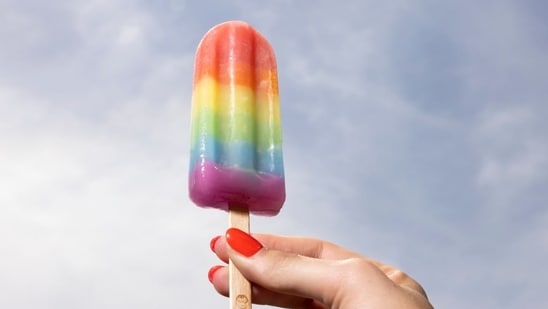
The signature JonnyPop is a rainbow stack of cherry, orange, lemon, lime, blue raspberry and grape. But there are dozens of JonnyPops: water pops, sour pops, twist pops shaped like unicorn horns, fruit pops otherwise known as “smoothie on a stick” and chocolate-dipped pops favored by TSA agents in the Chicago area.
Across the U.S., shoppers bought more than $170 million worth of JonnyPops at major retailers over the past year, according to market-research firm Spins, with roughly half of the company’s annual sales coming during the summer.
Before this summer ends, I called the founders to find out how their brand popped up all over America.
“It’s the classic decadelong overnight success,” Wray said.
Brust and Wray, both 34, met in physics class at St. Olaf College in their native Minnesota more than a decade ago. As economics majors, they started an investment club with two friends and contributed $500 each. Then they got bored.
“We quickly deployed our mighty capital of $2,000,” Brust said. “We were like, well, what are we going to do now?”
He had an idea. In high school, Brust had an entrepreneurial streak and fantasized about starting a frozen-confection business with his cousin, Jonathan, who later died from a drug overdose. Brust pitched his friends on the product they had imagined. He knew just what to call it: JonnyPops.
The original headquarters of JonnyPops was the basement of their college dorm, where they blended prototypes and experimented in ice-cube trays. They soon moved to local churches and wedding halls, which had commercial kitchens available during the week.
“On weekends, we would wake up at 4 a.m., get in the car and drive to a farmers market,” Wray said. “Every college kid’s dream.”
Their investment paid off. By graduation, they had basically majored in popsicles.
(“‘Popsicle’ is a trademark,” Brust said. “We don’t talk about Popsicles.”)
These days, the business of ice pops is much bigger than Popsicles. Americans buy more than $9 billion of frozen novelties a year, according to market-research firm Circana, up 20% over the past five years, with the growth driven by upstart brands like GoodPop, Yasso and JonnyPops. “The category is on fire,” said Dan Epley, Whole Foods Market’s senior vice president of center store merchandising.
Before it really heated up, Brust and Wray decided to make another contrarian investment. When factories couldn’t keep up with surging demand during the pandemic, they believed industry giants would pour resources into making stuff the world already loved. They made the opposite bet.
“We’re going to start making stuff the world’s never seen before,” Brust said.
They focused on stuff that would be harder and slower to make because it would require custom machinery. And instead of new flavors, they wanted to come up with new formats. Take the Bomb Pop, the red-white-and-blue classic that can transport you right back to childhood. Why is it only three layers? Why not six? Or eight? While they were at it, what about a pop that looked and tasted like a frosted rainbow cake?
To pull off such feats of precision engineering, they invested in their own manufacturing facilities. Their control of ingredients, equipment and the production line became one of the company’s secret weapons: Because they are gluten-free and made in a peanut-free space, JonnyPops can be served at every birthday party. (This company decision was also personal to Brust: His sister has a severe peanut allergy.)
Then they had to do something harder than pack a few extra layers of frozen water on a stick. In the ruthless competition for every inch of retail space, JonnyPops made its case for greater distribution through a metric carefully tracked by retailers: “new to category.” That is, the brand didn’t just win over people already buying other frozen novelties. It brought in people who weren’t in the habit of buying them at all.
At Whole Foods, the growth was incremental before it went exponential. Eight years ago, a regional buyer introduced JonnyPops in Northern California. Once a couple items became available nationally, Whole Foods added more JonnyPops every year. “This past year,” Epley said, “we exploded them.”
When they blew up and shoppers began seeking them out, the company had a peculiar strategy that kept them coming back.
In the early days, Brust and Wray stamped every JonnyPops stick with a reminder to do a simple “kind deed.” Back then, they printed all those sticks by hand. “A lot of long books got listened to,” Brust said. Over time, they noticed that something odd happened when people finished their JonnyPops. Instead of tossing the sticks in the nearest garbage, they kept them. Some even mailed them back. As it turned out, the sticks were sticky.
So the company launched a rewards program and gave fans an irresistible reason to collect sticks: to trade them for prizes.
The ultimate reward is a trip to Minnesota to create a flavor in the company’s R&D lab, which requires 10,000 sticks—a JonnyPop a day, every day for decades. More realistically, it takes families pooling sticks. And they have. The Everest of JonnyPops consumption has now been conquered three times.
These days, Brust and Wray don’t have to look at grocery shelves or the company mailbox to understand their product’s appeal. All they have to do is look around their homes. They both have young children, which means they’re surrounded by JonnyPops consumers. They just can’t use them for market research.
“When I bring something new home,” Wray said, “they want rainbow.”
At least they let him keep his shirt.
One Subscription.
Get 360° coverage—from daily headlines
to 100 year archives.
Archives
HT App & Website