Yogi Adityanath, who completes one month as Uttar Pradesh chief minister on Wednesday, has hit the ground running, grabbing headlines with a series of decisions ranging from banning paan and gutkha at government offices to cracking down on illegal slaughterhouses and setting up anti-Romeo squads.
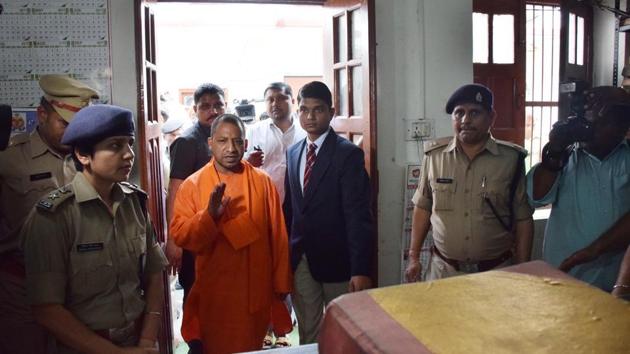
A new chief minister usually begins his stint by overhauling the bureaucracy, but Adityanath did not make changes immediately after assuming office. He retained former chief minister Akhilesh Yadav’s set-up, but warned officers against laxity.
He effected his first major administrative reshuffle on April 12, three weeks after taking charge, and shunted 20 senior IAS officers, putting eight of them on the waitlist. He transferred 44 IAS officers on Tuesday, the eve of his one-month completion in office.
A list of his key decisions and directives:
1) ASSET DECLARATION: An hour after he took oath on March 19, Adityanath ordered all ministers to declare their income, movable and immovable properties within 15 days. He asked them to submit declarations to the CM secretariat.
He also made them take an oath of cleanliness and honesty. He made it clear that his government will have zero tolerance on corruption and law and order. Though not all ministers and officers have come forward to declare their assets, Adityanath is unrelenting and has demanded adherence to the new deadline.
{{/usCountry}}He also made them take an oath of cleanliness and honesty. He made it clear that his government will have zero tolerance on corruption and law and order. Though not all ministers and officers have come forward to declare their assets, Adityanath is unrelenting and has demanded adherence to the new deadline.
{{/usCountry}}2) CLEANLINESS: Adityanath administered an oath of cleanliness and honesty to his ministers. He has fixed Friday as the day when the state staff must tidy up workspaces. He asked them to devote two hours per week to cleanliness. He also asked them to read the BJP’s 2017 poll manifesto and mull over how to implement them in their respective departments, besides making budgetary provisions for it.
3) PAAN BAN: On the second day as CM, Yogi ordered a ban on paan masala and gutkha consumption in government offices, hospitals and schools.
4) MEAT CRACKDOWN: He ordered a crackdown on illegal slaughterhouses, meat shops and cow smuggling. Some meat shops were burnt, and traders went on strike, drying up supply. The government has clarified that only illegal abattoirs were targeted.
5) ANTI-ROMEO SQUADS: The CM also asked for setting up of ‘anti-Romeo squads’ across the state to check harassment of women. When the anti-Romeo action created an outrage with the way police responded, Adityanath on March 25 ordered framing of guidelines and said the police should not be inhuman while implementing it.
6) SETTING THE AGENDA WITH MODI: On March 21, Adityanath went to Delhi to meet Prime Minister Narendra Modi to discuss distribution of portfolios to his ministers. He also informed the PM that MPs were lobbying for transfers, postings of officers. Modi, on March 23, ordered all MPs not to interfere in transfers and postings.
7) CLOSING POTHOLES: On March 25, Adityanath set a deadline of June 15 for making all UP roads pothole-free.
8) METRO IN GORAKHPUR: The new CM has also announced Metro train projects for Gorakhpur (his Lok Sabha constituency) and Jhansi.
9) CRACKDOWN ON LAXITY: During a visit to Gorakhpur, Adityanath said those officers who cannot work 18-20 hours were free to leave. He also said that the state will promote regional dialects. The state government staff began sticking to 9am-6pm duty hours in office following surprise inspections by various ministers.
10) FARM LOAN WAIVER: At its first meeting on April 4, the state cabinet waived farm loans up to Rs 1 lakh each of small and marginal farmers. This waiver was among the top promises in the BJP manifesto.
The decision is projected to cost the state exchequer more than Rs 36,000 crore and benefit approximately 2.15 crore small and marginal farmers across the state.
The cabinet also approved the construction of a sports stadium in Ghazipur in eastern Uttar Pradesh. The region has been Adityanath’s area of political influence. He is a five-time MP from Gorakhpur since 1998.
11) WHEAT AND POTATO PROCUREMENT: The government announced setting up of 5,000 wheat procurement centres across the state and projected that it will buy 80 lakh metric tonnes from farmers. It also announced it will buy potato at Rs 487 per quintal from farmers.
12) INDUSTRIAL POLICY: The government has announced that it will form a new industrial policy soon.
13) POWER SUPPLY: Last week, the Adityanath government also signed an agreement with the Centre assuring 24-hour power supply to the district headquarters, 20-hour supply at tehsil level and in Bundelkhand region, and 18 hours in rural areas. The government declared that by November 2018, all the villages and households in the state will get power supply.
14) REGULATION OF FEE IN PRIVATE INSTITUTIONS: The state government announced that it will form rules to check and regulate fee in private institutions. The government has asked all such institutions to submit their fee structure to the administration.
15) MORE MEDICAL COLLEGES: The government has said it will set up 25 medical colleges in the state in five years.
16) NAMING IAF TERMINALS: At Tuesday’s cabinet meet, on the eve of completion of one month in office, the BJP government decided to name the civil terminal at IAF airfield in Agra after BJP ideologue Pandit Deen Dayal Upadhyaya and the civil terminal at the IAF airfield in Gorakhpur after Mayayogi Gorakhnath.