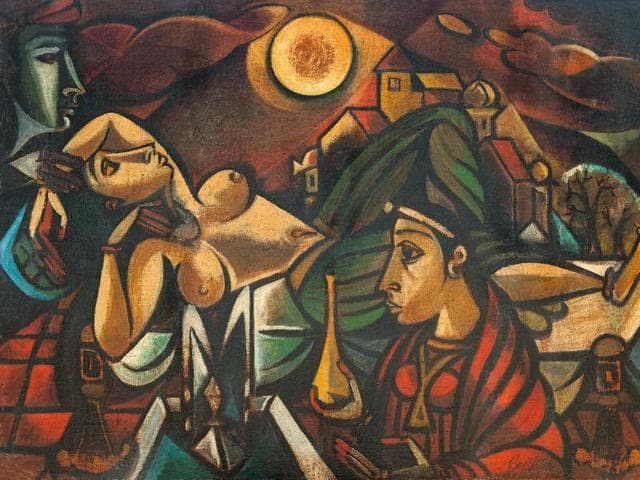
From temple art to being a staple of modern Indian paintings, we take a look at the evolution of nude art in the country
Anyone who has visited the temple of Khajuraho or seen miniature Kangra paintings could not have missed the depiction of men and women in amorous scenes. During the Mughal era (16th century), miniatures highlighting shringar rasa (erotic love) gained prominence and featured a nayika (heroine) waiting for her beloved.
Read: Being Laxman Shreshtha: The untold story of the legendary abstract artist
“Traditionally, the unclothed body did not really excite comment; the clothed body was not really part of our tradition. For instance, a garment like the blouse only came to use 200 years ago,” says Kishore Singh, director of Delhi Art Gallery (DAG) and an art critic.
And yet, painting/exhibiting nudes has led to controversy: in 2006, modern artist MF Husain’s nude portraits of Hindu deities and Bharatmata led to death threats and the artist went on a self-imposed exile. In 2013, when The Naked and the Nude, DAG’s exhibition, was on display in the capital, the Durga Vahini (Vishwa Hindu Parishad’s women’s wing), staged a protest.
The Naked and The Nude, after travelling to New York, is now on display at DAG Modern, Kala Ghoda, and features 90 artworks by 50 modern artists. From erotic artwork by modern artist FN Souza to the ‘feminist’ half-bird, half-human ‘kinnari’ seeking freedom by contemporary artist Gogi Saroj Pal, the exhibition portrays various aspects associated with nudity in art.
{{/usCountry}}The Naked and The Nude, after travelling to New York, is now on display at DAG Modern, Kala Ghoda, and features 90 artworks by 50 modern artists. From erotic artwork by modern artist FN Souza to the ‘feminist’ half-bird, half-human ‘kinnari’ seeking freedom by contemporary artist Gogi Saroj Pal, the exhibition portrays various aspects associated with nudity in art.
{{/usCountry}}Back in time
While nudes were ubiquitous in Indian art, an element of realism was missing. The opening of art schools (Sir JJ School of Art, Bombay, was founded in 1857) led to students studying models for realistic renditions of the body.
Nude artworks evolved under the Bombay Progressive Artists’ Group (1950s and ‘60s), who added their perspective and highlighted social evils. While the artists were trained under a European curriculum, their aesthetic remained Indian — from skin tones to the backdrop.
Modern artist FN Souza was one of the most provocative, and his works often depict violence. Yet his nudes also feature the tribhanga, an Indian aesthetic seen in depictions of Lord Krishna (the body is bent at the knee, waist and neck).
The exhibition highlights the distinction between the ‘naked’ and the ‘nude’: “If the artwork is created for the viewer’s pleasure, it is termed a ‘nude’. But if the artist uses the body as a storytelling device to depict social, political and gender conditions, then it is termed a ‘naked’ depiction of the body.”
Infamous art
Globally, there have been phases when nude art has been acceptable, followed by condemnation. While the Renaissance period (14th to 17th century) in European history witnessed a celebration of the body, there were protests from the Church. Closer home, the conservative attitude of the British impacted the depiction of nudes (late 19th century). The focus was less on the erotic and more on an academic study. “The British viewed our tradition of nudes as pagan and were dismissive of it,” says Singh.
Yet, artists such as Amrita Sher-Gil and Jamini Roy (early 20th century) continued to paint nudes (without commissions). “It found buyers among the elite in Bombay,” says Singh.
The ’70s and ’80s brought further changes as contemporary art emerged. Since then, art has largely revolved around current issues. “Much like still-lifes and landscapes, nude art has become part of a historical past. They are no longer common in galleries and few contemporary artists work in the genre,” says Singh.
The Naked and the Nude is on display till December 10, 11am to 7pm At DAG Modern, Dr VB Gandhi Marg, Fort, Kala Ghoda Call 4922 2700