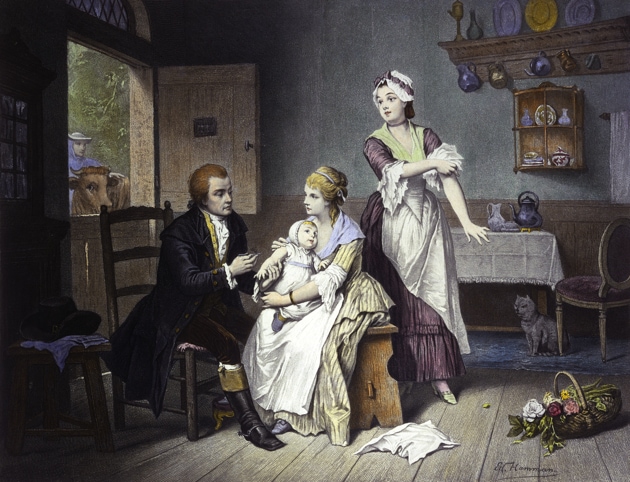
Edward Jenner, as schoolbooks rightly say, developed the first vaccine. He worked out a way to infect healthy humans with a cattle disease, cowpox, so they’d get mildly sick, recover, and enjoy lifelong immunity to the deadlier (or at least disfiguring) smallpox.
What schoolbooks don’t say is how the world coped before that. They did some pretty shocking things.
Smallpox has been around since at least the 3rd century BCE, as rashes on three Egyptian mummies indicate. The earliest record of it comes from 4th-century China. It’s from the Chinese that we learn of the oldest methods of fighting smallpox, with quarantines.
By the 15th century, they’d figured out that having a mild attack early helped develop resistance to a full-blown attack later. So healthy folk would wear the used clothes of the infected. Or try a slightly more revolting technique: they’d dry the scabs from infected people and snort the powder (often via a long silver pipe). The infection would take hold and patients would be quarantined. Some would die. But with most, the rash would clear up, and they’d be rendered immune.
Americans have a Black slave to thank for their early inoculations. History knows him only as Onesimus. In 1716, he told his owner, a Puritan minister in Boston, about the African technique of rubbing pus from an infected person into one’s skin to develop immunity. Boston society turned their noses up at such a vile suggestion. Then an epidemic struck, in 1721, killing half the city’s residents. The minister teamed up with a doctor to test the slave’s method — and managed to bring down the death rate.
{{/usCountry}}Americans have a Black slave to thank for their early inoculations. History knows him only as Onesimus. In 1716, he told his owner, a Puritan minister in Boston, about the African technique of rubbing pus from an infected person into one’s skin to develop immunity. Boston society turned their noses up at such a vile suggestion. Then an epidemic struck, in 1721, killing half the city’s residents. The minister teamed up with a doctor to test the slave’s method — and managed to bring down the death rate.
{{/usCountry}}Meanwhile, in the 18th-century, Lady Mary Montagu, wife of the British ambassador to the Ottoman Empire, became fascinated by how clear-skinned the local women were; none had been marked by the pox. Locals had figured out a way to inoculate children, using a needle to scratch pox matter into a healthy vein. Every autumn, they’d make an afternoon party of it, and the children would grow up without any (other) scars.
Montagu had her son inoculated in this way, in 1718. She then took the technique back home, where Christian doctors stiffly dismissed her as an untrained woman pushing Islamic mumbo-jumbo. But she found anxious mothers willing to try it, and with every inoculated child proving immune, the tide soon turned.
Jenner’s vaccine wouldn’t be developed until 1798, saving lives more reliably. But in Sudan, until the 19th century, you could ‘buy’ smallpox. Women would take their kids to the house of an infected child and tie a cloth on the sick child’s arm. The mothers would then discuss a price for the sharing of the infection. The money would change hands and the cloth, now infused with some pus, would be tied to the healthy child’s arm.
India, in contrast, has no mention of Shitala, the goddess of smallpox and contagious diseases, before the 12th century. The earliest records note that 8,000 children contracted the pox and died in Goa in 1545. By the 1700s, accounts mention local healers performing inoculations in Bengal and Bihar. They were called tikadars. It explains why, even after Jenner’s technique reached India in 1802, and India eradicated smallpox in 1975 and polio in 2014, vaccination doses are still called tika.
Follow more stories on Facebook and Twitter