The Covid-19 pandemic was declared a global health emergency by the World Health Organisation (WHO) on March 11 this year. Since then, various national and international organisations have been emphasising on maintaining personal hygiene and sanitation, of which, washing hands multiple times a day is of utmost importance. But in Mumbai, the financial capital of the country, washing hands regularly and personal hygiene are privileges for close to 20 lakh people living in the slums.
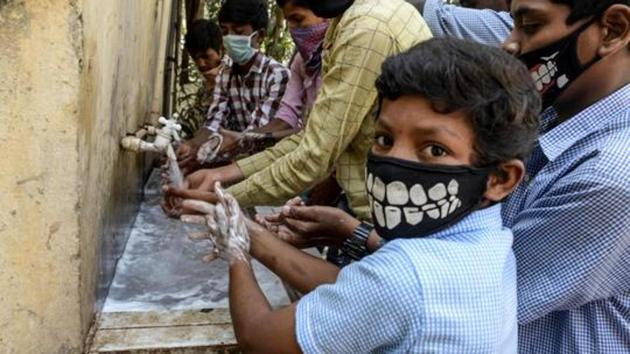
According to a recent report released by Mumbai-based Pani Haq Samiti (PHS) and the Centre for Promoting Democracy (CPD), of the 292 households they surveyed in the city, only 9.25% had personal toilet facilities, while 18.15% resorted to open defecation owing to lack of access and 75.34% were dependent on shared toilet facilities despite the fear of the infection. The report, “A ground assessment of Wash realities of Mumbai’s informal settlements during Covid-19” released in November, further revealed that 24.4% of the households did not receive daily water supply, while 19.31% could not access safe potable water during the lockdown.
The surveys, conducted in July, included citizens from across settlements like Bhim Nagar, Indira Nagar in the eastern suburbs, Ambedkar Nagar, Siddharth Nagar in the western suburbs, transit camp and Kaula bunder in Mumbai city and even those living on footpaths.
The report noted a recommendation by WHO to wash one’s hands for at least 20 seconds, which would require minimum 0.5 litres of water. This meant that, “A family of five living in a notified-slum of Mumbai, receiving less than 60 litres of municipal water supply per family per day, would use 25 litres or over 40% of their water supply just for washing hands. The remaining water would then have to be split between all other domestic uses like drinking, cooking, washing and bathing,” the report quoted.
{{/usCountry}}The report noted a recommendation by WHO to wash one’s hands for at least 20 seconds, which would require minimum 0.5 litres of water. This meant that, “A family of five living in a notified-slum of Mumbai, receiving less than 60 litres of municipal water supply per family per day, would use 25 litres or over 40% of their water supply just for washing hands. The remaining water would then have to be split between all other domestic uses like drinking, cooking, washing and bathing,” the report quoted.
{{/usCountry}}Sitaram Shelar, convenor of PHS, said, “Before Covid-19, the citizens would somehow jostle for water by stepping out, which was made further impossible during the lockdown with several restrictions. We had written to the municipal corporation earlier that we have identified 62 communities in the city that have no access to safe water and must be provided with public taps on humanitarian grounds.” The organisation is now looking at meeting the municipal commissioner to submit the report, Shelar said. “We are also looking at writing to chief minister Uddhav Thackeray and prime minister Narendra Modi,” he added.
PHS is a collective of community leaders from 54 settlements across 17 wards in the city. It has been working towards equitable distribution of water in Mumbai since 2014. It has also filed a public interest litigation in the Bombay high court (HC), which later gave a judgement upholding the right to water as a precondition to right to life. However, owing to various administrative blocks, including a policy by the Brihanmumbai Municipal Corporation (BMC) that people must obtain a no-objection certificate (NOC) from respective authorities (where shanties are built for example, central government or collector land) to get access to water, as many as 20 lakh people in Mumbai do not have access to safe drinking water, PHS noted.
P Velrasu, additional municipal commissioner, BMC, in-charge of the water department said, “As a policy, we provide water connections to everyone. However, it is a dynamic process and we fulfil the requirements as and when the requests come in. There might be procedural issues when it comes to encroached areas such as obtaining permissions that delay the process. However, for slums, we provide water at 70 litres per capita.”
A senior civic official from the solid waste management of BMC, who did not wish to be named said, “By March 2021, we are building 21,000 additional toilet seats in slum areas. We have completed more than 50% of the work already. As far as public toilets are concerned, we look at sanitising it at least four-five times a day in wake of the pandemic.”
In its report, the organisations have also listed a number of recommendations that can be implemented to improve the situation. It recommends a thorough study by BMC to understand ground realities, adopting an inclusive policy towards water and sanitation, making the centuries-old pyaaus (drinking water fountains) in various locations in the city functional and accessible to people and making sanitation economical and accessible for people.
“Water and sanitation must be considered a public good and its basic universal access must be ensured by the state. Universal access to water and sanitation is an imperative step on the way forward to collective health and recovery,” it stated.
Stay updated with all the Breaking News and Latest News from Mumbai. Click here for comprehensive coverage of top Cities including Bengaluru, Delhi, Hyderabad, and more across India along with Stay informed on the latest happenings in World News.
Stay updated with all the Breaking News and Latest News from Mumbai. Click here for comprehensive coverage of top Cities including Bengaluru, Delhi, Hyderabad, and more across India along with Stay informed on the latest happenings in World News.