
 E-Paper



MMRDA to boost Metro travel with bicycles, bus connectivity
The winning start-ups, which include a bike-sharing mobile application, a bus aggregator and a face-recognition system, will be implemented on a pilot basis at select stations on the Metro-1 line (Versova-Andheri-Ghatkopar) in a month. The pilot will be tested for three months.

 Prefer HTon Google


Come January 2020, you can rent a bike or take a bus from the Mumbai metro stations to your office/home. The Mumbai Metropolitan Region Development Authority (MMRDA) on Wednesday announced the winners of a mobility challenge launched in July this year.
The winning start-ups, which include a bike-sharing mobile application, a bus aggregator and a face-recognition system, will be implemented on a pilot basis at select stations on the Metro-1 line (Versova-Andheri-Ghatkopar) in a month. The pilot will be tested for three months.
“Depending on the response, the projects will be incorporated on all Metro lines from next year,” said RA Rajeev, metropolitan commissioner, MMRDA. The authority is looking at making Metro-2A (Dahisar-DN Nagar) and Metro-7 (Dahisar E-Andheri E) operational from December 2020.
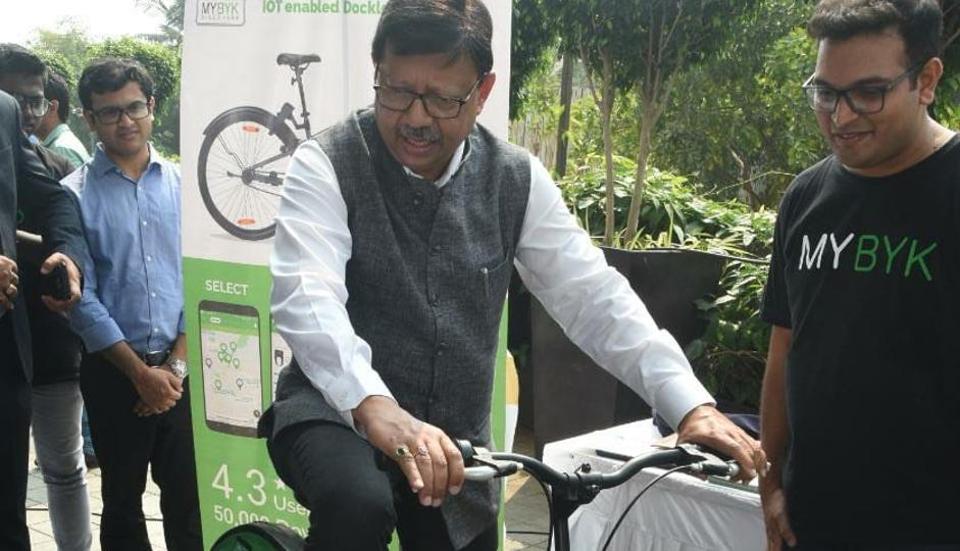
MyByk, a cycle-sharing mobile app, is likely to implement the pilot from DN Nagar station. “We have a monthly rental scheme, where you pay Rs 800 for a bike. You can take the cycles home or can also park them near Metro stations,” said Arjit Soni, the founder of MyByk. The application had earlier been introduced in Ahmedabad.
AllMiles, a bus aggregator, is looking at starting four routes from Powai to Saki Naka, Marol Naka, Jagruti Nagar, and Ghatkopar Metro stations. The 25 buses, of which 10 are air-conditioned, will tie-up with corporates in Powai to provide first and last-mile connectivity to office-goers. The company is already functioning in Hyderabad and Pune.
Orbo.ai will look at developing a face-recognition system for effective crowd management at Metro stations. The software will enable commuters to pass through gates via the face-recognition system, thereby reducing queues at the stations.
The winners will receive a combined research grant of ₹36 lakh to implement their projects.
With 14 Metro projects in the works, MMRDA launched the Station Access and Mobility Program (STAMP) in July, along with World Resources Institute (WRI) and Toyota Mobility Foundation, to look at ideas that can integrate different modes of transport for seamless last-mile connectivity.
The challenges invited over 80 applications, of which nine were selected over four months. In the next few years, MMRDA is looking at developing 337km of Metro network, with over 250 stations and an expected ridership of 1 crore daily commuters.
“With Mumbai to get more Metro lines in the near future, it’s the right time for STAMP to help transit and city agencies decide how they can maximise their potential for commuters,” said Madhav Pai, Indian director, WRI.
MMRDA is looking at a budget of Rs 25 crore for each Metro station to make last-mile connectivity hassle-free.


