On Wednesday, when one of the highest rains for a September day paralysed Mumbai’s roads and suburban trains, the monorail between Chembur and Mahalaxmi trudged on, providing relief for commuters stuck in the floods. The 20-km-long service, which is otherwise underutilised, was packed, with reports about long queues at ticket counters.
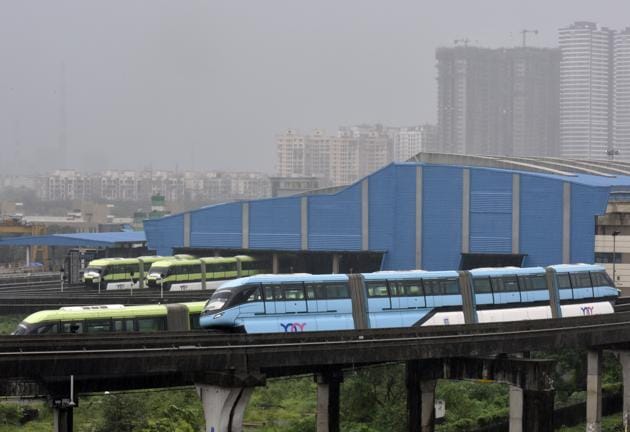
The monorail – the first phase of the eight-km-long route – which was inaugurated in February 2014, the second section in March – cost over ₹3,000 crore. Monorail differs from elevated Metro, as the train moves on a single rail, beam, or tube, with the coaches using rubber tyres for support and movement guidance. The Mumbai Metropolitan Region Development Authority (MMRDA), which built the line with private companies, had big hopes for it. The agency had predicted that the system will carry 7,500 commuters per hour in each direction, with a daily ridership of 1.5 to 2 lakh commuters. The MMRDA had said that the route linked parts of the city that are not connected by suburban rail or the under-construction Metro network.
A study published in the International Research Journal of Engineering and Technology (IRJET) that primarily looked at the reasons for the delay in construction of the Mumbai Monorail, said that the system had several advantages. The study said that the system was ideal as a feeder for a Mass Rapid Transit System (MRTS) – like the Metro and suburban railway. There are other advantages like lower maintenance cost as the infrastructure is not heavy like other MRTS (Mumbai local trains) and Metros (underground and over-ground).
{{/usCountry}}A study published in the International Research Journal of Engineering and Technology (IRJET) that primarily looked at the reasons for the delay in construction of the Mumbai Monorail, said that the system had several advantages. The study said that the system was ideal as a feeder for a Mass Rapid Transit System (MRTS) – like the Metro and suburban railway. There are other advantages like lower maintenance cost as the infrastructure is not heavy like other MRTS (Mumbai local trains) and Metros (underground and over-ground).
{{/usCountry}}But Mumbai’s monorail has been labelled a “white elephant” – a vanity project built without foresight. The service has received bad reviews for most categories that public transport are gauged for – planning, route and infrastructure quality.
The system has seen frequent breakdowns and in December, MMRDA terminated its contract with a two-company consortium appointed to run the railway. A fire in an empty monorail coach had led to the network being shut for nearly nine months. Daily ridership, after the second section was inaugurated, is reported to be around 10,000 – less than a tenth of the planned footfalls. Trains, which were planned at intervals of nine to 10 minutes, are run at gaps of over 20 minutes. Unlike the Metro, which is now planned to have more than a dozen routes, there are no plans to extend the monorail. In fact, there are predictions that the line will be pulled down.
The predicament of the Mumbai Monorail is not unique. When Seattle inaugurated a 1.2-mile line in 1962, it was largely seen as a tourist attraction, but the line became a transit system as the city’s population density grew. There is now a demand from citizens’ groups to incorporate the line into the area’s public transportation system. Cities across the world are realising that a combination of multimodal public transport – this includes bus, light rail like monorail, suburban railways like Mumbai’s local trains, trams and commuter ferries - increases the use of public transportation.
MMRDA said that on Wednesday, the system carried 15,000 passengers – 50% more than its daily average. Urban transport experts still have hopes for the monorail; some have suggested extending it to connect suburban railway and Metro stations.
“Having more coaches – I don’t know why the coaches are so expensive – and increasing capacity and safety can increase ridership,” says Ashok Datar of Mumbai Environmental Social Network, which specialises in public transport. “Extending the line by 1.5 km to Ghatkopar from Chembur will link it other networks,” he said.
After taking over the monorail’s operations from the private consortium, MMRDA has said it has reduced daily losses from ₹1.8 crore to ₹1 crore. “Considering that so much money has been spent increasing volume is the only way to make it popular,” says Datar.
Stay updated with all the Breaking News and Latest News from Mumbai. Click here for comprehensive coverage of top Cities including Bengaluru, Delhi, Hyderabad, and more across India along with Stay informed on the latest happenings in World News.
Stay updated with all the Breaking News and Latest News from Mumbai. Click here for comprehensive coverage of top Cities including Bengaluru, Delhi, Hyderabad, and more across India along with Stay informed on the latest happenings in World News.