Honestly, I’ve never been one for Khichdi. It’s too simple a meal for an overindulged, hedonistic palate like the one I’ve inherited.
I grew up in a home that was forever trying to compete with its own kitchen. No meal was entire without at least one meat, one type of fish, one crustacean, something deep-fried, a dish of potatoes, chutneys, pickles and dessert. Khichdi was rare and was punishment and retribution because you had eaten indiscriminately and the stomach was finally objecting.
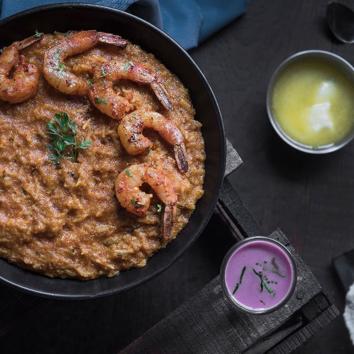
There were only two kinds of khichdi cooked at home, which would assuage the rumblings in my breadbasket. And both were bountiful, and rather fattening. One was not really a khichdi at all, come to think of it. It was a prawn pulao. Kolambichi Khichdi is medium sized prawns, flavoured with spices, onion, green masala and cooked along with long grain basmati rice, and large full lima beans. The other was Sabudana Khichdi. With its peanuts, potatoes, green chillies, cumin and lots of ghee, it was provocative, uplifting. But neither contained rice or lentils, and both were a far cry from pulverised rice and daal.
The only rice and yellow daal on the menu at home would be Maharashtrian-style Varan-Bhaat. Varan is either toor or arhar daal seasoned with salt and turmeric powder and sometimes cumin and hing, mashed and served with the Bhaat, or boiled rice, usually topped with a bit of ghee. Most Maharashtrians consider this a simple comfort meal. I could never dream of eating Varan-Bhaat without either Prawn Pickle or spicy Masala Kheema.
I was eventually forced to give khichdi a chance in the line of duty. I was filming for my TV show, The Foodie, and we were at Khichdi Samrat, a popular restaurant at the crowded and historic precinct of CP Tank, near Bhuleshwar. With no enthusiasm whatsoever and working very hard to invoke everything Stanislavski, I scanned the menu as the camera rolled. There were a variety of Khichdis I had never heard of. Masala, Hariyali, Makai Paneer, Veg Schezwan, Kathiawadi, Cheese, Vrindavan… I tried most of them, and lo and behold, the assortment of new tastes blew to bits my misconception that Khichdi was for the convalescent.
{{/usCountry}}I was eventually forced to give khichdi a chance in the line of duty. I was filming for my TV show, The Foodie, and we were at Khichdi Samrat, a popular restaurant at the crowded and historic precinct of CP Tank, near Bhuleshwar. With no enthusiasm whatsoever and working very hard to invoke everything Stanislavski, I scanned the menu as the camera rolled. There were a variety of Khichdis I had never heard of. Masala, Hariyali, Makai Paneer, Veg Schezwan, Kathiawadi, Cheese, Vrindavan… I tried most of them, and lo and behold, the assortment of new tastes blew to bits my misconception that Khichdi was for the convalescent.
{{/usCountry}}Khichdi in India is as old as the hills and finds its origins in ancient times, its name possibly derived from the Sanskrit ‘khichcha’, a dish made with rice and pulses. Ibn Batuta, the Muslim scholar and explorer who widely travelled the medieval world, writes about an Indian breakfast called ‘Kishri’ (moong boiled with rice and butter). In the court of Akbar, Abu Fazl in his Ain-e-Akbari mentions several renditions prepared in the royal kitchen, with luxury ingredients such as saffron, fine spices and dry fruit.
Over the centuries we’ve amassed about a million recipes. There’s the rather austere Bisi Bele Bath in Karnataka (toor dal and rice with tamarind, cardamom, cloves, cashew and vegetables). Pongal in Tamil Nadu (husked moong dal and rice with pepper, chillies, cumin and curry leaves, all cooked in ghee).
The Sindhi Patri Khichreen (husked green gram with cumin, haldi and hing). The Bengali Khichuri (moong daal and rice with a tempering of bay leaf, cinnamon, cardamom and cloves, and occasionally vegetables like cauliflower, peas and potato), as well as the spicy Mangshor Khichuri (mutton, moong, gobindobhog, peas, potato, pepper, turmeric, ginger, garlic, mustard oil and other spices). The Hyderabadi Kheema Khatta Khichdi, the Parsee-Style Khichdi with Saas-ma-Macchi…
So it wasn’t a surprise when my friend Anurag Katiar, who runs Indigo, Tote and Neel Kitchen & Bar, said he was staging a Khichdi festival at Neel. Besides Pongal and Bisebelebhat, Neel serves on this menu the Bihari Khichdi, a breakfast staple made with Kolam rice, moong daal, cumin, ginger and garlic, served with Aloo Bhujiya, Aloo ka Chokha, Black Lentil Papad and Lauki ka Raita.
There’s Pahadi Khichdi, made from unpolished short-grained rice, cooked with red kidney beans. Sautéed with onion, tomatoes and spices, it has the creaminess of a Rajma Chawal and is served with Onion Curd, Red Pumpkin Raita and a Mustard Chutney.
The ones that really caught my eye were the Prawn Khichdi and the Karnataka Mutton Khichdi. The latter is unpolished brown rice and kid goat meat simmered and spiced with black cardamom, cloves and bay leaves garnished with fresh mint leaves, fried onion and green chilli, served with Mango Pickle and Millet Papad.
So is the Khichdi a muddled, unintelligible mashup, or a medley of flavours that leaves you feeling warm and nostalgic. I’ve changed my mind. How about you?
Stay updated with all the Breaking News and Latest News from Mumbai. Click here for comprehensive coverage of top Cities including Bengaluru, Delhi, Hyderabad, and more across India along with Stay informed on the latest happenings in World News.
Stay updated with all the Breaking News and Latest News from Mumbai. Click here for comprehensive coverage of top Cities including Bengaluru, Delhi, Hyderabad, and more across India along with Stay informed on the latest happenings in World News.