If the recommendation of the Environment Pollution (Control & Prevention) Authority (EPCA) banning the use of non-CNG vehicles, in order to contain air pollution is implemented, nearly 92% registered vehicles in Ghaziabad and about 91% in Gautam Budh Nagar districts will be off roads.
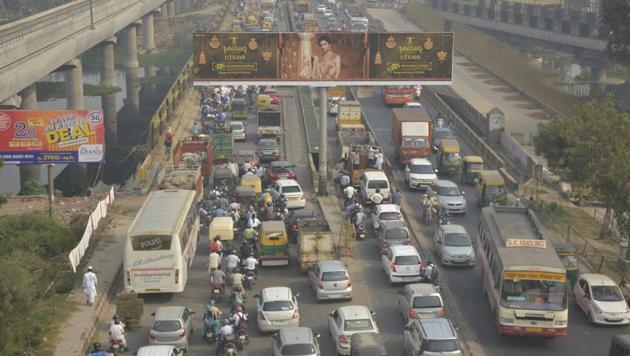
The EPCA has asked the Central Pollution Control Board (CPCB) task force to consider if the recommendation needs to be implemented in the NCR for the next few days to see continuation or deterioration of air quality.
The proposal, if accepted, is likely to affect nearly 13.4 lakh petrol and diesel vehicles in Ghaziabad and Gautam Budh Nagar. On the other hand, the air quality index (AQI), according to CPCB data, has remained under the ‘severe’ category for Ghaziabad since Diwali day and has refused to decline. The AQI for Greater Noida and Noida stood at 411 and 426, respectively, on November 13.
Stopping movement of all vehicles except those running on CNG would leave just about 8% of the total vehicles registered in Noida, on the streets. Of the total 6,74,800 vehicles in the district, just 56,027 vehicles are CNG-based. These include private and commercial four wheelers, buses and autorickshaws. There are 5,11,192 petrol vehicles and 1,07,581 diesel vehicles in Gautam Budh Nagar. According to experts as well as officials, allowing only CNG vehicles will hit all kinds of travel and commute options.
Transport officials said while most autorickshaws are CNG based, less than 20% of private vehicles as well as buses run on CNG in Noida. Additionally, all heavy commercial vehicles in the city used for carrying goods are diesel-based. With public transport coming to a halt, daily intercity as well as intracity commute will be affected till alternative solutions are provided.
{{/usCountry}}Transport officials said while most autorickshaws are CNG based, less than 20% of private vehicles as well as buses run on CNG in Noida. Additionally, all heavy commercial vehicles in the city used for carrying goods are diesel-based. With public transport coming to a halt, daily intercity as well as intracity commute will be affected till alternative solutions are provided.
{{/usCountry}}“All trucks and tempos used for carrying goods run on diesel and petrol as CNG does not provide enough power to heavy vehicles. Transportation of essential commodities may be affected by this,” A K Pandey, assistant regional transport officer, said.
Apart from these, all fire tenders, ambulances and police vehicles in the district are also diesel based and exceptions would need to be made for these.
“The decision on stoppage of petrol and diesel vehicles is being considered and discussion on it will be taken up in a high level meeting on Wednesday. We have to consider the after effects as well,” AK Tiwari, regional manager of the UP Pollution Control Board, said.
According to the statistics of the regional transport department, till September 30, Ghaziabad recorded a presence of nearly 8.5 lakh vehicles out of which 6.93 are petrol while 91812 are diesel vehicles. The city has a presence of only 63,701 CNG vehicles. Ghaziabad relies heavily on the almost 12,000 shared autos and nearly 125 private buses, which run on CNG, as mode of local transport.
Likewise, the Gautam Budh Nagar district also has a presence of nearly 6.10 lakh vehicles which include nearly 4.6 lakh petrol and 94315 diesel vehicles. It has nearly 53,677 CNG vehicles.
The officials of the India Meteorological Department had predicted light rain on November 13 and 14 and had expected that pollution levels may come down as a result.
“If there is ban on use of private and commercial petrol and diesel vehicles, the entire system of commuting will collapse. There is no public transport available in the city and commuters are heavily dependent on their two wheelers and cars. The repercussions of such measures should be well thought of before it is implemented,” Alok Kumar, president of federation of apartment owners, Indirapuram, said.
On November 12, EPCA chairman Dr Bhurelal has sent a written communication to UP chief secretary in which he had said, “We believe that public health is of utmost priority and this emergency measure may the only option we have... .”
“The pollution levels have reached severity and it is continuing. Public health is of prime importance. If the measure is implemented, people should be ready to face inconvenience for some days. It is because of lack of planning and foresightedness that the city has no public transport till date. But curbing pollution cannot be undermined with strict measures,” Akash Vashishtha, city based environmentalist and a lawyer, said.
As of now, the Ghaziabad administration has implemented the measures under the Graded Response Action Plan and has directed for their continuation till November 15.
Stay updated with all the Breaking News and Latest News from Mumbai. Click here for comprehensive coverage of top Cities including Bengaluru, Delhi, Hyderabad, and more across India along with Stay informed on the latest happenings in World News.
Stay updated with all the Breaking News and Latest News from Mumbai. Click here for comprehensive coverage of top Cities including Bengaluru, Delhi, Hyderabad, and more across India along with Stay informed on the latest happenings in World News.