There is a beautiful saying, “Vriksh kabahun nahi phal bhakhaye, nadi na sanchaye neer. Paramarth ke kaarne, sadhun dhara sharir.” It means the tree does not consume its own fruit, nor does the river retain its waters. Both exist for the benefit of others. Our saints and seers have long taught us that a life devoted to the welfare of those around us acquires a meaning far greater than individual achievement. If there is one person in whom this spirit was constantly reflected, it was Shri Ashok Singhal Ji. Starting September 27, we mark his birth centenary to celebrate an outstanding personality who brought together spiritual pursuit, cultural awakening, and decades of dedicated organisational work.
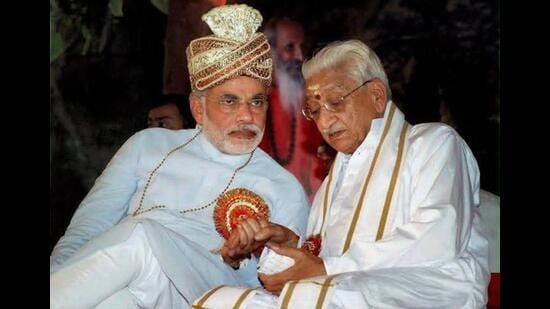
I consider it a privilege that I had innumerable opportunities to interact with Ashok Singhal Ji and receive his affection. One of the earliest instances dates back to 1981, when I was a young karyakarta (RSS worker) going about the organisational duties given to me. I received a handwritten letter from him. Naturally, it was a noteworthy moment for me. He talked about an important upcoming programme and gave a few tasks to be done.
Over several decades, I saw him work day and night. He would undertake long and often difficult travels to the remotest areas. He was particularly passionate about travelling across tribal areas of Gujarat. His mind was constantly running, thinking about what more one can do for those on the margins of society. Whenever any part of the nation was affected by a natural disaster, Ashok Ji was either among the first to reach there himself or among those guiding karyakartas to help those affected. My own experience with him in the aftermath of the 2001 Kutch earthquake was unforgettable.
This spirit of compassion and care for others is something that came to Ashok Ji very early in his life. He hailed from a very illustrious and prosperous family. His father, Shri Mahavir Ji, was a distinguished administrator. One of his brothers, Shri BP Singhal Ji, went on to become a police officer and later a Member of Parliament. Another brother, Shri VP Singhal Ji, was the chief secretary of Tripura when the state was just formed. Other family members succeeded in the world of commerce and agriculture. But from a young age, Ashok Ji was attracted to something else altogether: the revival of Bharat and bringing glory to Maa Bharti’s children. Growing up in Prayagraj, Ashok Ji would sit for hours on the banks of the Sangam. The river naturally interested him, but so did the people who came, such as saints, seers and devotees. It nurtured an understanding of India’s cultural ethos and strengthened his intention to do something for society. This desire to live for others drew him to the RSS. He embraced every responsibility that came his way with enthusiasm, discipline and a sense of duty.
{{/usCountry}}This spirit of compassion and care for others is something that came to Ashok Ji very early in his life. He hailed from a very illustrious and prosperous family. His father, Shri Mahavir Ji, was a distinguished administrator. One of his brothers, Shri BP Singhal Ji, went on to become a police officer and later a Member of Parliament. Another brother, Shri VP Singhal Ji, was the chief secretary of Tripura when the state was just formed. Other family members succeeded in the world of commerce and agriculture. But from a young age, Ashok Ji was attracted to something else altogether: the revival of Bharat and bringing glory to Maa Bharti’s children. Growing up in Prayagraj, Ashok Ji would sit for hours on the banks of the Sangam. The river naturally interested him, but so did the people who came, such as saints, seers and devotees. It nurtured an understanding of India’s cultural ethos and strengthened his intention to do something for society. This desire to live for others drew him to the RSS. He embraced every responsibility that came his way with enthusiasm, discipline and a sense of duty.
{{/usCountry}}Ashok Ji nurtured institutions and movements through persistence and hard work. He was blessed with a formidable voice and an oratory that could hold an entire gathering in its spell. Equally noteworthy was his care for fellow karyakartas. Anyone who came into contact with him could not help but marvel at his remarkable simplicity. He shared a deep bond with the sant samaj (the community of saints and holy persons) and commanded immense respect among saints and seers across the country. They valued his counsel and listened to him with great regard.
My mind goes back to two instances which brought out his legendary persona. The first was in 1993, when the Vishwa Hindu Parishad organised a convention in the US to mark 100 years since Swami Vivekananda’s Chicago address. The vision to host such a conference overseas, planning, and bringing together of diverse stakeholders revealed Ashok Ji’s organisational genius.
The second instance is from the year 2000. The World Hindu Conference was organised in Port of Spain, Trinidad and Tobago. I could see how his presence ignited so much enthusiasm among other delegates. After my address, his words of appreciation were a very moving experience for me. I saw yet again how his encouragement filled every karyakarta with so much energy.
No mention of Ashok Ji is complete without recalling his pivotal role in the Ram Janmabhoomi Movement. Who can forget his address at the Boat Club Rally in 1991? Or the defining image of an injured and bleeding Ashok Ji at the peak of the movement. Today, if there is a grand Ram Mandir in Ayodhya, it is because of stalwarts like him who selflessly immersed themselves in the effort to make it possible. He would have been the happiest person on seeing the Ram Mandir take shape in Ayodhya.
Ashok Ji was blessed with remarkable clarity of thought and it was clearly seen in his belief that our society needs to be harmonious, that the message of brotherhood has to be reaffirmed. He worked towards strengthening social unity and equality. He firmly believed that there could be no distinction of any kind in society and that every individual deserved equal dignity and respect. It was his thought that the first brick of the Ram Mandir in Ayodhya should be laid by Shri Kameshwar Choupal Ji, a grassroots VHP karyakarta from Bihar who hailed from the marginalised sections of society. At a Dharm Sansad in Kashi, he decided that the Dom Raja would be honoured and went on to work with him as part of various community efforts.
Beyond nation-building, two areas were very close to Ashok Ji’s heart: education (especially Vedic education) and music. As the MP from Varanasi, I feel very proud that the city I represent, the eternal Kashi, played a huge part in Ashok Ji’s life. He was educated at BHU and was known to be a good student. He was closely associated with the Ekal Vidyalaya initiative, which worked to extend basic education to remote villages, especially among tribal communities. He was a voracious reader as well as a good listener and he always told younger karyakartas to read as much as possible.
Those who knew Ashok Ji closely knew how well he sang. I recall meetings in Nagpur, where he would sing the Ekal Geet, leaving everyone mesmerised and setting the tone for the meeting. A video of him surprising everyone and singing “He matribhoomi meri, he pitrbhoomi meri” during his 90th birthday celebrations in 2015 went viral.
On his birth centenary, let us ensure that more youngsters know about his greatness. And let us renew our pledge to realise his dreams for our nation and our people.
Narendra Modi is Prime Minister of India.