The world seems to be existing almost continually on an edge. The arena of conflicts that can escalate into global catastrophe has expanded enormously in the 21st century. Climate change and issues of environmental degradation have been raising pressing question marks over the modern world’s way of dealing with nature. “Our world is at a unique juncture in history, characterised by increasingly uncertain and complex trajectories shifting at an unprecedented speed,” begins a UNESCO report on the ‘Futures of Education’. The question arises, can a viable human future be imagined unless humankind learns to care for nature and is able to accommodate different people and their cultures in a harmonious whole rather than seeking to assert the dominance of one over another? Indian civilisation has, for centuries, been proclaiming to the world how to bridge the gulf between the inner and the outer world, reconciling the material and the spiritual, and creating a common ground where all kinds of differences can be accommodated within yearning for truth. Education in ancient India was instrumental in developing ideas and attitudes that remain relevant even in today’s world of artificial intelligence. One of its best examples was the ancient Nalanda University which flourished in the northeastern part of Bihar.
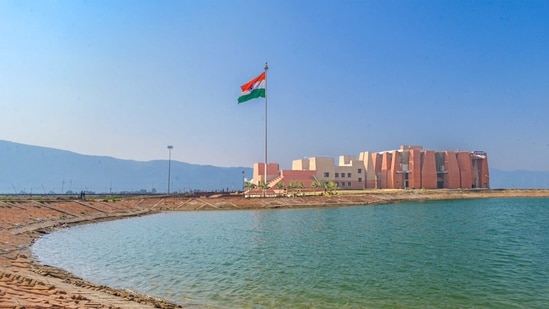
The idea behind establishing the new Nalanda University was to revive the ancient learning that had made Nalanda an international centre of knowledge. It was an idea that would bring East Asia and India into a partnership for recovering and renewing the legacy of ancient Indian thought and practices While established by Parliament in 2010, the real impetus to the project was given in 2014 when a new push was given to reclaim the glory of the ancient Nalanda university. By 2017, work on a world-class infrastructure had started to make Nalanda University an important international centre for education.
In an important study of ancient Nalanda University, historian Pintu Kumar said, “The emergence of ŚrīNālandāMahāvihāra and its new organised instructive practices marked the beginning of a new era in South Asian education. It symbolised the height of the ancient Indian educational system… The transformation of mahāvihāras into learning and training institutions was the beginning of institutionalized instruction in South Asia, which was itself different from gurukulas.” The Buddhist sources tell us that it was King Sakaraditya (Kumara Gupta I) who laid the foundations of the Nalanda University in the middle of the 5th century AD. While the West has historically found it difficult to accommodate divergent religious and cultural inspiration, it is remarkable that the ancient Gupta rulers could extend significant patronage to what began as a Buddhist centre of learning, while being devoted to Hindu Vaishnava religious ideas and practices.
The knowledge about the glorious epoch represented by ancient Nalanda University comes chiefly from Hsuan Tsang and other travellers who came and resided here for a time. This university attracted scholars from far and wide. A L Basham mentions that the ancient Nalanda “did not confine itself to training novices for the Buddhist order, but also taught the Vedas, Hindu philosophy, logic, grammar and medicine. It would seem that the student population was not confined to the Buddhist order, but that students of other faiths who succeeded in passing a strict oral examination were admitted.” From the 5th to the 12th century till it fell to the pillage of Bakhtiyar Khilji, the ancient Nalanda University contributed significantly to the growth of philosophy, logic, medicine, astronomy, and other areas of knowledge. Stalwarts such as Nagarjuna, Diganaga and Asanga resided and taught at Nalanda University and Shisksha Sammucchchyaya by Shantideva, a compendium on learning was written here.
{{/usCountry}}The knowledge about the glorious epoch represented by ancient Nalanda University comes chiefly from Hsuan Tsang and other travellers who came and resided here for a time. This university attracted scholars from far and wide. A L Basham mentions that the ancient Nalanda “did not confine itself to training novices for the Buddhist order, but also taught the Vedas, Hindu philosophy, logic, grammar and medicine. It would seem that the student population was not confined to the Buddhist order, but that students of other faiths who succeeded in passing a strict oral examination were admitted.” From the 5th to the 12th century till it fell to the pillage of Bakhtiyar Khilji, the ancient Nalanda University contributed significantly to the growth of philosophy, logic, medicine, astronomy, and other areas of knowledge. Stalwarts such as Nagarjuna, Diganaga and Asanga resided and taught at Nalanda University and Shisksha Sammucchchyaya by Shantideva, a compendium on learning was written here.
{{/usCountry}}Prime Minister Narendra Modi has often spoken of making the 21st century an Asian century. When he inaugurates the campus of the new Nalanda University, it will mark a significant step in that direction. The campus has students from all across the world, and the university project itself has participation from 17 different countries. It is apt that the ambassadors of these countries will be present at the inauguration. The PM’s visit to the Nalanda University is a step forward in furthering Indian and Asiatic legacy for the benefit of mankind in its hour of crisis.
Ashwin Parijat Anshu is assistant professor, Zakir Husain Delhi College, Delhi University. The views expressed are personal