There is something deeply moving about a small plaque inside the iconic Akashvani Bhawan on Parliament Street in Delhi. It reminds visitors of an extraordinary moment in India’s history: The plaque commemorates Mahatma Gandhi’s first and only visit to the All India Radio studios, on November 12, 1947. Nearly eight decades later, the day continues to hold a special place in the history of Indian broadcasting, commemorated as Public Service Broadcasting Day. But, this year, something seemed to be missing. The traditional celebrations at Akashvani Bhawan associated with the day were conspicuous by their absence.
Interestingly, November 12 was formally declared Public Service Broadcasting Day only in 2001. The idea had been announced by the then information and broadcasting minister, Sushma Swaraj, in 2000. The objective was to commemorate Gandhi’s historic broadcast and remind broadcasters of their responsibility towards society.
For years, Akashvani marked the occasion with special programmes, prayer meetings, and musical tributes. The annual gathering at the iconic building became an important reminder of the institution’s association with Gandhi. Suhas Borker, convener of Jan Prasar, who conceptualised the observance, has argued that Gandhi’s life and work represent the essential values of public service broadcasting.
Gandhi had visited the Broadcasting House to address thousands of Hindu and Sikh refugees who had crossed the border from Pakistan and were living in a camp at Kurukshetra. They had suffered unimaginable hardships during Partition. Gandhi was initially reluctant to speak on the radio. He was not particularly comfortable with the medium, which was considered fairly modern at the time. However, after considerable persuasion, he agreed. When he entered the studio, he reportedly looked at the radio equipment and described it as a miraculous power.
The studio was specially arranged to resemble the setting of the prayer meetings at Birla House, where Gandhi regularly addressed people. A takhtposh, the low wooden settee he used during his prayer meetings, was placed in the studio.
{{/usCountry}}The studio was specially arranged to resemble the setting of the prayer meetings at Birla House, where Gandhi regularly addressed people. A takhtposh, the low wooden settee he used during his prayer meetings, was placed in the studio.
{{/usCountry}}Accompanied by Rajkumari Amrit Kaur, independent India’s first health minister, Gandhi arrived at Akashvani Bhawan at around 3.30pm. He began his address with the words, “My brothers and sisters who are suffering, I do not know if only you or some other people are also listening to it...”
His message was followed by a recording of Vande Mataram. According to the Hindustan Times report published the following day, Gandhi spoke for about 20 minutes, and his voice was exceptionally clear.
Among the thousands of refugees waiting at Kurukshetra was a nine-year-old boy, Jagdish Batra, who later became a senior advocate of the Supreme Court. He once recalled that everybody in the camp was eagerly waiting to see Gandhi. People wanted to tell him about the terrible experiences they had gone through while crossing the border. When they learnt that Gandhi would not be visiting the camp and would instead address them through All India Radio, there was disappointment. Batra, too, had been looking forward to seeing Bapu.
That broadcast was much more than a radio address. It was an attempt to reach out to people who had lost almost everything. Gandhi could not physically visit every refugee camp, but his voice could travel where he could not.
Veteran Akashvani broadcaster and Hindi newsreader Devki Nandan Pande once told me that whenever he entered the room Gandhi had visited, he would bow his head in reverence. “For me, that particular studio was not merely a workplace. It was a place where history had been made,” he told me around 35 years ago.
Akashvani’s archives have also preserved Gandhi’s recorded speeches. There are 147 speeches in its collection. These include his first recorded prayer address in Kolkata on May 11, 1947, his final prayer address at Birla House on January 29, 1948, and the historic broadcast of November 12, 1947.
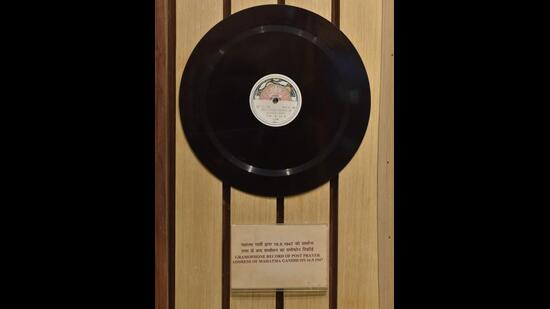
Gandhi’s association with radio did not end with that single visit. His daily interfaith prayer meetings at Birla House were recorded and broadcast by All India Radio. A refugee, KD Madan, was given the responsibility of recording Gandhi’s post-prayer addresses every evening. These recordings were broadcast at 8.30pm, ahead of the national news at 9pm, from September 1947 until January 29, 1948, a day before Gandhi was assassinated.
All India Radio also played an unforgettable role on January 31, 1948, when the nation followed Gandhi’s funeral procession and last rites through its live commentary. Melville de Mellow delivered an almost ten-hour-long commentary, describing the massive crowds and the final journey of the Father of the Nation. His voice remains part of India’s collective memory.
This year, however, November 12 passed without the customary public celebration at Akashvani Bhawan that had given the occasion its special character in previous years. There were commemorative activities elsewhere, including a discussion organised by Jan Prasar at the India International Centre. Yet the apparent absence of a prominent traditional gathering at Broadcasting House raises an important question: Should an occasion associated with one of the most meaningful moments in India’s broadcasting history become just another date on the institutional calendar?
Public service broadcasting is not simply about transmitting government announcements or presenting programmes. It is about reaching people, particularly those whose voices are often unheard. Gandhi’s broadcast to Partition refugees remains a powerful example of how a communication medium can offer comfort, dignity, and a sense of belonging to people in distress.
The plaque inside Akashvani Bhawan still tells its story. But plaques alone cannot keep history alive. Institutions must also nurture the memories and values associated with them. Gandhi came to the radio station only once, but the significance of that visit deserves to be remembered every year, with the seriousness and warmth it deserves.
Vivek Shukla is a former journalist and author of the book Gandhi’s Delhi. The views expressed are personal