When Mike Johnson, the low-profile representative from Louisiana became the Speaker of the House of Representatives last month, few in Washington DC knew him. But in an interview, Johnson left little to the imagination when asked to explain his worldview.
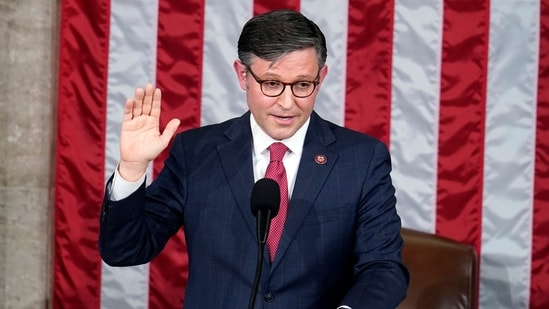
“What does Mike Johnson think about any issue under the sun? Go pick up a Bible off your shelf and read it. That’s my worldview. That’s what I believe,” the senior-most elected Republican figure declared unapologetically.
Johnson is opposed to abortion access and same-sex intimacy. He denied the legitimacy of the 2020 presidential elections and had few qualms about the January 6 insurrection at the Capitol, which was animated by the presence of religious extremists. He is a member of the Freedom Caucus, the Far-Right branch of the Republican Party which has moved from the fringe to the mainstream of America’s oldest political formation in less than a decade. And he is a Donald Trump loyalist. Since Trump’s election in 2016, American political scientists have offered several frameworks, primarily economic and cultural, to explain the rise of the Far-Right.
Globalisation and technology hollowed out American working-class jobs. Liberals failed to recognise this angst and shift policy gears. The dramatic shift in the voter base of the two parties, where White and increasingly Black and Hispanic voters who didn’t go to college are opting for Republicans while the college-educated across race veers towards Democrats, reflects this changing political landscape. The demographic churn, with the rise in the power of people of colour, caused anxieties among the White majority. Barack Obama’s presidential tenure was emblematic of this trend, and the most progressive vote in America in 2008 and 2012 was followed by the most regressive vote in 2016. Immigration has also led the Right to peddle the “Great Replacement Theory”, which suggests that the influx of outsiders was part of an organised conspiracy to take over America.
{{/usCountry}}Globalisation and technology hollowed out American working-class jobs. Liberals failed to recognise this angst and shift policy gears. The dramatic shift in the voter base of the two parties, where White and increasingly Black and Hispanic voters who didn’t go to college are opting for Republicans while the college-educated across race veers towards Democrats, reflects this changing political landscape. The demographic churn, with the rise in the power of people of colour, caused anxieties among the White majority. Barack Obama’s presidential tenure was emblematic of this trend, and the most progressive vote in America in 2008 and 2012 was followed by the most regressive vote in 2016. Immigration has also led the Right to peddle the “Great Replacement Theory”, which suggests that the influx of outsiders was part of an organised conspiracy to take over America.
{{/usCountry}}All of it is linked. But perhaps no single framework explains Johnson’s rise, Trump’s popularity, the judiciary’s arch-conservative orientation, the elimination of national legal protection for abortion rights, the backlash against pedagogy around slavery and the obsession with sexual mores than the increased salience of Christian Nationalism, fuelled by demographic anxieties amid the relative decline of the Christian population as America becomes more multi-religious.
Yet, even the American liberal media hesitates to consistently label Republicans a Christian nationalist force, a reticence that does not extend to, say the Bharatiya Janata Party (BJP), which always has the “Hindu nationalist” descriptor attached. This is not to say that the BJP doesn’t prioritise Hindutva in its political matrix, but imagine the western media’s narrative if Narendra Modi went around saying that only the shastras define his worldview.
The impact of Christian nationalism —which scholar Paul D Miller defines as the presumption that Christians are America’s first citizens, architects, and guardians; they invented America and have the right to stay on top and define its culture and identity; and that America is for Christians, particularly White Christians, and should be a Christian nation — has, however, been captured in polls repeatedly.
A May 2022 University of Maryland Critical Issues Poll showed that 61% of Republicans supported declaring the US a Christian nation, even if more than half the Republicans acknowledged that this would be unconstitutional. An October 2022 Pew study showed that 45% of those polled said the US should be a Christian nation, while one-third said it already is one.
And, a February 2023 Public Religion Research Institute and Brookings Institution said that 54% of Republicans polled could either be classified as adherents (21%) or sympathisers (33%) of Christian nationalism, with adherents seven times more likely than non-adherents to suggest that “true patriots” may have to resort to violence. Over half the adherents and 38% sympathisers also endorsed the idea of an authoritarian ruler.
Now see the link with party politics. According to the Brookings study, 71% of Christian nationalist adherents and 57% sympathisers held favourable views of Trump. Another analysis by labour leader Michael Podhorzer shows that the Republicans represent nearly every one of the highest-density evangelical districts (93% of the top quintile) in the House while the overwhelming majority of the Republican House Caucus (70%) represents most evangelical districts. Seeing Vivek Ramaswamy, the only non-Christian in the Republican presidential field, resort to acrobatics such as suggesting that his Hindu faith is akin to Judeo-Christian values is yet more evidence of this trend.
Add it all up. A substantial segment of the American population interprets Trump’s slogan of America First as Christians First. One chamber of the American legislature is led by a declared evangelist. The American Supreme Court is dominated by those who wear their religious beliefs on their sleeves. A man whose personal life history has little in alignment with Christian “values” but is seen as its champion led the American executive till 2020 and may return in 2024. Republican candidates of other faiths have to pledge their alignment with the religious values of the dominant to be accepted. And the Democrats hesitate to call out religious fundamentalism in clear terms for fear of alienating voters of that faith.
None of this is to suggest that Christian nationalism is the sole reason for the extreme turn of the Republicans or that only Christians back the Grand Old Party. Nor is it to ignore the history of how Christianity has always shaped American national life. Neither is it to discount the robust countervailing narrative that views America as a nation that gives freedom and equal rights to adherents of all faiths, a pluralist and secular view that constitutes the majority in the US. And nor is it to underestimate the trend of wider secularisation of society where religion plays a far less central role in determining everyday life than in the past.
But to understand why America is today politically dysfunctional, institutionally corroded, and internationally inconsistent, it is time to reverse the gaze. The American dream is colliding with its Christian nationalist nightmare.
The views expressed are personal