This year, the US is celebrating 250 years since its Declaration of Independence. In October, India marked a very different but unusual milestone: 25 years since Narendra Modi first assumed executive office — first as chief minister (CM) of Gujarat and subsequently as Prime Minister (PM) of India.
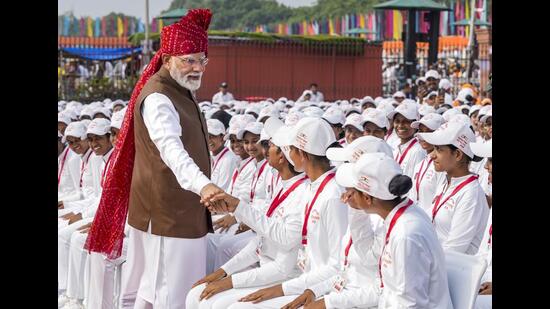
Modi has spoken of his admiration for one of America’s founding fathers, Benjamin Franklin. In a conversation with former US president Barack Obama, he recalled Franklin’s life with particular admiration — how a person from an ordinary background could transform his circumstances through effort, learning and enterprise, becoming a politician, diplomat, social reformer and thinker.
Perhaps what attracted PM Modi was Franklin’s belief that circumstances could be changed through purpose, enterprise, and action.
There is a resonance here with PM Modi’s own journey from a modest background to the highest executive office in India.
I first met Modi in Gujarat in 2009. I was then Sri Lanka’s tourism minister, visiting Ahmedabad for the Vibrant Gujarat summit. Modi was the CM of Gujarat at the time. I spoke at a session he chaired. The following morning, he invited me to meet him and, during our discussion, asked me to speak at the conclusion of the valedictory session.
My speech reflected what I had observed during those few days. I referred to a remark he had made: “Dreams are not those which you see when you sleep. Dreams are those which don’t let you sleep.” I spoke of his vision and foresight, but also of something I considered particularly important in a political leader — execution. We had just signed a MoU with Gujarat on tourism cooperation and investment. I said that we did not want it to remain “just a piece of paper”. The CM wanted us to “walk the talk”.
{{/usCountry}}My speech reflected what I had observed during those few days. I referred to a remark he had made: “Dreams are not those which you see when you sleep. Dreams are those which don’t let you sleep.” I spoke of his vision and foresight, but also of something I considered particularly important in a political leader — execution. We had just signed a MoU with Gujarat on tourism cooperation and investment. I said that we did not want it to remain “just a piece of paper”. The CM wanted us to “walk the talk”.
{{/usCountry}}I also quoted another remark of his that had stayed with me: “I am too busy working for Gujarat to bother about my own image.” At the end of the address, Modi embraced me. I remember the gesture to this day.
It was clear to me then that he was an exceptional political leader. His journey from a modest background to becoming Gujarat CM and then India’s PM is itself part of the story of a changing India.
I had the opportunity to observe that transition from New Delhi, between 2021 and 2023, as Sri Lanka’s high commissioner to India. In PM Modi, I recognised something of the CM I had met in Gujarat: the emphasis on getting things done and a visible concern and empathy for ordinary people.
Over the past decade, India has seen a remarkable expansion of physical and digital infrastructure, financial inclusion, connectivity, welfare delivery, and manufacturing ambitions. But perhaps the most important change is less tangible: Modi has helped give Indians greater confidence in their own abilities and capabilities.
This confidence is also visible in India’s foreign policy. The country is increasingly assuming the responsibilities of a major power. Its relationships with the US, Russia, Japan, Europe, the Gulf, Southeast Asia and Africa have acquired greater strategic depth. Through the G20, BRICS, Quad and other forums, it is participating in discussions that shape the international order. It is also providing leadership on reforming the UN and has sought to give the Global South a stronger voice.
For India’s neighbours, this transformation has been particularly important. I saw this during Sri Lanka’s economic crisis in 2022.
I had the privilege of dealing regularly with senior members of PM Modi’s team, including External Affairs Minister Dr S. Jaishankar, Finance Minister Nirmala Sitharaman and National Security Adviser Ajit Doval. I saw firsthand how closely they worked together and how they operated as one under the Prime Minister’s leadership.
For Sri Lanka, India’s assistance came at a critical moment.
Fuel, food, medicines and foreign exchange were in desperately short supply. India provided assistance of close to US$4 billion through credit facilities, currency support and other measures. India also helped Sri Lanka move quickly towards its IMF agreement.
For us, these instances give Neighbourhood First a very practical meaning. During Covid, India provided medicines, vaccines, and other assistance across the neighbourhood and the wider Global South. Bangladesh, Bhutan, Maldives, and Nepal have benefited from the country’s assistance at various times. For the neighbourhood, a stronger India creates a range of opportunities.
More recently, after Cyclone Ditwah struck Sri Lanka, India again responded rapidly with relief supplies, medical assistance and disaster-response capabilities.
In the CM I had seen in 2009 and the PM I watched working on a vastly larger canvas, the continuity was the determination to move from aspiration to execution.
India remains a work in progress. Employment, education, inequality, urbanisation and social cohesion remain major challenges. There will continue to be democratic debate about policies and the direction of Indian politics. But its confidence has changed.
Coming back to Franklin, his influence came from the breadth of his interests and the institutions and ideas he helped create. Whether history ultimately makes a similar judgement about Modi remains to be seen. But after 25 years, there is enough evidence of what his lasting legacy may be:
Perhaps PM Modi’s most enduring legacy will be a more confident India: a country that believes in what it can build, has the capacity to shoulder the responsibilities of a major power, and knows that it has earned a place at the table where the future of the world is being shaped.
Milinda Moragoda is a former Sri Lankan cabinet minister and diplomat, and founder, Pathfinder Foundation, a strategic affairs think tank. The views expressed are personal