Some of you may think this column should have been written last week in the immediate wake of Gandhi Jayanti. The truth is that’s precisely why it wasn’t. To ask questions of the Mahatma on his birthday would have been inappropriate timing. A week later it feels fine.
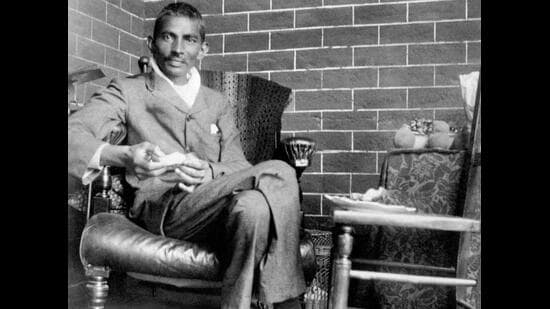
There are several unresolved questions about Gandhi’s views that need to be addressed. I don’t have the answers, but his biographers have wrestled with them for decades. There’s one in particular I want to address today. It’s about the Gandhi of the 1890s and 1900s in South Africa.
Was the young Gandhi a racist? Two South African scholars, writing almost 20 years ago, said he was. Ashwin Desai and Ghulam Vahed in The South African Gandhi mention how at the turn of the century he would call Blacks “kaffirs”. Even at that time, it wasn’t a polite way of referring to them although it was common to do so. In 1904, he said “about the mixing of the kaffirs with the Indians I must confess I feel most strongly”. In 1905, he didn’t wantIndians and Africans “herded together indiscriminately” in hospitals.
Ram Guha, one of his most renowned Indian biographers, agrees. He accepts the young Gandhi of his early days in South Africa was an “unthinking racist”. He writes, “in his first few years in South Africa, Gandhi was strongly prejudiced against Africans and used extremely pejorative language about them.”
{{/usCountry}}Ram Guha, one of his most renowned Indian biographers, agrees. He accepts the young Gandhi of his early days in South Africa was an “unthinking racist”. He writes, “in his first few years in South Africa, Gandhi was strongly prejudiced against Africans and used extremely pejorative language about them.”
{{/usCountry}}Guha makes a further point. The Gandhi of the 1890s and 1900s never thought of associating with Africans politically. “He was disinclined for Indians to make common cause with the Africans”. Gandhi kept both a social and political distance from native South Africans.
What could be the explanation for this racist attitude? Was it Gandhi’s Indian upbringing? Or was it the attitude of the people around him that influenced him? No one knows for sure, but I would assume it’s probably both.
That Indians are colour conscious and prejudiced against dark skin is undeniable.The young Gandhi would have inherited that attitude. But in his early years in South Africa, he was surrounded by Indians and would no doubt have absorbed their way of relating to Blacks. They certainly looked down upon them.
So both his upbringing in Gujarat and his companions in Durban would have influenced his belief that Blacks are inferior.
But that’s not the end of the story. Gandhi changed his views. He had the courage and the strength of conscience to do so. As Guha puts it, he evolved from a young racist into “a non-racist and finally into an anti-racist”.
The truth, it seems, is not simple and straightforward. Guha points out that Desai and Vahed have, possibly deliberately, failed to cover how Gandhi’s views changed. Perhaps their intention was to make a point about the early Gandhi and not paint a fuller portrait.
So where does that leave us? The young Gandhi was no doubt racist but the mature Gandhi most certainly was not. Is that not something we should applaud? We can all be wrong but only very few, willingly and voluntarily, correct themselves and embrace different views. At the very least that’s true of Gandhi.
Finally, does this throw into question the greatness of the Mahatma? I would argue it does not. These facts don’t diminish Gandhi but humanise him and emphasise his ability to correct error and rise above morally-debased thinking. If anything, his achievements are the greater for this. Gandhi was not a saint and certainly not a god. But he was a great man. With all the attributes that make for greatness as well as the failings of being a fallible human being.
So then, why was I hesitant to write this last week? That perhaps says more about me than the Mahatma. Birthdays, I believe, are days to eulogise, not criticise. And who am I to hold his early racism against Gandhi? After all, I can’t claim to be free of this curse. Can any of us?
Karan Thapar is the author of Devil’s Advocate: The Untold Story. The views expressed are personal