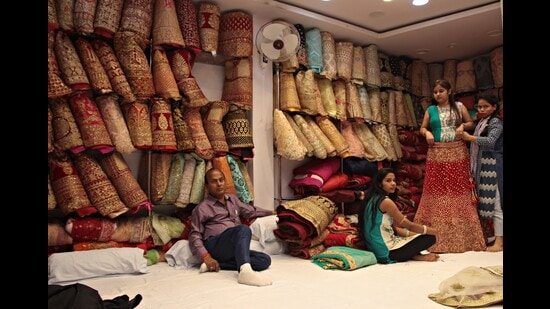
If Donald Trump has tariffs, India has weddings. The upcoming wedding season bodes well for the Indian economy, with the wedding industry pegged at $130 billion. Government data suggest that this industry, the second-largest in the country, is responsible for creating nearly one crore jobs. Such is the potential of the Indian wedding market that almost every sector caters to the life event of two individuals joining in matrimony.
Three cheers for the resilience of the Great Indian Wedding? Probably not.
Just like the unsavoury bits of the shaadi ka laddoo — and the unpredictability of its crumbling — horrors underlie these glitzy stats. Research shows that an average Indian family’s expenditure on a wedding is about three times its annual income. Worse, this single life event claims twice the amount spent on the child’s education for 18 years.
Are we still feigning surprise at the continuance of dowry killings despite some of the strictest legislations against perpetrators? If yes, we are simply blindsiding ourselves. By pretending to be horrified at a young woman’s death while comfortably consuming “aesthetic” visuals from various moodboards and events, not limited to ostensibly wedding-related ones, we are complicit in this societal scourge.
The manufactured consent, to borrow from Noam Chomsky, around the spectacle of the wedding is rarely seen as an assent to dowry. All conversations around a “dream wedding” are but a neatly gauzed talk of what the woman is worth in mercantile terms. The asymmetry of gendered agency is too glaring to give in to the naïveté of the bride’s choice. It is no longer amusing to watch the tragedy of the wedding expenditure unfolding from the pleats of a designer lehenga — or, its much-cheaper replica.
{{/usCountry}}The manufactured consent, to borrow from Noam Chomsky, around the spectacle of the wedding is rarely seen as an assent to dowry. All conversations around a “dream wedding” are but a neatly gauzed talk of what the woman is worth in mercantile terms. The asymmetry of gendered agency is too glaring to give in to the naïveté of the bride’s choice. It is no longer amusing to watch the tragedy of the wedding expenditure unfolding from the pleats of a designer lehenga — or, its much-cheaper replica.
{{/usCountry}}An entire army has risen, and rightly so, against parents who force their daughters back into abusive marriages. Examining this tendency under the socio-economic microscope reveals despair and debt. A daughter’s wedding is often considered part of her inheritance among the affluent and a necessary debt among the poor. A marriage on the rocks, therefore, is seen as both an emotional and an economic blow to the woman’s family.
The seduction of the perfect wedding is far stronger than that of the mate one is exchanging vows with. It is no wonder, therefore, that even the rebellious, unconventional couple find themselves managed by the rubrics of the arranged marriage. What is in vogue, then, is an ideal setting where everything is aesthetically — and expensively — arranged to announce the matrimonial choice. Instead of reinventing the mercantile underpinnings of the arranged marriages, most weddings end up being co-opted into the economy of desire.
Curated images of wedding celebrations, promising an equally fanciful afterlife for the couple despite the inevitable attack of the mundane, work like a serrated knife. The cuts are way too many to bandage. The easier thing is to stay benumbed. It is easier to appreciate the gloss than subject oneself to the process of thinking.
No underscoring of the essentially economic institution of marriage is going to dent its control over the collective psyche of religiously driven peoples. The bigger problem is those who willingly suspend their disbelief around the myth of marriage and, by extension, the wedding. The cultural primacy of the fetishised union of two individuals continues to bring death and disaster in many cases. But we are doubling down on the aesthetics.
Women continue to be harassed in the name of dowry and its many “cultured” euphemisms. Just because polite society doesn’t display or announce the dowry, it doesn’t negate its existence. We know that dowry is also the “respect” given to the wedding party in tastefully calligraphed envelopes. Part of the dowry goes to caterers, decorators, photographers and videographers, make-up artists, wedding planners, entertainment artists, and even matchmakers.
The most unfortunate aspect of this scenario is that women, and their families, continue to be seduced by the siren song of the shehnai and often become willing participants in the perpetuation of the death cult. Weddings are like the Goblin market in Christina Rossetti’s poem, where the mercantile “Come buy, come buy” shouts of the goblins continue to lure Lizzies and Lauras.
Nishtha Gautam is an author and academician. The views expressed are personal