
Late last week, the International Court of Justice (ICJ) housed in the Hague, the Netherlands, ruled that the State of Myanmar committed genocide against the Rohingya community in 2017. Notably, it happens to be the first time ICJ has held a State responsible for such a crime. On the same day, in the Chinese city of Shenzhen, the leaders of the US, China and Russia — Donald Trump, Xi Jinping, and Vladimir Putin — declared that the International Criminal Court and “other similar bodies” must not abuse their jurisdiction. It is ironical that the court, set up at the end of World War II, delivered its gravest finding on the day the reigning great powers told such courts to stay within their limits.
Given this context, what should be India’s response to the judgment? As an important neighbour to Myanmar and home to tens of thousands of Rohingya fleeing persecution, New Delhi should formulate a clear-headed response that caters to its national interests.
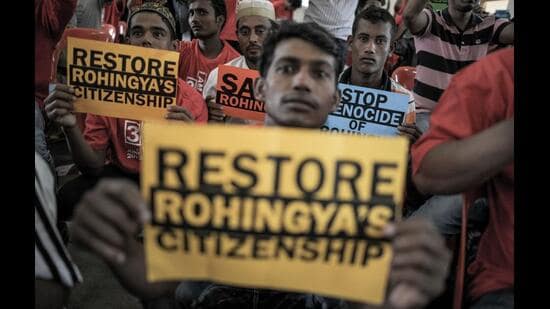
The case and judgment deserve to be taken seriously on their merits. The court found that more than 10,000 people were killed in what Myanmar army called “clearance operations” in northern Rakhine. Some 1.2 million Rohingya have lived in camps in Bangladesh, for close to a decade now, as non-citizens and without a way back home, in utterly inhuman conditions. The judges at ICJ ordered Myanmar to compensate the victims and to allow safe, voluntary, and dignified return to their homes in Myanmar. The humanitarian basis of the case here is clear beyond argument.
One quick reminder before we move forward to what New Delhi can do. Recall that Aung San Suu Kyi was State Counsellor and foreign minister, the head of an elected government, when the crimes took place. Yes, the same Aung San Suu Kyi who was awarded the Nobel Peace Prize. She shockingly remained silent as the Rohingya fled or died, declined to condemn the army, and, even more shockingly, in 2019, went to the Hague herself to defend Myanmar against the charge of genocide. The court’s finding is as much against the Myanmar junta as it is against Suu Kyi.
{{/usCountry}}One quick reminder before we move forward to what New Delhi can do. Recall that Aung San Suu Kyi was State Counsellor and foreign minister, the head of an elected government, when the crimes took place. Yes, the same Aung San Suu Kyi who was awarded the Nobel Peace Prize. She shockingly remained silent as the Rohingya fled or died, declined to condemn the army, and, even more shockingly, in 2019, went to the Hague herself to defend Myanmar against the charge of genocide. The court’s finding is as much against the Myanmar junta as it is against Suu Kyi.
{{/usCountry}}So, the verdict is on point. But now comes the hard part. The ICJ has no means of enforcing its rulings, never had. That job belongs to the UN Security Council, which hasn’t enforced ICJ rulings earlier and, in all probability, won’t now either. While ICC, named in the Shenzhen declaration, is a different court, the language of the declaration on State consent and the immunity of officials is indicative of what veto-holding members of the UNSC think of international justice.
That said, India has several interests in relation to Myanmar. The two countries share a 1,643-km border, and insurgent groups from India’s North East have historically crossed the border for various reasons, with/without the Myamarese junta’s knowledge. Access through the Kaladan corridor and Sittwe port, to India’s North East — this route is much faster than the alternatives — depend on Naypyidaw’s cooperation. Keeping this in mind, New Delhi hosted President and the leader of the junta, Min Aung Hlaing, in June. More important, India and China are competing for the goodwill of a government that the world court has just found responsible for genocide, the most despicable crime a State can commit in our times. Neither Beijing nor New Delhi can, or will, give up their leverage with the junta for an international court judgment nobody can enforce.
Yet, India needs to take a view on the judgment for a range of reasons. The country may also be in a position to use the situation to its advantage as well as for humanitarian purposes. India is party to the Genocide Convention; an estimated 40,000 Rohingya live in India and an equal or more number of Myanmarese citizens have crossed over to India since the 2021 coup, and New Delhi wants the Rohingya to go back to their homes in Myanmar. But, they can go back only if conditions in Myanmar change. Here’s where the court’s ruling becomes important. The ICJ has now ordered Myanmar to allow “the safe, voluntary, and dignified return of displaced Rohingya to their places of residence”. In that sense, the ICJ judgment suits India’s interests.
But this needs to be done carefully because alienating Naypyidaw would cost India a great deal without doing much good to the Rohingya. So New Delhi should accept the spirit of the judgment, without joining a finger-pointing campaign for enforcement that is bound to fail.
Thanks to the ICJ judgment, the junta could be under increased scrutiny than it has been at any time since the coup, and the last thing it needs is to alienate New Delhi. India should use it to press for a credible citizenship process for the Rohingya and for conditions that make their return possible. This is also a good time to push India’s other concerns, such as the anti-India insurgent camps and the long-stalled connectivity projects. A government on the back foot, like the one in Naypyidaw, is likely to listen more carefully.
There is another important aspect India must highlight to the international community. New Delhi is often told that it stays silent on a range of international issues. On the Rohingya issue, New Delhi is entitled to ask what its critics or the larger international community have done. International funding for the camps in Bangladesh has fallen from nearly $692 million in 2019 to under $500 million a year. This year’s UN appeal was cut by a quarter, and was still 37% short when it was launched. The UNSC is choosing to look away. While on the question of the manner of Rohingya deportations, India’s record could be better — it has done more for the community than most of the so-called do-gooder nations. Therefore, countries that will neither enforce the court’s orders nor pay for the genocide victims and a displaced people should not lecture those who live next door to the problem State.
Happymon Jacob is the author of India After Non-alignment, and editor, INDIA’S WORLD magazine. The views expressed are personal