
We live in an age marked by two contradictory trends: high levels of geoeconomic interdependence accumulated over three decades of capitalist globalisation, and high levels of geopolitical conflicts, strife and competition that are disrupting trade and commerce. This whipsaw effect maximises risks, spreads insecurity, and forces countries across the world to search for a new post-liberal paradigm to guide their way forward.
Since no single new international paradigm or system has appeared, what we are witnessing is a transition laden with uncertainty about the final destination and no guarantees of a happy journey. To cite the Italian political theorist Antonio Gramsci, “the old is dying, and the new cannot be born; in this interregnum a great variety of morbid symptoms appear.”
The most visibly morbid symptom of our fragmented world is the perilous condition of transcontinental connectivity projects that were envisaged and underwritten by magnanimous hegemons or leading States, but are now caught in the narrow ultra-nationalistic crossfires raging all over. From the Russia-Europe oil and gas pipelines to the ‘maritime silk road’ of China’s Belt and Road Initiative (BRI), ambitious crisscrossing integration projects are either crashing or hitting massive speed bumps amid the proliferation of wars and divides.
Closer to home, the India-Middle East-Europe Economic Corridor (IMEC), launched in New Delhi with sky-high expectations in 2023, has run aground in the face of relentless wars involving the United States (US), Israel, Iran and its proxies across West Asia. The resultant attacks on commercial shipping and the ruthless weaponisation of geography around the Persian Gulf and the Red Sea have left IMEC’s crucial middle segment — a cross-border land railway network built by Indian know-how and running via the UAE, Saudi Arabia and Jordan to the Mediterranean port of Haifa in Israel — inoperable.
{{/usCountry}}Closer to home, the India-Middle East-Europe Economic Corridor (IMEC), launched in New Delhi with sky-high expectations in 2023, has run aground in the face of relentless wars involving the United States (US), Israel, Iran and its proxies across West Asia. The resultant attacks on commercial shipping and the ruthless weaponisation of geography around the Persian Gulf and the Red Sea have left IMEC’s crucial middle segment — a cross-border land railway network built by Indian know-how and running via the UAE, Saudi Arabia and Jordan to the Mediterranean port of Haifa in Israel — inoperable.
{{/usCountry}}The irony is that the same IMEC, which the US had championed as a regional counterbalance to China by bringing America’s Israeli and Arab allies and Indian strategic partners together into a common transnational market embrace, is now a casualty of forever wars in West Asia spearheaded by the US itself.
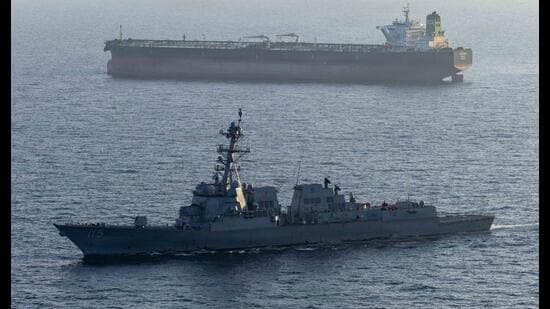
IMEC is a victim not only of reignited visceral enmities within West Asia, but also of strategic divergence between the US and its allies and partners. American military attacks on Iranian naval vessels and on civilian merchant ships in the Indian Ocean that caused casualties among Indian seafarers, as well as the American and Iranian blockades of chokepoints which have affected the flow of oil supplies to India, reveal this strategic divergence in stark terms.
In light of all these hurdles and the total breakdown of a rules-based maritime order at the western end of the Indian Ocean, India has pragmatically sought low-cost workarounds and alternatives to keep at least some elements of IMEC alive. IMEC’s ‘Eastern Corridor’ is booming thanks to the India-UAE Comprehensive Economic Partnership Agreement (CEPA). Bilateral merchandise trade, which stood at $43 billion in 2021, has crossed $101 billion in 2026. India’s trade with other Gulf Cooperation Council (GCC) members is also growing, making the ‘IM’ part of the ‘IMEC’ a fait accompli already.
Utilising the UAE’s port of Fujairah, and Oman’s ports of Salalah, Sohar and Duqm (where India has military and civilian stakes), as landing and take-off points for merchant ships could help bypass the instability caused by Iran, its allied Houthi militia, Israel and the US. From these ports, if the UAE and Saudi Arabia can lower their own raging rivalry and enable transportation of goods up to Egypt, which could become a crucial transit state to the prosperous markets of Europe via the Mediterranean Sea, it is possible to at least partially reap dividends of the IMEC idea.
Since the US under President Donald Trump is not underwriting IMEC or creating the cooperative space for complex routes like this to work out, the onus is on India, the starting and ending point of IMEC, to engage all stakeholders with creative alternative routing arrangements. The other endpoint of IMEC, which is the European Union (EU), has every incentive to earnestly coordinate with India for corralling disparate countries into a club of prosperity. New Delhi and Brussels stand to gain the most from the activation of IMEC or remnants of it, and they need to act upon their strategic convergence.
India and the EU, whose free trade agreement has been dubbed the “mother of all deals’, must simultaneously formulate a joint strategy for deepening three-way digital commerce and trade in services involving themselves and West Asian and North African partners. India’s Digital Public Infrastructure (DPI) solutions, including systems such as the Modular Open-Source Identity Platform (MOSIP) and India Stack, do not require physical passage of commercial shipping through war zones and endangered maritime chokepoints. Technology can help bypass the geopolitical blockages in ways that were unthinkable a decade ago, and India should leverage its digital financial diplomacy to open up virtual pathways.
None of these types of patches and band-aids will by themselves suffice to create a new alternative system to the old model of universal globalisation. But they could be harbingers of Gramsci’s “the new” to arise. If the most prominent rising power in the world, India, grasps its historic mandate at the current juncture and displays diplomatic adaptability and geoeconomic creativity, it might lay the foundation for the coming post-liberal multipolar order, which will not be global but a series of networks of friends clustered into clubs operating around shared interests to reap the benefits of cooperation.
Sreeram Chaulia is dean, Jindal School of International Affairs. The views expressed are personal