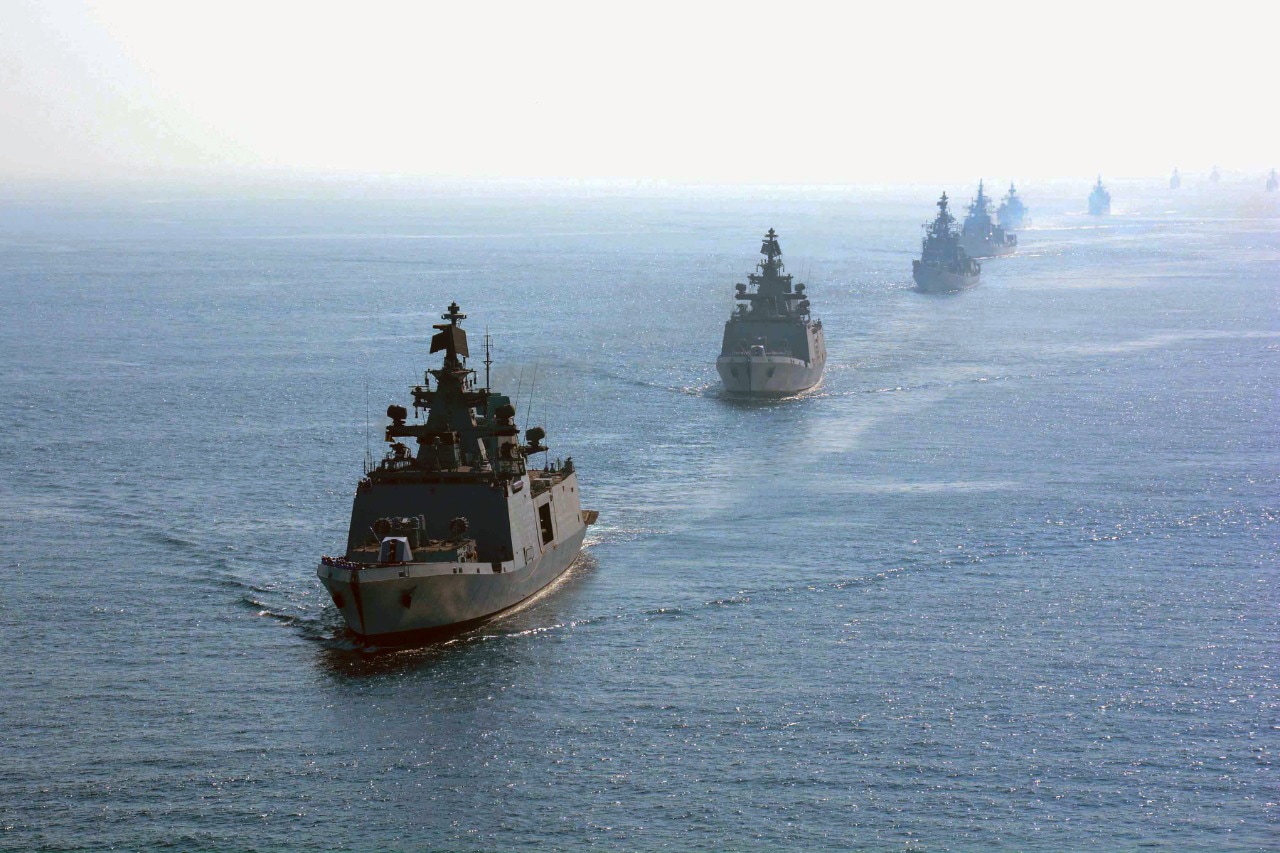
Indians who fretted over the recent images of Chinese People’s Liberation Army Navy (PLAN) ships in Indian Ocean ports such as Hambantota and Djibouti would have been delighted to learn that on August 15, there were nine Indian Navy (IN) warship in seven ports worldwide – one in each continent – to hoist the Tricolour on the 75th anniversary of our independence. Both navies were sending out the same, subtle, message.
Maritime power, unlike land and air power, has many
Indians who fretted over the recent images of Chinese People’s Liberation Army Navy (PLAN) ships in Indian Ocean ports such as Hambantota and Djibouti would have been delighted to learn that on August 15, there were nine Indian Navy (IN) warship in seven ports worldwide – one in each continent – to hoist the Tricolour on the 75th anniversary of our independence. Both navies were sending out the same, subtle, message.
Maritime power, unlike land and air power, has many roles to play, equal in importance to those it accomplishes in war. Given their mobility, versatility and sustainability, warships can be placed in, virtually, any location in the world’s seas; right up to the territorial waters, and even harbours of another nation without infringing national sovereignty. The ship’s mere presence could attain political ends, by conveying messages of friendship, reassurance, intimidation or coercion. Navies, worldwide, struggle, often in vain, to convince their political masters, about their utility as powerful “instruments of state power”. The success attained by the PLAN, in this context, is worthy of examination.
In September 2020, the US Department of Defence made the stunning announcement that the PLAN, with a battle force of 350 ships and submarines, had overtaken the US Navy, with its strength of 293 ships. The PLAN did not grow overnight, and remains the clearest manifestation of the grand-strategic vision of China’s political leadership.
On its formal establishment in 1950, the PLAN was provided with hardware and advisers as well as doctrine by a fraternal USSR. The Sino-Soviet split of 1960, although a major setback for the PLAN, also became a blessing in disguise because the Chinese leadership launched a reverse-engineering project, at the national level, to reproduce Soviet armaments. It was a combination of Deng Xiaoping’s economic reforms, and the appointment of General Liu Huaqing as PLAN commander, in 1982, that triggered its transformation from an inconsequential coastal force, to a substantive blue-water navy.
Signs of a “maritime awakening” at the political level, started emerging when the 2004 defence white paper spelt out the PLAN responsibilities as, “safeguarding China’s maritime security and maintaining the sovereignty of its seas.” At the 2012 Party Congress, general-secretary Hu Jintao took China watchers by surprise, when he declared that China aimed to become “a maritime Great Power.” A year later, Xi Jinping provided the rationale by spelling out China’s maritime objectives as: Defence of the homeland against seaward attack by the US; protection of its seaborne trade and energy traffic; and recovery of national territory (Taiwan).
Clearly, China’s political leadership was shrewd enough to realise that becoming a “maritime power” required the acquisition of a full range of technological, industrial and human-resource capabilities. Resolutely, and methodically, they set about putting in place the constituents that have made China a true maritime power. China is today the world’s most prolific ship-producing nation, both in terms of warships and merchantmen. China’s merchant fleet outnumbers all others, on the high seas. China boasts of the world’s largest Coast Guard as well as deep-water fishing fleets, its ports rank among the best internationally, and it is a world leader in seabed exploration.
The IN has had an easier birth and fewer growth pangs; progressively acquiring hardware and capabilities in all three dimensions of maritime warfare. A visionary naval leadership has ensured that today, it is a compact, but highly professional and potent maritime force, assessed as being up to “NATO standard”. India’s security elite has, however, failed to realise that a “fighting navy” constitutes just one strand of a nation’s maritime strength, and without the remaining components, India cannot claim to be a “maritime power”.
Incomprehension, at the politico-bureaucratic level, of the significance and constituents of maritime power has had two deleterious effects. First, parsimonious budgets have stunted our navy’s growth, in numbers as well as in capabilities. Second, gross neglect in many areas of India’s maritime sector has ensured that our civil shipbuilding industry is moribund, our merchant shipping grows at a snail’s pace, our major ports are overloaded and await modernisation, seabed exploitation has yet to take off, the fishing industry is antiquated, and human resources are lacking.
India’s failure to bring a sharp focus on maritime capacity-building represents a huge missed opportunity. The steady development of the maritime sector would have established a badly-needed industrial base for India’s naval power. It would have also provided the impetus to heavy as well as ancillary industries, helped in skilling our youth and generated thousands of job opportunities.
Given the current Chinese intransigence, and our misreading of their expansionist intent, Sino-Indian tensions are likely to persist. Keeping the conflict confined to the Himalayan heights is militarily advantageous to China, because a “continental fixation” helps to keep India confined in a South-Asia box.
In this context, we must remember that China’s jugular vein is to be found in the Indian Ocean sea lanes, which see an overwhelming proportion of its trade, energy, raw materials and finished products carried by merchant shipping. Since any disruption of seaborne traffic will have repercussions for China’s industry, economy and political stability, we must be prepared to exploit this vulnerability, should the situation demand. By the same logic, we must be prepared to see a steady rise in PLAN presence in Indian Ocean waters (and ports). Consequently, this would be a good juncture for India to undertake a reappraisal of its maritime capabilities as well as its maritime strategy.
Admiral (retired) Arun Prakash is a former chief of the Indian Navy
The views expressed are personal
One Subscription.
Get 360° coverage—from daily headlines
to 100 year archives.
Archives
HT App & Website