Recent conflicts have delivered a blunt correction to conventional defence planning: Advanced platforms matter, but long-drawn wars are decided by the capacity to sustain the rate at which ammunition is being consumed, through commensurate industrial ability to replenish the arsenal. Russia’s artillery expenditure in Ukraine, Europe’s scramble to expand shell production, and the US’s depletion of interceptor stocks in the Iran campaign, all point to one conclusion: Stockpiles built for peacetime evaporate in weeks, and production lines calibrated for commercial demand of peacetime cannot be scaled up at will during wars.
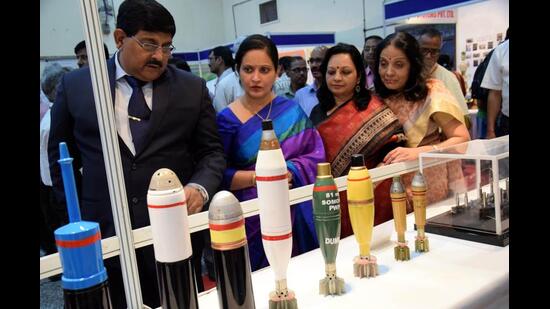
For India, this crisis presents an opening — and is a test of whether India can convert export demand into durable industrial capacity for handling surges rather than simply selling and being content with rising defence exports for the time being. India has already moved from the periphery to the centre of the global ammunition trade. Since the Russia-Ukraine war began, India has supplied European countries with ammunition worth roughly ₹8,271 crore, becoming one of the largest suppliers to Eastern and Central Europe. Indian defence exports have surged by 1,600% during this period. Indian firms sell to European governments rather than directly to Ukraine, preserving diplomatic deniability while monetising the war market.
Israel, unsurprisingly, has also become a significant buyer: In last couple of years, India has shipped about ₹630 crore worth of artillery shells, mortar rounds, and explosives to Israel — roughly equal to its exports to Israel over the preceding six years combined.
Saudi Arabia on October 28 reportedly approached New Delhi with an urgent request for an additional 10,000 rounds of 155mm artillery ammunition, as security concerns rise amid the conflict with the Houthis. The Saudi demand reinforces India’s position as a supplier to both European and West Asian buyers simultaneously, diversifying away from dependence on any single export market while keeping multiple production lines active.
{{/usCountry}}Saudi Arabia on October 28 reportedly approached New Delhi with an urgent request for an additional 10,000 rounds of 155mm artillery ammunition, as security concerns rise amid the conflict with the Houthis. The Saudi demand reinforces India’s position as a supplier to both European and West Asian buyers simultaneously, diversifying away from dependence on any single export market while keeping multiple production lines active.
{{/usCountry}}The more consequential development for India is the entry of private firms into the artillery ammunition manufacturing sector that was long dominated by the government-run ordnance factories. The government’s ambition is to shape India into a global production hub for ammunition, with the private sector’s role in defence manufacturing targeted to reach 50% or more. India’s cost advantage is the single-most disruptive element in the global ammunition market. In India, the production cost of a 155mm artillery shell is about $300-400 per unit, compared with European equivalents selling for upwards of $3,000. This is not merely a function of lower labour costs. India inherited a sprawling ordnance infrastructure from the British and expanded it during the Cold War. When European governments shut down their production lines after the Cold War, India kept many of its lines ticking. The embedded capacity of India is now a commercial asset. European buyers are desperate to supply Ukraine without draining their own already thin stocks. As a result, India is the source that is affordable, available, and politically expedient. For India’s own strategic position, vibrant exports keep order books full and production lines running. This lowers the cost of India’s reserve replenishment by offering more value for money.
Yet the same trap that caught Europe and the US, can catch India: Peacetime production growth does not necessarily imply wartime surge capacity. Ukraine’s western backers discovered that stockpiles built over decades of relative peace were exhausted within months, and production lines took years to scale. In the war against Iran, the US expended over half its interceptor stockpile in a matter of weeks, with replenishment measured in years. India’s ammunition manufacturing capabilities are calibrated to export order books and for domestic peacetime consumption. Surge demand during a conflict is a different ball game.
The caveat accompanying cost-effectiveness has always been quality. Indian-manufactured 155mm shells have been linked to barrel bursts and failures in India as well as with international clients. These accounts come from sources with their own biases, and India’s defence ministry has consistently defended its quality control. But the pattern matters for understanding the limitations of cost advantage. European buyers purchasing Indian shells for transfer to Ukraine may be less sensitive to quality failures than a country equipping its own soldiers. If Indian ammunition is to move from a discount commodity to a trusted supply, the quality gap must close.
The window for India is real but narrow. Europe is actively seeking to diversify supply chains away from sole dependence on the US, and Saudi Arabia’s urgent request signals that West Asian demand is equally acute. India offers a non-western, non-Chinese source of ammunition, with NATO-certified quality in some cases and a political system not aligned with any active belligerent. But the cost advantage is unlikely to sustain permanently. Western firms such as BAE and Rheinmetall are gearing up to enhance their capabilities manifold. This shall eventually bring prices down as volumes rise. India’s window to exploit the price gap is, therefore, finite.
The strategic play should not be to sell cheap shells forever, but to use the current demand surge in building the industrial depth that will enable Indian firms to compete on reliability rather than only on price when the emergency premium fades. Revenues earned from soaring exports of ammunition must be re-invested in the quality and surge capacity. That is a far more important objective than export order books alone. In the end, India’s ammunition exports to Europe and Israel also represent a high-stake geopolitical balancing act, which cannot be ignored.
Colonel Shashank Ranjan (retd.) is associate professor of practice and director, Pankaj Kumar Jha Centre for Security Studies, OP Jindal Global University. The views expressed are personal