Political parties in the fray will soon set the tone and tenor of their campaigns for the 2027 Uttar Pradesh assembly elections. Given the likelihood of a close contest, the themes across campaigns will be watched with great interest. Discussions with various people across regions in the state suggest the preponderance of an unlikely figure: Lord Krishna.
What does a god have to do with the ordinary act of people choosing their representatives, you may ask. Krishna of the Mahabharata — the epic is ultimately a tale of politics as much as of a great war — carries so much symbolism that contemporary politics has found use for him. And where can this hold more true than in Uttar Pradesh, where Mathura, the city believed to be Krishna’s birthplace, is located?
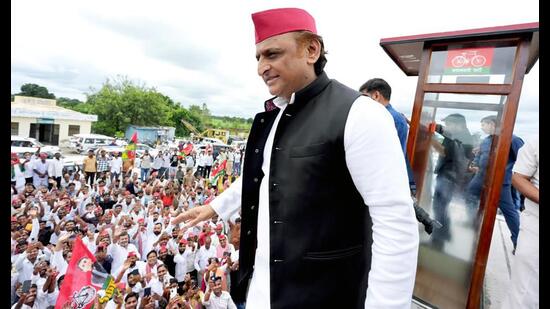
Akhilesh Yadav, the chief ministerial face of the Samajwadi Party (SP), recently started his Pichchada, Dalit, Alpsankhyak (backward classes, Scheduled Castes, and minorities), or PDA Rath Yatra from the Congress bastion of Raebareli. He likened the upcoming elections to the Mahabharata war. He invoked Krishna’s role as Arjuna’s charioteer in the war to project an image of his PDA Rath Yatra as being set on the path of dharma. His party workers have cast him as Mahanayak Krishna in election posters, and Akhilesh himself claims that he and his party members are followers of the god who was also a cowherd and a king. This is being done for two purposes: The first is to mobilise the SP’s caste base, the Yadavs, who claim descent from Krishna; the second is to assert a Hindu identity that appeals to a cross-section of castes across the state, through the obvious connotations of invoking Krishna. The latter seems to be a strategy to counter the Bharatiya Janata Party (BJP), which, as is well known, is the strongest political proponent of Hindutva in the country. It is against this backdrop that we need to see Akhilesh’s seemingly casual remark that the way to Ram Rajya (Ram, just like Krishna, being an incarnation of Lord Vishnu) runs through the path of samajwad (socialism).
The SP is, thus, reinterpreting Krishna as a metaphor for the struggle for social and economic justice, in which Akhilesh is leading the PDA cause. At the same time, Akhilesh and his party’s repeated invocations of the friendship between Sudama and Krishna have a greater social engineering goal in mind — creating and consolidating a Brahmin-Yadav alliance for the elections (Sudama was a poor Brahmin who was a close friend of Krishna from his gurukul).
{{/usCountry}}The SP is, thus, reinterpreting Krishna as a metaphor for the struggle for social and economic justice, in which Akhilesh is leading the PDA cause. At the same time, Akhilesh and his party’s repeated invocations of the friendship between Sudama and Krishna have a greater social engineering goal in mind — creating and consolidating a Brahmin-Yadav alliance for the elections (Sudama was a poor Brahmin who was a close friend of Krishna from his gurukul).
{{/usCountry}}But why mention the Brahmins? Public conversation in Uttar Pradesh suggests this caste group feels deprived under the Yogi Adityanath regime. Akhilesh and the SP see an opportunity in tapping support from this community, which makes up around 10% of the state’s population.
On the BJP side, the dominant campaign pitch seems to be the resolution of the Krishna janmabhoomi issue in Mathura, echoing Ayodhya and Varanasi. The party hopes to mobilise voters using this longstanding Hindutva talking point. A belief that the Muslims demolished the Krishna janmabhoomi sometime in the medieval era and used part of the land to construct the Shahi Idgah of Mathura holds strong among a significant section of Hindus. CM Adityanath has, on multiple occasions in the past, committed to reclaiming the land and building a grand temple complex, similar to the one in Ayodhya.
Clearly, Krishna and associated symbolisms and metaphors will be part of the campaign vocabulary in Uttar Pradesh in the run-up to the 2027 polls. Now, recall the trajectory that politics involving Ram followed in the state. It remained dominant for decades, with the Ram janmabhoomi demand gradually gaining resonance as an issue of Hindu pride among a large section of the community across the country. But then came the Supreme Court’s judgment in the case, followed by the construction of the grand temple in Ayodhya. The realisation of this key point in the Hindutva agenda lowered the electoral impact of the Ram janmabhoomi issue soon after.
Now, Krishna seems to be replacing Ram in the political discourse — this time, with the important distinction that both the Opposition and the ruling party are invoking the god. But what is even more important is the manner in which the blue-skinned god is being invoked by the two parties. Metaphors lend themselves to multiple interpretations, enabling both parties to draw from the same source while pushing competing narratives.
What then becomes the differentiator? What will the voter make of the juxtaposition of the SP invoking Krishna metaphors before the elections against the BJP’s longstanding support for reclaiming temples believed to be lost to Sultanate-era demolitions? The trust the narrator, a party leader or spokesperson, enjoys among the masses lends credence to their interpretation of the metaphor. It has to be said that long years of consistent political and cultural messaging are more likely to have engendered trust among the people.
That said, voting decisions don’t always neatly follow such patterns in social life. So, the real result of Krishna-centric mobilisation will only be known at the hustings. For now, as the parties’ campaign pitches rise, we can look for indicators of what the political class thinks matters to the voting public.
Badri Narayan is vice-chancellor, Tata Institute of Social Sciences, Mumbai. The views expressed are personal