In popular consciousness, at least in the national capital and abutting cities, Jantar Mantar is synonymous with protests against the government. It offers a particular setting deemed desirable for rallies to be heard by the State — proximity to the corridors of power (Parliament) and a prominent urban-scape the masses visit in the normal course (Connaught Place). That perception could perhaps change with the government denotifying it as a protest site. This may end an era, since the term ‘Jantar Mantar’ has been closely connected to the expression of dissent in India since the 1990s.
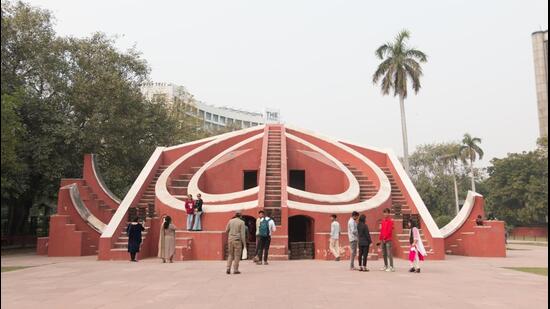
Jantar Mantar and its environs have always occupied a very distinctive place in Delhi’s landscape. Its history begins sometime in the 16th century, when Akbar occupied the Mughal throne. The young emperor married the princess of Amer in early 1562, an event that marked the beginning of close ties between the Mughal royal family and the Kachhwaha Rajputs of Amer. Several relatives of the princess rose to high offices in the empire. For instance, her nephew Man Singh became the governor of several important provinces and a trusted general of Akbar.
It was probably during Akbar’s reign that a piece of land in Delhi was given to the rulers of Amer. Though Akbar moved his capital to Agra in 1558, Delhi remained an important city of the Mughal Empire, and many saw it as the true capital of Hindustan. Akbar himself had ruled from the city for a few years, living in the fortress built by his father Humayun, which we now call Purana Qila. The land given to Amer was some distance north of this fortress.
As time passed, the Amer rulers and others connected to them built on the land. Two distinct settlements, Jaisinghpura, founded by Maharaja Jai Singh (reigned 1621-67), and Madhoganj, named after Madho Singh (reigned 1750-68), were founded. Several temples were built as well: The Hanuman temple (now on Baba Kharak Singh Marg near Connaught Place) is the best known of these. It is said that one of the prominent Bhakti poets, Tulsidas, visited this temple.
{{/usCountry}}As time passed, the Amer rulers and others connected to them built on the land. Two distinct settlements, Jaisinghpura, founded by Maharaja Jai Singh (reigned 1621-67), and Madhoganj, named after Madho Singh (reigned 1750-68), were founded. Several temples were built as well: The Hanuman temple (now on Baba Kharak Singh Marg near Connaught Place) is the best known of these. It is said that one of the prominent Bhakti poets, Tulsidas, visited this temple.
{{/usCountry}}The Amer rajas also built their own residence on this land, which they used when visiting Delhi. It was this house that was offered to the visiting Sikh Guru Harkishen when he came to Delhi in 1664. Following Guru Harkishen’s death shortly thereafter, the site was given to the Sikhs as a permanent memorial. This was the genesis of the Gurudwara Bangla Sahib. The bangla in the name references the house (bungalow) it originally was, though it has since been rebuilt and considerably expanded.
The construction of the Jantar Mantar was the work of a later ruler, Sawai Jai Singh, who also founded the new capital of Amer — Jaipur — in 1727. In the 1720s, Sawai Jai Singh, who had a deep interest in astronomy, also embarked on a related project. Astronomical observations were a matter of interest for the Mughal rulers, too, as the determination of auspicious timings depended on accurate astronomical readings. Emperor Muhammad Shah was concerned that many errors had crept into the astronomical tables, and Jai Singh pressed for the need to take fresh and accurate readings to update the charts. This paved the way for the construction of several large observatories across various cities within the imperial territories — Ujjain, Varanasi, Mathura, the new city of Jaipur, and within the raja’s own land in the imperial capital, Delhi. The set of giant astronomical instruments, or yantra, built in Delhi is what we today call Jantar Mantar.
Delhi’s Jantar Mantar and the surrounding settlements remained the property of the rajas of Jaipur for more than two centuries thereafter, though Delhi experienced many political upheavals. In the second half of the 18th century, the city was battered by civil wars and invasions; during this period, the buildings that made up the Jantar Mantar complex sustained significant damage. General disorder within the Mughal Empire also led to neglect of the buildings. Despite this, the complex remained a prominent, imposing landmark. The British artists, Thomas and William Daniell, who visited Delhi in 1789, chose to include two sketches of the Jantar Mantar among the total of 10 views of Delhi that made it into their published aquatints of Indian scenery.
Despite Delhi coming under the rule of the British East India Company in 1803 and direct Crown rule in 1858, Jantar Mantar and the lands around it continued to be the property of the Jaipur rajas. In 1852, the Delhi Archaeological Society carried out repairs on some of the instruments, with ₹600 given for the purpose by the then maharaja. In 1910, repairs were again carried out in anticipation of prominent visitors who would come to Delhi for the Coronation Durbar of George V.
The year 1913 marked a major reorganisation of the lands in Delhi. Most of the Jaipur lands were acquired for the construction of the new British capital — New Delhi. The old settlements of Jaisinghpura and Madhoganj were cleared away, though Jai Singh Road acknowledged the nomenclature for posterity. Jantar Mantar, of course, was too important a monument to be demolished. It, in fact, remained the property of the maharajas of Jaipur, who gave ₹30,000 for the creation of a garden around it and handed over the maintenance to the government of India.
The flag of the Jaipur State continued to flutter over Jantar Mantar for many years. The observatory was transferred to the state of Rajasthan only in 1949 and eventually came under the government of India. In 1956, the government notified the site as a nationally protected monument. Though somewhat dwarfed by the high-rise constructions in its vicinity, Jantar Mantar stands proud today, with its layers of complex history.
Swapna Liddle is a Delhi-based historian and conservationist. The views expressed are personal