The Opposition in India is passing through a serious crisis of credibility. The issues, arguments, and narratives it has repeatedly raised are increasingly seen as neither rational nor grounded in facts. From the basic needs of ordinary citizens, to the aspirations of a rising India and the country’s larger policy challenges, the Opposition has struggled to play an effective and constructive role. Instead of offering credible solutions to the people’s real concerns, it appears increasingly caught up in an abstract battle of narratives, often built more on political allegations than on facts.
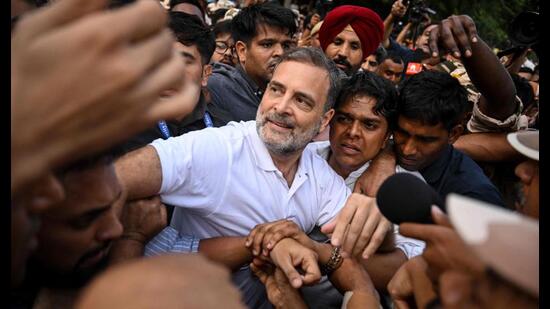
In a democracy, governments are routinely scrutinised. The Opposition, however, is rarely subjected to the same degree of scrutiny. Yet, the Constitution entrusts the Opposition with an important democratic responsibility, and it cannot evade that responsibility. The crisis deepens when the Opposition not only fails to discharge its role but its leadership also becomes increasingly obstinate, driven by a sense of entitlement and political arrogance. At its worst, such politics can push public discourse towards confrontation and disorder rather than democratic accountability.
For decades after Independence, the Congress either ruled at the Centre on its own or played a decisive role in governments supported by it. It therefore had a defining influence on India’s economic policies, budgets, administrative systems and development trajectory. Non-Congress governments did come to power at different points, but Congress remained the dominant force in national politics for several decades. Its long record in government must therefore be judged not merely by its achievements but also by its failures, policy choices and accountability. Over time, allegations of corruption, administrative inertia, policy indecision and questions surrounding leadership became central to political discourse. Public dissatisfaction grew, and the Congress steadily lost political ground.
In 2014, that accumulated discontent assumed a decisive electoral form. Under the leadership of Narendra Modi, the BJP secured a clear majority and formed the government at the Centre. This was not merely a change of government; it was a clear indication of a changing popular mood towards a political order that had dominated national politics for decades.
{{/usCountry}}In 2014, that accumulated discontent assumed a decisive electoral form. Under the leadership of Narendra Modi, the BJP secured a clear majority and formed the government at the Centre. This was not merely a change of government; it was a clear indication of a changing popular mood towards a political order that had dominated national politics for decades.
{{/usCountry}}That moment should have provided the Opposition with an opportunity for serious introspection. Understanding the reasons for electoral defeat, acknowledging organisational and leadership weaknesses, and returning to the people with new policies and a credible alternative should have been the natural democratic response to defeat. Instead, a section of the Opposition began questioning the very legitimacy of the electoral mandate. Terms such as majoritarian democracy, post-truth politics and manufactured web were invoked in an attempt to discredit or diminish the significance of the 2014 verdict.
The questioning of electoral mandates subsequently took another form with allegations surrounding Electronic Voting Machines (EVMs). There is nothing undemocratic about questioning an electoral process; indeed, scrutiny is an essential part of democracy. But serious allegations must also be supported by serious evidence. The Election Commission provided political parties an opportunity to demonstrate alleged manipulation of EVMs. Yet, no established case has emerged to demonstrate that India’s electoral mandate was systematically altered through EVM manipulation.
VVPAT and prescribed counting procedures are part of the electoral verification mechanism. The pertinent question is not whether anyone should be allowed to raise questions about EVMs, but whether those questions can be substantiated. Have discrepancies between EVM counts and VVPAT slips been established at any polling station in a manner that demonstrates systematic manipulation? Has any court, on the basis of such evidence, invalidated an election on grounds of EVM manipulation? These are legitimate questions.
Repeatedly making an allegation does not transform it into a fact. Democracy has room for doubt and scrutiny, but doubt cannot be allowed to substitute for evidence.
The latest effort appears to be directed at casting suspicion on the Election Commission itself. Questions are being raised about the Commission’s functioning, sometimes in the name of the Special Intensive Revision (SIR) and sometimes on the basis of reports appearing in newspapers. A constitutional institution is being portrayed as suspect without establishing the allegations through credible evidence. At times, even the Supreme Court has been dragged into the political crossfire. This raises a larger concern: When constitutional institutions are repeatedly questioned without adequate evidence, does the Opposition strengthen democratic accountability — or weaken public faith in the institutions themselves?
The Opposition’s problem, however, does not end there.
Disagreement with government policy is both a democratic right and a democratic responsibility. But opposition for the sake of opposition does not make a political party an alternative. India today is an aspirational nation. Narendra Modi has understood this changing India and his government has sought to move rapidly in that direction. Under his leadership, the discourse of electoral politics and governance has changed. Citizens today are not merely concerned about survival or basic welfare. They are increasingly demanding better roads, reliable electricity and water supply, quality healthcare and education, employment and security, along with modern infrastructure, technology and new opportunities for investment and economic growth.
The more important question, therefore, is: What is the Opposition’s own policy and roadmap on these issues?
Whenever the Opposition criticises a government scheme or policy, it must also explain where the flaw lies, how it should be corrected and what it would do better if entrusted with power. People do not want to hear only what the government has allegedly done wrong. They also want to know what the Opposition intends to do right.
Over the past decade and a half, a substantial section of the Opposition has appeared more invested in the politics of narrative than in presenting credible policy alternatives. Questions have been raised about electoral processes and constitutional institutions, among several other issues. Yet the effort to convert allegations into demonstrable evidence, and political opposition into a coherent alternative policy framework, has been far less visible.
For the Congress and other Opposition parties, the challenge is therefore much larger than winning the next election. It is to undertake an honest assessment of their long political legacy, acknowledge the reasons for repeated electoral setbacks and reorganise themselves in accordance with the aspirations of a changing India.
India needs a strong Opposition. It needs an Opposition that asks difficult questions of the government, exposes its shortcomings and does so with facts. It needs an Opposition that scrutinises institutions but backs its allegations with evidence. It needs an Opposition that opposes government policies while simultaneously placing better policies and credible alternatives before the people.
The BJP itself has demonstrated this role in states where it sits in Opposition, seeking to hold state governments accountable while presenting an alternative political and policy agenda.
The real battle for the Opposition, therefore, is not to construct a narrative against one government or one leader. It is to rebuild its own credibility.
Respect for the electoral mandate; honest introspection after defeat; evidence instead of allegations; policy instead of narrative; and alternatives instead of mere opposition — these are the principles that can restore an Opposition’s credibility in the eyes of the people.
In a democracy, the people are the final arbiters. The Opposition must decide whether it merely wants to oppose the government — or whether it genuinely intends to emerge as a credible alternative for the country.
Rajneesh Agrawal is member of Rajya Sabha from Madhya Pradesh. The views expressed are personal
(This is a Hindustan Times digital exclusive)