
 E-Paper



Mandir turns the spotlight on Constitutional secularism
Post the 75th Republic Day, what does the consecration of the Ram temple say about India’s constitutional secularism?

 Prefer HTon Google


India’s State apparatus was mobilised in unprecedented ways for the consecration of the Ram temple at Ayodhya. Post the 75th Republic Day, what does this say about India’s constitutional secularism?
There is no straightforward answer. Contrary to early works on Indian secularism, such as Donald Smith’s 1963 book, which forecast a progressive “secularisation of both private and public life,” the reverse has happened. Large parts of the world, including India, are, in the words of a sociologist, as “furiously religious as it ever was and in some places more so than ever”.
India’s constitutional secularism – as mandated by the Constitution and interpreted by the courts — is notoriously difficult to classify. One influential typology proposes two kinds of secularism: Assertive, which excludes religion from the public sphere; and passive, which allows for public visibility of religion. Few countries such as France fall in the former category while many, including India and the United States, fall in the latter category which represents a broad spectrum
While most typologies regard India as a secular State, the framers decided to eschew the use of the word “secular” in the Indian Constitution, which was inserted much later, despite fervent pleas by some members of the Constituent Assembly. Indian secularism has tried to oscillate between sarvadharma samabhava (goodwill towards all religions) and dharma nirapekshata (religious neutrality). Jawaharlal Nehru’s position on the secular State was one that was not “irreligious”, but respected and honoured “all religions giving them freedom to function”.
In the Indian case, one of the planks of a liberal conception of secularism – the wall of separation between State and religion – is constitutionally absent. Though Articles 25 and 26 guarantee the right to individual and collective freedom of religion, they along with other articles also empower the State to intervene in Hindu religious institutions and practices. Scholars have tried to capture the essence of Indian secularism in different ways. One of the more well-known formulations is Rajeev Bhargava’s idea of “principled distance”, where the State “neither mindlessly excludes all religions nor is merely neutral towards them”. While this captures some elements of Indian secularism, they run up against the reality of Indian secularism.
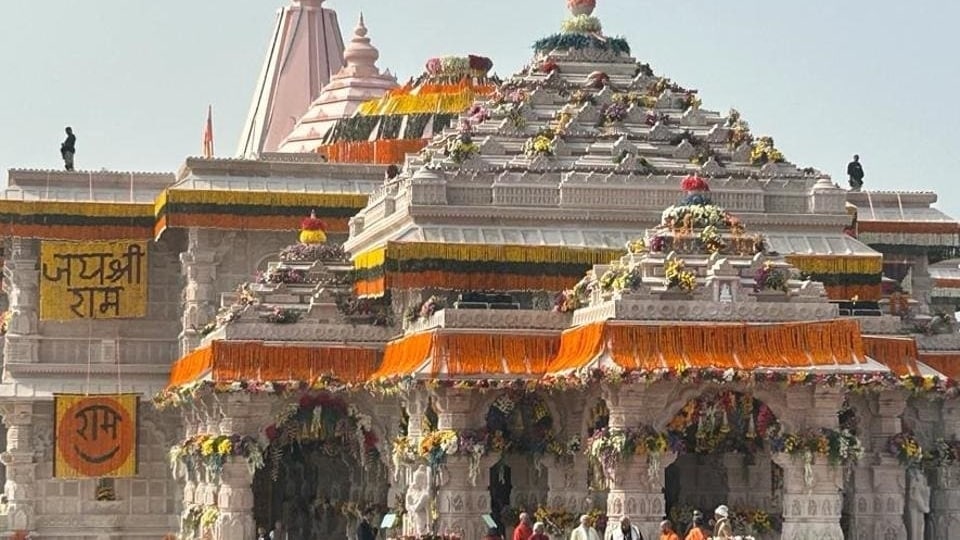
The dispute over Ayodhya has represented one of the most potent challenges to Indian secularism. The political and legal battles over the temple site in independent India beginning in 1949, when an idol of Lord Ram was found inside the existing Babri Masjid, to the 1992 demolition of the mosque to the 2019 Supreme Court (SC) paving the way for the construction of a temple have been marked by duplicity and double standards.
The courts have been central to questions around State and religion in India and drew fulsome praise from Prime Minister Narendra Modi at the temple opening. While it is difficult to distil a consistent line of reasoning in the SC’s religious jurisprudence, the Court has constructed its own version of an all-encompassing Hinduism, which has helped the Hindu nationalist project on occasion. This was best articulated in a landmark 1966 ruling where the court said underneath the “divergence” of Hinduism, there is an “indescribable unity”. In the same ruling, the court labelled Hinduism as a “way of life”. While this might have seemed relatively innocuous, a similar logic was used in a 1996 ruling, in the midst of the Ram Janmabhoomi movement, conflating Hinduism with Hindutva. Indeed, the idea that Hinduism as well as Hindutva are cultural expressions that subsume all other religions has been put forward by Hindu nationalists. The court’s seal of approval, unsurprisingly, made its way to Bharatiya Janata Party (BJP) manifestoes and Rashtriya Swayamsevak Sangh mouthpieces.
The second way in which the court has shaped Hinduism is by positioning itself as the arbiter of what constitutes “true” religion. It has done so through the use of what is known as the “essential practices” test, something that has become a trademark of India’s religious jurisprudence. Indeed, judges have sometimes been likened to dharmashastras or high priests in their zeal to discover the fundamentals of religion.
This tendency to erase the differences within Hinduism was very much in evidence in the 2019 Ayodhya ruling. In the voluminous judgment, the court stated that the “Hindu community” claims the disputed site as the “birthplace of Lord Ram” ignoring that there are many Hindus who either do not worship Ram or are ambivalent about the disputed site. Much of the judgment revolved around evaluating the faith and reverence of Hindus for a mythological site, which is tricky at the best of times. Despite admitting that the existing mosque on the site had been first “desecrated” in 1949 and destroyed in 1992, the bench unanimously ruled the claim of the Hindus to the entire disputed property to be on a better footing than the Muslims. The Court compensated the Muslims by awarding a plot of land elsewhere in Ayodhya to build a mosque.
A historical parallel to the opening of the Ram temple can be found in 1951 when the rebuilt Somnath temple was inaugurated. The then Prime Minister (PM) Nehru did not attend the function and was unhappy with President Rajendra Prasad for “associating” himself with and attending the “spectacular opening”. Times have changed dramatically and a party, whose rise in the 1990s from a marginal entity was predicated on Ayodhya, is expectedly, extracting maximum mileage from the temple. When the PM starred in the ceremonies around the temple consecration, the line between the State and religion was obliterated.
Ronojoy Sen is with the National University of Singapore and author of Articles of Faith: Religion, Secularism, and the Indian Supreme Court. The views expressed are personal


