In a car-crazy city such as Delhi, prioritising the needs of pedestrians is by no means an easy task. But the national capital surprised itself when it closed off streets to motorised traffic at Karol Bagh’s Ajmal Khan Road in May 2019 and Chandni Chowk in September 2021, and came up with regulations for “enhancing walkability” across the city.
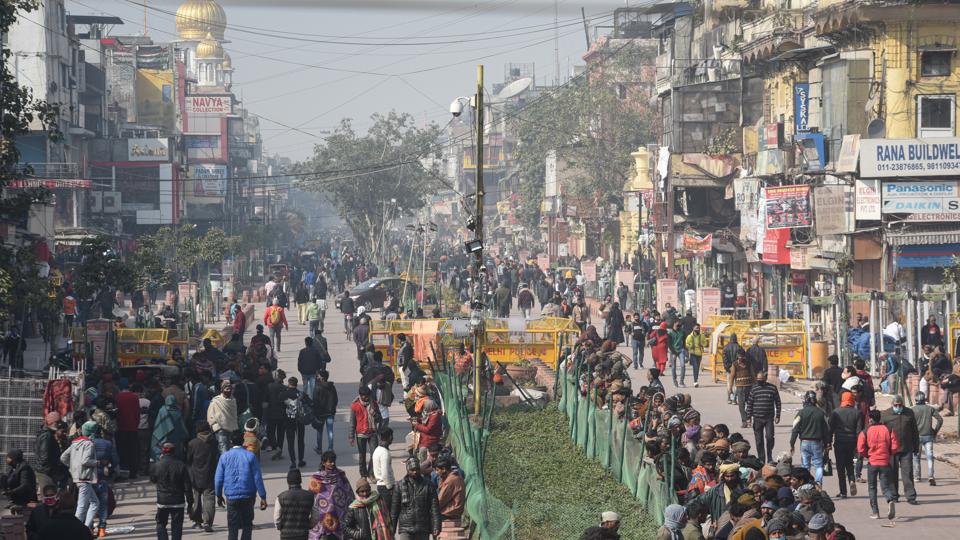
The projects at Ajmal Khan Road and Chandni Chowk — two of the oldest and the most congested shopping streets in
In a car-crazy city such as Delhi, prioritising the needs of pedestrians is by no means an easy task. But the national capital surprised itself when it closed off streets to motorised traffic at Karol Bagh’s Ajmal Khan Road in May 2019 and Chandni Chowk in September 2021, and came up with regulations for “enhancing walkability” across the city.
The projects at Ajmal Khan Road and Chandni Chowk — two of the oldest and the most congested shopping streets in Delhi — created hope that more markets would be inspired to go motor vehicle-free. But in December last year, the shop owners from Kamla Nagar, a retail hub in north Delhi, stalled the municipality’s efforts to revive the pedestrianisation project. Previously, Krishna Nagar, an east Delhi market, tried the vehicle-free arrangement but couldn’t sustain it for more than a couple of months. Successive attempts to pedestrianise Connaught Place have also failed due to resistance from local traders.
Meanwhile, Delhi Development Authority (DDA) is yet to constitute a high-level committee under the chairmanship of Delhi Lieutenant Governor Anil Baijal to oversee the implementation of the regulations on walkability, which were notified in August 2019. Among other things, the plan promised 27 area-specific walk plans. A report published in HT on February 7 quoted officials blaming the pandemic-induced restrictions for the delay even as they insisted that walk plans for six locations were ready.
Covid-19 has driven home the importance of open spaces and cities across the world are removing cars from some of their busiest streets. But in Delhi, the pandemic is being blamed for lethargic policy implementation.
Ajmal Khan Road pedestrianisation, for instance, was briefly undone between July 2020 and April 2021 when retailers complained of business losses and limited public transportation availability during the pandemic. This broke the momentum, says Jai Prakash, former mayor of North Delhi Municipal Corporation.
Although now a functional pedestrian zone, Ajmal Khan Road has fallen into disrepair because of poor management and what the planners call an incomplete job. The struggle to balance the needs of all stakeholders is evident in this stretch as well as in Chandni Chowk.
Despite the shortcomings, pedestrians are still sold on the concept. The one km stretch of Ajmal Khan Road offers them the freedom to walk at their own good pace. The benches — although a few of them are broken — are still a good place to rest.
The newly restored Chandni Chowk, a Mughal-era market nestled between the Red Fort and Fatehpuri Masjid, is being rediscovered by walkers. With the overhanging maze of wires gone underground, the street cleared of all motor vehicles (between 9 am and 9 pm) and only rickshaws allowed, shop fronts are visible to visitors who no longer need to jostle for walking space. Residents of the congested bylanes of the walled city have been quick to reclaim the 1.3 km stretch — which now has wide walkways, benches and a green central verge — for strolling, cycling, socialising and “catching fresh air”.
But pedestrians, who were never a priority in Delhi’s car-centric city planning, have learnt to live with limited expectations. In the Ajmal Khan Road stretch, for example, footpaths and paved street space done up under the pedestrianisation project are rutted in many places, few of the benches are broken and the potted trees look feeble. This is perhaps a warning for Chandni Chowk, which too is showing early signs of wearing out.
“We don’t allow a flyover to degenerate or a big road space fall into disrepair. Then why let pedestrian spaces be neglected like this?” asks Anumita Roy Chowdhury, executive director at Centre for Science and Environment, a Delhi-based green think tank.
Back in May 2019, Roy Chowdhury conducted a localised study of Ajmal Khan Road and found that the air was cleaner and footfalls were more than in the adjoining Arya Samaj Road where motorised traffic moved.
“Going forward, Delhi will have to identify key commercial areas and pedestrianise them so they become the low-emission zones in the city. So, the success of Ajmal Khan Road and Chandni Chowk projects is extremely important. Delhi has to sustain them and think about how to scale them up and replicate them,” she says.
An incomplete task
In May 2019, Delhi witnessed a makeover of Ajmal Khan Road, which got rid of motor vehicles and reclaimed the vacant space for pedestrians. The plan to pedestrianise was in the works since 2010 when DDA’s United Traffic and Transportation Infrastructure (Planning and Engineering) Centre (UTTIPEC) approved it and the administration conducted a trial run. But the project failed to get prioritised.
In 2016, the Union ministry of housing and urban affairs in a report identified Karol Bagh as part of the plan to decongest Delhi and later, a committee under the Union ministry of home affairs (MHA) for traffic management of Delhi got involved, bringing in knowledge partners who assisted North Delhi Municipal Corporation on the project. Professional urban designers and architects were hired by the corporation. Local stakeholders were consulted. Using flexible bollards to block traffic, paint to mark non-motorised vehicles lanes, placing street furniture and potted trees, and cancelling the on-street parking permit for the stretch, authorities pedestrianised Ajmal Khan Road in May 2019.
In December that year, the pedestrian street hosted a two-day festival “Girls Step Out At Night” to promote safe and accessible public spaces for women, even after sundown.
Cut to 2022, Murali Mani, the head of the traders' welfare association of Ajmal Khan Road, says the project is as good as abandoned and both traders and residents are now opposed to the arrangement.
“Maintenance of the infrastructure is poor. Scooters and motorcycles enter the pedestrianised zone. There are no designated points for stoppage of (app-based) cabs. They have removed vehicles from the pedestrian stretch but an overall parking plan has not taken off. Authorities should allow cars for pick and drop, at least till the time we are in the pandemic. Our businesses are suffering,” he says.
Planners insist that there is nothing in the project that makes it unsustainable. “But it’s a job yet to be completed. A comprehensive parking management system for the area is a vital component, which hasn’t yet started. Clearing encroachments is a continuous task, which needs regular municipal action. If these items are missed, infrastructure slowly wears off causing agony to people,” says Anuj Malhotra, the knowledge partner to MHA who is assisting pedestrianisation projects, including the one at Ajmal Khan Road.
Parking
The Ajmal Khan Road pedestrianisation was sold to the stakeholders with a promise of adequate on-street and off-street parking arrangements in close proximity to the pedestrian street. Out of the four multi-level parking projects for Karol Bagh, the municipality has been able to award tenders for only one. The construction would take a couple of years but streamlining surface parking would have been a quicker fix to the problem.
Sanjay Goel, the commissioner of North Delhi Municipal Corporation, says a surface parking plan for the entire project area is ready. It entails granting the operation and management of parking lots and even the job of regulating the no-parking zones to a single concessionaire, to bring “some sanity to the area”.
“Engaging too many small operators doesn’t work because they may not have the wherewithal and experience to handle large parking operations professionally. In fact, Indian Railway Stations Development Corporation was keen to come on board,” he says, adding that the project is still awaiting clearance from the deliberative (political) wing of the corporation.
The lack of adequate parking has come in the way of pedestrianisation projects in other zones as well. Retailers from Kamla Nagar say the sole underground parking in their market already runs to full capacity taking in cars from residents and traders who have a monthly arrangement. “Where will the shoppers and the rest of us park if they remove parking from the market and pedestrianise the street?” asks Nitin Gupta, president of Kamala Nagar traders' association.
For the success of any civic improvement project, point out experts, all elements of planning have to come together and be enforced in a time-bound manner.
“If remote parking requires further revamp and management, it has to happen fast. In any case, there is a Supreme Court mandate for Delhi to implement parking area management plans across all wards of the city, which is long due,” says CSE’s Roy Chowdhury, adding that in commercial areas, variable parking fees should be enforced for demand-side management.
These measures and other provisions such as prioritising the movement of pedestrians, cyclists, public transport users and the differently-abled; securing footpaths, green spaces, intersections and vending zones and keeping access for emergency vehicles free while demarcating parking spaces are mandated in the Delhi Maintenance and Management of Parking Places Rules, which were notified in September 2019.
As pointed out in Metro Matters last month, stakeholder agencies tasked with the execution of the parking rules have so far made little progress because of financial and space constraints, resistance from traders and residents, and the reluctance of the political class to launch any reform that might seem harsh in the run-up to Delhi municipal elections due in a couple of months.
Shopkeepers vs vendors
Much like parking, Delhi hasn’t come around resolving the issue of street hawking, leading to conflict in the pedestrian streets as well as the rest of the city. A means of sustenance for the poor and mostly migrant population, street vending is important to a city’s informal economy, meeting the retail needs of a large section of urban dwellers. But their presence in public spaces is often contested by authorities, market and resident associations who see them as “encroachers” who block the right of way and take away customers from local shops.
The Street Vendors (Protection of Livelihood and Regulation of Street Vending) Act passed by Parliament in 2014 protects the rights of hawkers. It mandates surveys to identify hawkers, the constitution of town-vending committees, designating areas for vending and issuing certificates to the identified street vendors. But the slow implementation of these rules has ensured that street trade remains the most contentious and unregulated employment activity in Delhi. Streets marked for pedestrianisation are also entangled in this conflict.
Retailers at Kamla Nagar say the municipal corporation must remove “illegal” street vendors before it blocks traffic for pedestrianisation. “We respect the rights of a person who has been vending for 30 years. But if you inflate the number of vendors, issue certificates to people who don’t exist so that these can be used by new persons who begin squatting on our streets, we will oppose it. Our market has a limited carrying capacity,” says Gupta.
Many large markets in Delhi are designated as no-vending zones but vendors have continued to sell their wares. Recently, acting on court orders, municipalities have evicted vendors from Nehru Place, Connaught Place, Chandni Chowk and Sarojini Nagar.
At the time of pedestrianisation in 2019, authorities removed hawkers from Ajmal Khan Road stating that it is a no-vending zone. Alternate vending sites were offered to those evicted, but vendors continue to demand spots back in the pedestrianised market.
“Initially, we were shown UTTIPEC guidelines (of 2009) for hawking zones and made to believe we would be given spots within the pedestrianised street. But later, we were told that Ajmal Khan Road is a no-hawking zone and no vendor could be given space here. We were provided space in locations where it is difficult to conduct business. So many of us haven’t relocated,” says Vir Bhadra Maurya, a local street vendor who is also a member of the Karol Bagh street vending committee.
In Chandni Chowk, traders have moved the Delhi high court seeking direction from the authorities to remove illegal vendors from the no-hawking and no-squatting areas in the market. In a separate petition, they have challenged the validity of the Delhi Street Vendors (Protection of Livelihood and Regulation of Street Vending) Scheme-2019 framed by the Delhi government under the Street Vendors Act.
“Our market was declared a no-vending zone in 2000 and vendors were relocated to adjoining places within the municipal zone. The pedestrianisation project later also did not provide for vending zones. If vending is not allowed in this space, why should a vendor identification survey be conducted here?” asks Sanjay Bhargava, the head of the market’s Vyapar Mandal.
Arbind Singh of the National Association of Street Vendors of India (NASVI) says the orders on no-vending zones predate the Street Vending Act of 2014 and need to be looked at again. “We agree that we can’t have an unending stream of hawkers crowding a space. Therefore, processes such as those mandated in the Street Vending Act must be followed,” he says.
“Municipalities need to demarcate the spot for vendors to integrate them in pedestrianisation projects as well. It can be done by deciding the holding capacity (of the market) and adjusting vendors accordingly.”
Roy Chowdhury says that streets can accommodate vendors without sacrificing mobility if Delhi puts in place a street management plan, which will “comprehensively look at all street activities, apportion and manage space so that one usage does not dominate over another."
“Otherwise, this unending conflict and tension will not allow any new generation strategies (such as pedestrianisation) to get implemented. We have to synergise various policies and guidelines and shift from road management to street activity management. We need to regulate so there’s no free-for-all,” she says.
No pain, no gain
Successful examples of pedestrianisation across the world have shown that there is no gain without pain and that only proper planning and enforcement can minimise that pain. Removing motor vehicles from a busy market is bound to invite some pushback and need political determination to counter it.
But officials in the civic agencies say that there is not enough political will backing these projects. With Delhi municipal elections due in the next couple of months, there is obvious reluctance to push any bold initiative.
Radical mobility reforms are hard to push when political stakes are high. But a number of mayors across the world took their chances and saw their initiatives through. New York City’s Times Square pedestrianisation, for example, happened in 2009 when then-mayor Michael Bloomberg was seeking re-election.
Bloomberg’s aide wanted to defer the plan until after the elections. “(But Bloomberg told them)… I don’t ask my commissioners to do the right thing according to the political calendar. I ask my commissioners to do the right thing, period,” wrote Janette Sadik Khan, the city’s then transportation commissioner, in her book Streetfight: Handbook for an Urban Revolution that she co-authored with Seth Solomonow, who was her chief media strategist. Bloomberg won a third term in 2009 just months after pedestrianising Times Square and building 322 km of bicycle lanes in two years.
In an article for The Guardian last October, Sadik-Khan and Solomonow argued that "reallocating public spaces from motor vehicles for people to walk and cycle would send some residents into paroxysms of anger” but voters still rewarded those mayors who initiated these projects.
They gave an impressive list of re-elected mayors to back their point: NYC’s Bloomberg, Milan’s Giuseppe Sala, London’s Sadiq Khan, Paris’ Anne Hidalgo, Barcelona’s Ada Colau and Oslo’s Marianne Borgen — each known for “ambitious road reclamation” projects.
Perhaps, therein lies an inspiration for the leadership in Delhi.
Shivani Singh is HT's metro editor. Her column Metro Matters gives readers a flavour of Delhi in all its complexity.
The views expressed are personal
One Subscription.
Get 360° coverage—from daily headlines
to 100 year archives.
Archives
HT App & Website