A restored version of the 1972 classic, Pakeezah will be screened at the Festival Lumiere at Lyon, France, which began on October 10 and will conclude on October 18.
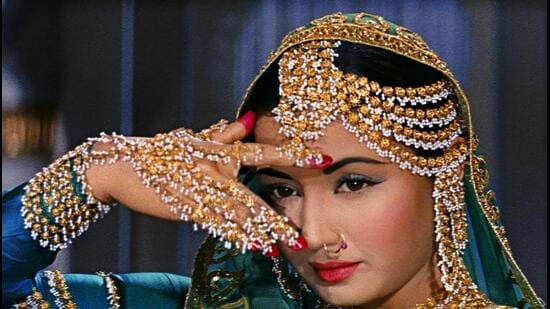
This, of course, has again drawn attention to the life and times of the movie’s lead actress, Meena Kumari.
As a young girl, circumstances at home forced her to step out and look for work. As a grown woman, she was deprived of the very things she had worked so hard for: a family, a home, friendships, and love.
But between her birth and her death; between the innocence of those early days and the loneliness of her later years; between a stifled childhood and her final agony; there hangs a life. The 38 dazzling years of Meena Kumari.
And almost as a testimony to those years, Pakeezah — a blood-soaked swan song — continues to breathe and shine, like an ember.
Fifty-four years after it was first released, and following the 4K restoration process, Pakeezah will have its world premiere.
Tragedy, tension drama, beauty, poetry, music, sorrow, hope, romance, love and loss — it is almost as if all the emotions found in human experience converged in this film to tell a tale that has seeped deep into our consciousness and will remain there for a long time to come.
{{/usCountry}}Tragedy, tension drama, beauty, poetry, music, sorrow, hope, romance, love and loss — it is almost as if all the emotions found in human experience converged in this film to tell a tale that has seeped deep into our consciousness and will remain there for a long time to come.
{{/usCountry}}When Meena Kumari was working on Pakeezah, she was ailing both physically and mentally. She was on the brink, not of a new world, but of one left behind — a world that had inspired hope once, but had failed her miserably.
And in the film, one of those rare examples of art imitating life, Meena became one with her character: a much-adored, much-desired courtesan of Lucknow’s twilight era of nawabs.
It is poignant to watch Meena in the movie, as in her life, wanting to step across the brink, willing to leave everything behind. One can only imagine the pain that she must have borne that made the pursuit of death sweeter than life itself.
Importantly, it is not a quick, easy death that she desires but a long, drawn out one — to fade out slowly, like an incense stick, and yet managing to linger quietly, defiantly, in the air long after.
Her death was not Meena’s loss. It was ours. It was the world’s. It reveals a lot about the society we have built that denies hope to so many, especially to someone who had encountered its worst and yet was willing to go on and make the most of one’s existence.
Pakeezah is a cry, a pleading, a protest, and a prayer — for a better and just world. The songs in the film are a gateway to the world of Pakeezah.
Each song adds to the narrative and takes it forward. They are not there to provide relief from the plot, or some cheap entertainment in the middle of a complex story in order to make the audience stay.
The songs push the viewer further, to make us singe and burn, so that what follows can be experienced with all the intensity and passion that Pakeezah requires of anyone choosing to watch it. That is the confidence of the film. She is sure of herself.
Cinematically, Pakeezah is an achievement of the highest order. Privately, the world of Pakeezah is not one that we would want to live in. It is a place we would want to visit for a while — to learn the graces, to receive an education in pride and faith, and, then, to help and rescue the people living in that world.
Will there be admirers and suitors of Pakeezah in today’s India? Will the title character find hearts to settle in? Who knows! Our culture is being replaced by something coarser. Our politics needs a new imagination. Our air is toxic and our rivers are dying — and yet we continue to exist in our bubbles, in our gated colonies and high-rise apartments.
We succeed daily in unseeing the suffering around us and further undoing fellow human beings whom society has always strung out along the margins of power and privilege.
It might take years — even decades — to reimagine our world and to rebuild it in the image of the highest possible. And when that happens, when the values that make us human are imbibed and enshrined again, the likes of Pakeezah, and yes, Meena Kumari, might, just might, want to return from the brink, and dream and live again amidst us.
Shivendra Singh is a writer from Lucknow. The views expressed are personal