In April, Prime Minister (PM) Narendra visited Saudi Arabia for a third time since assuming office 11 years ago. During this period, India has enhanced its centuries-old ties with the Persian Gulf nations, which host the largest (25%) share of Indian expatriate population globally (about nine million), to the level of strategic cooperation. In an interview with Arab News ahead of his April visit, PM Modi emphasised the long-standing ties between India and the Arab world. He said Indians and Arabs have interacted with each other since the days of Kalila wa Dimna. Much of this interaction has centred on culture, through transmission of ideas and translations of texts.
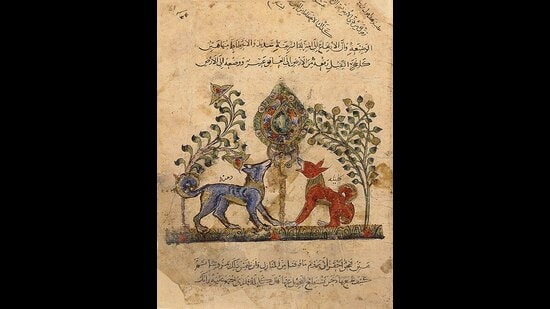
The PM did not elaborate on Kalila wa Dimna; nor did Arab News add a parenthesis, for it has been among the most popular books in the Arab world since Ibn Muqaffa compiled it in the 8th century from Panchatantra for philosophers to benefit from the wisdom of the Indian classic. Panchatantra reached the rest of the world as a celebrated treatise on governance tutelage through its Arabic translation. Novelist Salman Rushdie has argued that Alf Laylah wa Laylah (The Arabian Nights/One Thousand and One Nights) also has probable Indian origin. The Arabian Nights, the Arab world’s biggest contribution to literature, has influenced storytelling and inspired writers globally for centuries. In a May 2021 New York Times piece, Rushdie cited scraps of information and wrote that The Arabian Nights stories first found their way into Persian somewhere around the 8th century
Indian texts were of great interest during what is regarded as the Islamic Golden Age, when Arabs preserved and transformed the lost Graeco-Roman philosophical and scientific knowledge. In 771, the Abbasid ruler Al-Mansur commissioned translations of Indian texts into Arabic, when Baghdad’s centrality to scholarship and trade drew people to the city. Baghdad had an Indian quarter apart from Jewish and Christian suburbs, Greek, Chinese, and Armenian quarters by the 9th century. The milieu facilitated the exchange of pivotal ideas. An Indian text in the 8th century introduced nine numerals and zero to Arabs and helped develop the decimal system. Polymath al-Khwarizmi, who invented the algorithm concept, built on these ideas in Baghdad and created what is known as “the Arab hegemony” in mathematics. The new system of numerals reached Europe via the Arab world. The Europeans called them Arab numerals, while Arabs rightly refer to them as the Indian numerals or Hindsa.
{{/usCountry}}Indian texts were of great interest during what is regarded as the Islamic Golden Age, when Arabs preserved and transformed the lost Graeco-Roman philosophical and scientific knowledge. In 771, the Abbasid ruler Al-Mansur commissioned translations of Indian texts into Arabic, when Baghdad’s centrality to scholarship and trade drew people to the city. Baghdad had an Indian quarter apart from Jewish and Christian suburbs, Greek, Chinese, and Armenian quarters by the 9th century. The milieu facilitated the exchange of pivotal ideas. An Indian text in the 8th century introduced nine numerals and zero to Arabs and helped develop the decimal system. Polymath al-Khwarizmi, who invented the algorithm concept, built on these ideas in Baghdad and created what is known as “the Arab hegemony” in mathematics. The new system of numerals reached Europe via the Arab world. The Europeans called them Arab numerals, while Arabs rightly refer to them as the Indian numerals or Hindsa.
{{/usCountry}}The Cheraman Juma Masjid in Kerala, among the oldest mosques in the subcontinent, has stood as a symbol of deep India-Arab ties for centuries. Chera emperor Cheraman Perumal, the story goes, travelled to Mecca after Arab traders told him that the miracle of the moon splitting, which he saw in his dream or from his palace, was associated with Prophet Muhammad. The legend is that, in the 7th century, a friend of Perumal built the Cheraman Juma Masjid after he died in the Arab peninsula. In modern times, India continues to be part of the Arab world’s social fabric, thanks to the expatriates in the region. Their remittances have enhanced living standards in states such as Kerala. Six Indians in the UAE were on Forbes’ India’s 100 Richest List in 2023. The Gulf countries accounted for an average of 28% of total remittances from 2014 to 2020, according to RBI. But it all began with words and trade: PM Modi’s recall of Kalila wa Dimna was a reminder of an ancient connection, a cultural bridge of civilisations.
The views expressed are personal.