Last weekend, I booked tickets at an IMAX theatre to watch the latest big budget offering from Bollywood, Ramayana (the first part). The two-part series cost the makers ₹4,000 crore. Watching it is a bit like ordering khichdi at a Michelin-starred restaurant. It’s a dish you’ve grown up eating, one whose taste is deeply embedded in your childhood memories. But you’re curious to see what a Michelin-starred chef, armed with exotic ingredients, fancy equipment, and an extravagant budget, can do with something so familiar.
Naturally, the ticket costs four figures, and every piece of the cheese-caramel popcorn in my medium-sized bucket costs me ₹5. You get the drift. Another four digits.
The mandatory cancer awareness ads played at the start, instructing a crowd that, I suspect, drinks alkaline water to quit consuming gutkha (chewing tobacco). My seat was next to a couple, next to where the girl was seated. The moment I bent to occupy it, the couple looked at each other and switched places. I could only hope it wasn’t about my imagined intentions. Unfazed, I put on my 3D glasses, and the movie started playing. Here’s this thing: Every time I watch a 3D movie, I regret not booking for the 2D version instead. That’s how life is, I guess.
A family walked in late, with flash-lights to make their way to their seats, blinding everyone else temporarily. Clearly, civic sense and income are not correlated.
{{/usCountry}}A family walked in late, with flash-lights to make their way to their seats, blinding everyone else temporarily. Clearly, civic sense and income are not correlated.
{{/usCountry}}Moments later, a guy in the row behind received a video call from his relatives wishing him a Happy Diwali. And he dutifully responded to everyone, as the phone was passed around at the other end. One could only grit their teeth, and then surrender. Thankfully, though, this is becoming less common.
All of these, make movie watching memorable in India. Movies are bookmarks for our memory, especially those watched in a theatre. You may forget the plot, the villain’s name, or even the ending, but you’ll remember who accompanied you, what time the show started, where you sat, and the name of the theatre. And, often, what you ate. You especially remember the samosas from the single-screen theatre days, wrapped in a piece of newspaper where one headline about gore or the other didn’t affect your appetite and enthusiasm.
Unlike today, when a film’s box-office collection is discussed like a quarterly earnings report, back then, you secretly prayed for the movie’s success. You had invested three hours of your life, twenty rupees of your father’s money, and considerable social capital negotiating permission to go. The film simply must not flop.
I remember watching Jurassic Park at Jawahar and Hum Aapke Hain Koun..! at Shyam in Muzaffarpur. The halls were geographical landmarks. You could tell a rickshawallah to take you to Jawahar, and he wouldn’t ask which Jawahar — only one Jawahar that mattered.
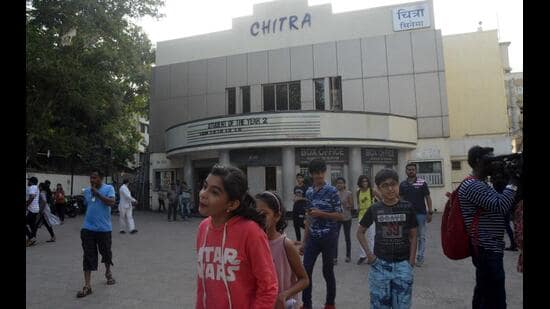
Most single-screen theatres in India seemed like they were named after someone’s child or grandchild — Jawahar, Shyam, Jyoti, Sujata, Sapna. It was often the grandchild of a local politician or businessman. In small-town India, owning a cinema hall was a natural progression for a successful MLA. First came the petrol pump, then the daaru ka theka (liquor shop), and then the prestige project — a cinema hall. A particularly enterprising MLA would own two theatres: One for screening Hindi films, and the other for ones that carried the A censor-certification.
Sujata in Ranchi was infamous for screening adult films, while Sapna Sangeeta was among Indore’s best-known cinema destinations. I’ve often wondered about the children after whom these theatres were named. Imagine being Sujata, studying in a boarding school somewhere in the hills, completely unaware that hundreds of adolescent boys were bunking school to attend the 11 am show at a theatre bearing your name.
These children must have enjoyed considerable celebrity status in their boarding schools. Their grandparents had immortalised them in concrete, neon signage, and a booking window. They were probably sent thousands of kilometres away for a quality education. And perhaps, given the local political climate, to remain beyond the reach of kidnappers.
Small-town India had an extraordinary density of cinema halls. This was before cable television became widespread, and much before smartphones and Instagram Reels started delivering entertainment in 15-second instalments. A cinema hall was one of the few places where a man could escape his daily grind for three hours.
Times haven’t changed much. The escaping responsibilities part still exists, as communicated to me sternly by the spouse, while I was munching popcorn in the theatre, watching VFX rakshasas (demons).
A word about the movie: It pulls together well towards the end. The couple next to me seems jubilant. Another movie added to the bookmarks.
Abhishek Asthana is a tech and media entrepreneur, and tweets as @gabbarsingh. The views expressed are personal