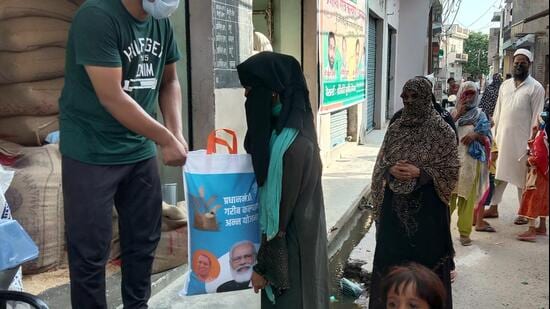
The Pradhan Mantri Garib Kalyan Anna Yojana (PMGKAY) — with over 800 million beneficiaries — is the largest food security programme in the world. In most parts of the country, the Centre routes food grains to the beneficiary through the Fair Price Shop (FPS) network. But, in 2015-16, Chandigarh, Puducherry and the urban pockets of Dadra & Nagar Haveli chose to discharge the entitlement in cash, credited directly into the beneficiary’s bank account, equivalent in value to the free foodgrain they would have otherwise drawn from FPS.
However, once cash leaves the government’s books through Direct Benefits Transfer (DBT), it carries no trace of what it was actually utilised for, with no way for the government to confirm that it had been used for the intended purpose.
This is the limitation that the Digital Rupee — RBI’s Central Bank Digital Currency (CBDC) — has allowed the government to finally address. CBDC has been deployed to improve upon the DBT architecture. Unlike ordinary DBT, a CBDC token can be programmed to be redeemable only against food grains, with a defined validity window, and only against a wallet that is actively linked to an Aadhaar-verified household. The Digital Rupee leaves a continuous, auditable trail, from the Consolidated Fund of India (CFI) to the point of redemption.
This year, the three UTs migrated from the DBT model to CBDC-based disbursal. Because every wallet must be actively authenticated against an Aadhaar-linked beneficiary before a CBDC token can be credited, the migration has functioned as a continuous, non-intrusive confirmation that the entitlement is reaching and being utilised by an actual household each month.
{{/usCountry}}This year, the three UTs migrated from the DBT model to CBDC-based disbursal. Because every wallet must be actively authenticated against an Aadhaar-linked beneficiary before a CBDC token can be credited, the migration has functioned as a continuous, non-intrusive confirmation that the entitlement is reaching and being utilised by an actual household each month.
{{/usCountry}}With the adoption of CBDC, funds that would otherwise take time to clear through the banking system are credited to the beneficiary’s digital wallet in real time, with each transaction recorded permanently against the CFI. For beneficiaries, this has meant fewer disputes over whether a transfer was actually made.
CBDC wallets have been enabled on feature phones as well, through SMS- and USSD-based channels, so a beneficiary needs only a basic handset to receive, hold and redeem the Digital Rupee. This keeps the facility within reach of the very households PMGKAY is meant to serve. In practice, redeeming or checking a CBDC token takes little more than confirming a transaction on the wallet, with the credit and a receipt appearing instantly, the same everyday familiarity that users of the UPI report more broadly has now been extended to the PDS.
If the above UTs demonstrate what CBDC can do for a cash-based transfer, Gujarat is demonstrating what it can do when food grains are distributed physically. The overwhelming majority of PMGKAY beneficiaries continue to receive their entitlement in kind, through FPS. It is the integration of digital tokens with this model that Gujarat was chosen to pilot.
The Gujarat pilot rests on two distinct innovations. The first is tokenisation: The subsidy value due against each transaction is issued not as pre-funded cash, but as a digital token — a purpose-bound, non-transferable claim on the CFI that exists only for the duration of that specific transaction and is extinguished the moment it is redeemed. The second is Just-in-Time (JIT) settlement: Rather than positioning funds across the supply chain months in advance against anticipated demand, tokens are generated and settled with the FPS dealer at the point of actual sale, matched precisely to the quantity of foodgrain actually lifted and sold. Tokenisation supplies the traceability, and JIT supplies the timing — they replace a system of advance, undifferentiated cash float with one of exact, auditable, transaction-linked settlement.
The CBDC token enables the beneficiaries to know their household’s monthly entitlement of food grains and the subsidy borne by the Centre. Immediately upon completion, an online receipt is generated on the beneficiary’s mobile detailing the transaction, ensuring complete transparency and accountability of the FPS dealer.
As the model moved toward a full state-wide rollout, it also flagged a further structural saving: CBDC-based settlement removes the need for parallel ePoS and eKYC infrastructure at the FPS level altogether. Once CBDC achieves 100% coverage in a State, the ePoS machine becomes redundant, since the token itself carries the authentication and the audit trail that ePoS devices are meant to provide.
Ten more states have already begun the next phase of CBDC rollout.
The Jan Dhan-Aadhaar-Mobile architecture that underpins over 580 million bank accounts and the real-time payment rails that today carry roughly half of the world’s UPI transaction volume have made a programmable rupee possible that can be placed directly in the hands of a ration cardholder or a FPS dealer. One Nation One Ration Card removed the geography of entitlement; CBDC is now removing its opacity.
Sanjeev Chopra is secretary, Food and Public Distribution, Government of India. The views expressed are personal