The recent and inevitable Delhi Metro fare hike raises a number of issues, though none of them are new. For those of us who use it, the way we traverse and even think about the city will never be the same. There is no going back now, but the question the fare hike raises is how to go forward?
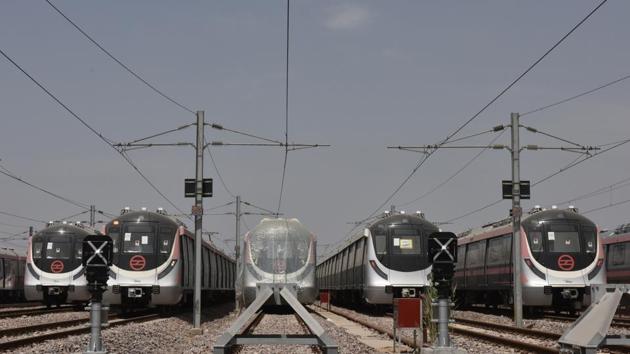
From the start, researchers at the TRIPP Institute at IIT Delhi showed through precise economic modelling and comparative public transport analysis that the Delhi Metro would not be a sustainable form of transport compared to, say, investing big time in the city’s bus infrastructure. ‘Big time’ does not mean a six-kilometre stretch of bus rapid transit (BRT), but rather an integrated system of transport that both expands and greatly improves what was there before.
One could argue that the Metro project was always inherently ‘anti-people’; it was a massive, top-down infrastructure laid onto the city with great care in terms of its engineering and ‘world-class’ production values, but less care in terms of its sustainability and coordination with the city itself. It was a largely Japanese-funded, diplomat-negotiated, transnational global production. In fact, ‘the people’ were mostly not consulted, and people in the city’s other urban and transport agencies most often didn’t speak to one another, and certainly didn’t work together when it came to Metro planning. Many argued this was the secret to the DMRC’s success.
Now, in addition to ‘the people’, with the arrival of the Metro, we have a new idea of ‘the public’. This Metro-riding public has demands of its own, as it should. Political parties naturally will want to speak to and for this public, however accurately or inaccurately. Most people will let them; but it is this public that will have to assert its claim on the Metro and the city for anything to change, and for the future of the Metro system to be as they would like it – efficiently and safely run, affordable, integrated, maybe even beautiful. This will be the challenge and will require the city’s transport and environment-related NGOs and urban research organisations to be at the table — whether with politicians or the DMRC, but ideally both.
{{/usCountry}}Now, in addition to ‘the people’, with the arrival of the Metro, we have a new idea of ‘the public’. This Metro-riding public has demands of its own, as it should. Political parties naturally will want to speak to and for this public, however accurately or inaccurately. Most people will let them; but it is this public that will have to assert its claim on the Metro and the city for anything to change, and for the future of the Metro system to be as they would like it – efficiently and safely run, affordable, integrated, maybe even beautiful. This will be the challenge and will require the city’s transport and environment-related NGOs and urban research organisations to be at the table — whether with politicians or the DMRC, but ideally both.
{{/usCountry}}The Delhi Metro has become a lifeline for so many in the National Capital Region — across income-levels and geographical boundaries. But ‘lifeline’ carries with it a requirement of sustainability. The Delhi Metro, at least compared to malls and other world-class spaces in the city, is more ‘of the people’ since it is not a space of consumption but rather offers a range of experiences to more kinds of people than most other urban projects.
I’m not arguing for or against this fare hike; I’m sure there has to be one, and I’m sure this one won’t be the last. It’s also true that each fare hike will make the Delhi Metro less ‘for the people’, even if there will always be a Metro-riding public. The Metro will also likely never be sustainable, even if the DMRC increases its property and other commercial schemes. Metro systems are extremely expensive to run and maintain, and the less subsidised they are (or become) the more ‘anti-people’ they will also become. But this was also engrained in the very idea of the Metro from the beginning; how could it be otherwise?
In the course of my research on the Delhi Metro, I have talked to hundreds of Metro riders, and for at least two-thirds of them affordability is a key issue in their decision to take the Metro. What makes the Metro a lifeline is precisely its ability to serve the majority of city-dwellers. If not, the very premise of the Metro disappears. This raises a larger issue that goes beyond transport. Who does government represent — visible publics or people of all stripes and income-levels? More dramatically, who lives and who does not?
This contradiction is precisely what becoming ‘world-class’ entails. To have those amenities that put Delhi on par with cities around the world; to have people experience the awesome compression of time and space that Metro-riding affords; and yet to have a city that becomes ever more exclusive for an expanding, elevated public.
Rashmi Sadana teaches at George Mason University
The views expressed are personal