On October 2, we once again paid tribute to Mahatma Gandhi. His remarkable legacy lives on, but there is one aspect of his persona I want to focus on: cultural rootedness, even while he was also a global citizen. To my mind, this is one of the less appreciated reasons for his extraordinary historical stature. At a time when colonialism had succeeded in persuading many Indians that western civilisation represented the summit of human achievement, Gandhi refused to accept that becoming modern required becoming culturally deracinated.
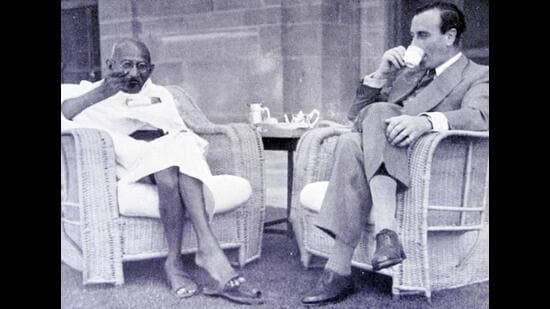
It was for this reason that he chose to be Indian in dress, custom, diet and deportment, shunning the debasing emulation of the rulers, and following the cultural idiom of his soil. He could speak the Queen’s English. He had been shaped by the institutions of the British Empire. He studied law in London and practised there as a barrister. Yet he wrote his first book, Hind Swaraj, in Gujarati. His effortless ability to belong to his own milieu, so different from the upper classes of Indians of the times — who were at best poor copies of the British — enabled him to meet the British on terms of cultural equality.
Equally, Gandhi was, as Nehru himself put it, “a Hindu to the depth of his innermost being.” During his jail terms in South Africa, he read Vivekananda’s Raj Yoga, commentaries on Yog Sutra, the Bhagwad Gita every day, the Upanishads, the Manusmriti, Patanjali’s Yoga Shastra, and also wrote an abridged version of Tulsidas’ Ramcharitmanas. But his Hinduism did not require the diminution of other religions. The Sermon on the Mount was among the Christian teachings that deeply influenced him. He engaged with Christianity, Islam, Jainism, Buddhism, and other traditions, not as someone standing outside religion and surveying it anthropologically,but as a believer searching for universal ethical truths within different faiths.
At the same time, his Indianness was not anti-western. He could correspond with Leo Tolstoy, John Ruskin, and Henry David Thoreau without feeling compelled to be defensive or hostile. His intellectual exchanges extended across continents, but his moral imagination remained anchored in India, profoundly rooted yet remarkably cosmopolitan.
{{/usCountry}}At the same time, his Indianness was not anti-western. He could correspond with Leo Tolstoy, John Ruskin, and Henry David Thoreau without feeling compelled to be defensive or hostile. His intellectual exchanges extended across continents, but his moral imagination remained anchored in India, profoundly rooted yet remarkably cosmopolitan.
{{/usCountry}}A civilisation has something distinctive to contribute when it knows what it is bringing to the table. This authenticity often bewildered the British and left them psychologically defeated. Charles Smith, who was Mountbatten’s butler in India, recalls what happened when Gandhi came one afternoon for tea at the Viceroy’s Palace. The tables in the garden were laden with scones and sandwiches, but he smiled benignly at his hosts and chose to “eat a bowl of curds he had bought. He even persuaded Lord Louis to sample a mouthful!” On another occasion, Gandhi responded to the urgent summons of Mountbatten in his own inimitable way. “Judge of my astonished delight,” Mountbatten recorded, “on my finding him enter my study with his finger to his lips to indicate that it was his day of silence. So I did all the talking. He scribbled a few friendly notes on the back of used envelopes.”
It would be easy to turn Gandhi’s cultural rootedness into an argument for cultural insularity. That would fundamentally misunderstand him. Gandhi’s Indian identity was not a fortress. It was a window. He stood firmly somewhere, and because he knew where he stood, he could look outward. He was a nationalist without being intellectually provincial.
India today is far more globally connected than Gandhi’s India could have imagined. Its economy, technology, universities, corporations and young people operate in a world without the cultural boundaries that once existed. But can Indians study at Harvard, work in Silicon Valley, speak good English, consume global culture and yet remain Indians without xenophobia or chauvinism? The key question is whether they can absorb what is desirable without losing the capacity to distinguish between assimilation and imitation. In fact, it is precisely because India is now so globally visible, that the question of cultural confidence becomes more — not less — important.
One of Gandhi’s great contribution was to pose the question: What does it mean to be modern and Indian simultaneously? An India, which does not want to be a nation of only mimic people, must answer this truthfully.
Pavan K Varma is an author, diplomat, and former Rajya Sabha MP. The views expressed are personal