On September 26, Maharashtra declared 265 of its 358 talukas drought-affected, following an 18.8% rainfall deficit between June and mid-September. The worst shortages hit Marathwada and adjoining regions. The government responded with crop-loan restructuring, land-revenue concessions, drinking-water tankers, fodder supplies and examination-fee waivers. These steps matter. Yet they address only the visible damage. Drought does not fall evenly across a household.
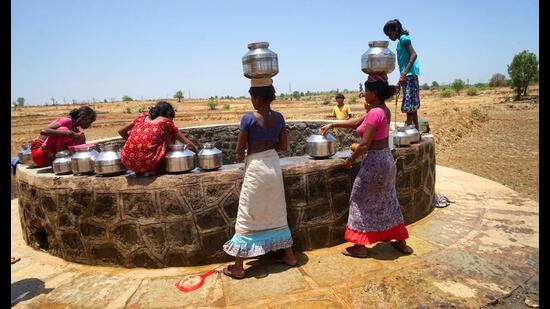
In rural India, the responsibility for drinking water, cooking, cleaning and livestock falls largely on women. When local sources fail, the distance and time required rise. Those extra hours rarely appear in loss assessments, but they crowd out paid work, rest, health care and schooling. A 2026 study by researchers affiliated with IIT Bombay records the human cost. Girls in Babhulgaon of Parbhani district in Maharashtra spent two to four hours a day collecting water during peak scarcity. The result was chronically being late to school, frequent absenteeism and even high chances of dropout. Women reported musculoskeletal pain, anaemia, heat stress and psychological distress.
Economic evidence points the same way. In dry years, the double burden is clear: falling agricultural income and expanding unpaid labour. India’s National Policy on Disaster Management, 2009, already recognises that disasters strike unevenly. It lists women, children, the elderly and economically weaker sections as especially vulnerable, and urges states to give special attention to women-headed households, farmers, artisans and marginalised groups while restoring livelihoods. Recognition, however, has not yet shaped the design of relief.
Standard drought packages focus on crop-loss assessments, loan relief and input support. They do not compensate the woman who loses productive hours collecting water, the landless labourer whose daily wages vanish, or the girl whose education is interrupted. Access itself is skewed. Women who farm but lack land titles often cannot claim benefits tied to formal ownership. Treating women as farmers in their own right, not merely as members of farming households, is an essential first correction.
{{/usCountry}}Standard drought packages focus on crop-loss assessments, loan relief and input support. They do not compensate the woman who loses productive hours collecting water, the landless labourer whose daily wages vanish, or the girl whose education is interrupted. Access itself is skewed. Women who farm but lack land titles often cannot claim benefits tied to formal ownership. Treating women as farmers in their own right, not merely as members of farming households, is an essential first correction.
{{/usCountry}}Compensation must recognise losses that conventional accounting overlooks. Livelihood assistance should reach women agricultural labourers, tenant farmers and those working on family land without titles; eligibility should rest on actual participation, not ownership alone. Self-help groups and local institutions can help identify and reach them. Water security must be treated as economic security: emergency supplies, functional village infrastructure, decentralised storage, rainwater harvesting and groundwater recharge need priority in the worst-hit settlements, with women given a meaningful voice in village water committees. Education relief must go beyond fee waivers to include transport support, attendance monitoring, school drinking-water facilities and targeted help for girls at risk of dropping out. A July 2024 Asian Development Bank Institute paper, Droughts: Learning Continuity and Recovery, linked successive Maharashtra droughts to declines in mathematics and reading scores and higher dropout rates, while highlighting preventive programmes in Karnataka that helped protect learning.
Drought is also a public health and nutrition emergency for women. Its consequences are particularly serious for pregnant or lactating women and adolescent girls, whose nutritional requirements demand special attention. When household incomes decline, and food becomes scarce or expensive, women are often the first to compromise on the quantity and quality of their own diets.
Relief packages must incorporate dedicated nutritional support through Anganwadi centres and the Public Distribution System, iron-folic acid supplementation, regular anaemia screening, mobile health camps and priority maternal healthcare. Pregnant and lactating women and adolescent girls in severely affected villages must be identified for targeted intervention.
For a farmer’s widow, the loss of her husband may also mean the loss of the principal cultivator and household income. Women without land titles, savings or family support face similar difficulties. Farmer widows should be recognised on the basis of their actual dependence on agriculture, rather than being excluded for lack of land ownership or inheritance documents. Gram Panchayats and women’s SHGs can help identify beneficiaries and ensure that assistance reaches those otherwise overlooked.
Finally, assessments themselves must change. Gender-disaggregated indicators on time spent collecting water, unpaid care work, lost agricultural wages, school absenteeism, and access to relief would make the full social and economic cost visible.
Maharashtra’s recurring droughts offer a chance to measure disaster differently. Success cannot be counted only in tankers deployed or loans restructured. It must also be measured by whether women regain livelihoods, girls stay in school, households secure reliable drinking water, maternal and adolescent nutrition is protected, and vulnerable women receive meaningful economic support.
Fauzia Khan is a former member of Parliament (Rajya Sabha). The views expressed are personal