Poor grades in 10th standard prompted Yadwinder Singh’s father, a small farmer of Rasulpur Khurd village in Amritsar, to issue his son an ultimatum.
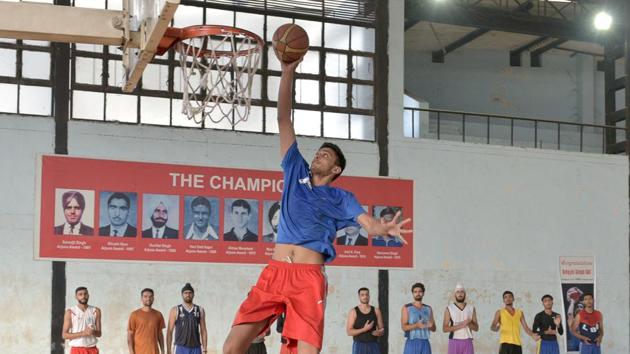
The 15-year-old Yadwinder was given two choices: either focus on studies or carve a career in sports. He was told he had no other option as the family was finding it hard to eke out a living from the two acres of ancestral land.
Yadwinder, then a state-level basketball player, chose the second option. The tall lad appeared for trials at the Ludhiana Basketball Academy (LBA), then in its first year of inception (2002), and the rest is history. Basketball not only gave him a decent living, but also helped him lift the socio-economic status of his family.
Besides being employed with the ONGC, Yadwinder has an annual contract of Rs 25 lakh with UBA Pro Basketball League, the men’s professional basketball league in India.
“When I joined the LBA as a teenager, I never thought basketball would help me reach this far. Even in my wildest of dreams, I could never imagine that a farmer’s son with such a small piece of landholding would ever able to live such a lifestyle and help his family. But basketball and LBA have made this possible,” says 30-year-old Yadwinder Singh, who is now based in Dehradun.
Looking back at the days when he had no money to even buy a pair of basketball shoes, he recounts, “I used to wear shoes till their soles were totally worn out. But since 2007, when I got a job in the Indian Railways, things started improving. Now I have no such worries in life.”
{{/usCountry}}Looking back at the days when he had no money to even buy a pair of basketball shoes, he recounts, “I used to wear shoes till their soles were totally worn out. But since 2007, when I got a job in the Indian Railways, things started improving. Now I have no such worries in life.”
{{/usCountry}}Basketball, a vehicle to better life
Yadwinder’s is not the one success story at LBA. Around 60 of its products, most of them from rural families, have got jobs in the government sector. And around a dozen of its players have an annual contract with UBA Pro Basketball League, ranging from Rs 6 lakh to Rs 45 lakh.
Buoyed by the success of his seniors, Gurwinder Singh, 18, son of a labourer from Malout in Punjab, also hopes basketball will help him in bailing out his family.
“My father is a daily-wager with a meagre monthly income of Rs 8,000. I know that if I work hard on the court, I will be able to get my family out of poverty,” says Gurwinder, member of the Punjab’s junior national gold-medal-winning team.
Because of the good performance in the junior circuit and an invitational tournament, Gurwinder, along with another junior player from the academy, Shail Kalyan, got selected for the senior national camp for the world qualifiers.
Out of the 12-member squad for the FIBA World Cup qualifiers, six — Arshpreet Singh Bhullar, Satnam Singh Bhamara, Gurvinder Singh Gill, Amritpal Singh, Palpreet Singh Brar and Jagdeep Singh Bains — are from the LBA—the highest number from any training centre or state unit in the country.
“Half the players in the current national squad are from the LBA. This speaks volumes about the credentials of this academy,” says the academy’s coach in-charge Rajinder Singh, a former services and Indian team coach.
“Most of our trainees are from very humble families, and the hunger to achieve something in life is the key to their success,” adds Teja Singh Dhaliwal, secretary of the Punjab Basketball Association.
“This year, 15 of our trainees have got jobs in various government departments, including Railways, Army and Punjab Police. A couple of days ago I got a call from a Colonel for recruiting players from our academy. Everyone knows that once a player is admitted to the academy, his career is secure,” says Dhaliwal.
Cradle of champion hoopsters
LBA has been churning out players for the national team for over 13 years now, but ever since its trainee Satnam Singh became the country’s first player to be drafted to the NBA (D League), LBA’s legacy has crossed the borders.
The latest success story is that of Amyjot Singh, who has made it to the NBA G-league.
“LBA has a rich legacy, which is getting richer with every passing year. People outside the country are also aware of the work the academy is doing to lift the standards of the Indian basketball,” says Satnam Singh, who is currently working on his fitness to make a comeback to the NBA.
LBA was started in 2002 and within a span of two years, two of its first-batch trainees, Jagdeep Singh and Yadwinder Singh, made it to the junior India team. Since then, there is no Indian team, in any age group, that has left the Indian shores without a LBA player in its ranks.
The academy received a big boost during the 2011 Asian Basketball Championship in WuHan China, when half of the Indian men’s squad was from the academy.
Out of 12 members, six, including Satnam, Jagdeep, Yadwinder, Amyjot, Amritpal and Talvinderjeet, were LBA products.
This year, Punjab has won both the youth and junior national championships, thanks to the LBA trainees.
“We now hope to lift the senior national title as well,” says chief coach, Rajinder Singh, who joined the academy in October 2015.
“We started the academy to not only produce top-class cagers, but also to uplift the country’s basketball standards. And Satnam’s selection in NBA in 2015 and now Amyjot’s entry to the NBA G League is a proof of the hard work put in by the academy’s coaches,” says former Basketball Federation of India president RS Gill, the architect of LBA in May 2002.
“Former India coach S Subramanian is the person behind the rise of LBA. He was the first coach-in-charge of the academy. It’s because of him that many youngsters were able to carve a career in the sport,” says Gill, fondly remembering Subramanian, who passed away in 2013.