
 E-Paper



Photos: Living off garbage in South Africa’s Johannesburg
In South Africa’s Johannesburg, an estimated 6,000 waste-pickers make a living by collecting other people’s garbage. In what is pitted as the most unequal country in the world owing to economic disparities, lack of job creation and high rates of unemployment have made people take to this profession. On one hand, the country has the most millionaires and billionaires of any sub-Saharan African nation. On the other hand, almost half of the population of 55 million is considered chronically poor.
Updated on: May 15, 2019 1:02 PM IST

Share via


Copy link

1/10

 View Photos in a new improved layout
Updated on May 15, 2019 1:02 PM
A waste-picker pulls a trolley of salvaged recyclable material along the road as the sun rises in a wealthy suburb of Johannesburg, South Africa. An estimated 6,000 waste-pickers in Johannesburg who live off other people’s garbage in what the World Bank calls the most unequal country on earth. A legacy of apartheid, inequality remains so ingrained that the ruling African National Congress hasn’t been able to narrow the wealth gap since taking power 25 years ago. (Waldo Swiegers / Bloomberg)
2/10
 View Photos in a new improved layout
Updated on May 15, 2019 1:02 PM
Luyanda Hlatshwayo, a waste-picker, lifts a bag of garbage from a bin placed outside a residence. The 35-year-old university dropout often makes the 8-kilometre trip on an empty stomach—he can only afford to eat twice a day. Time is precious because he must salvage as many recyclables as possible—tin cans, plastic bottles, cardboard boxes—before the city garbage trucks arrive. (Waldo Swiegers / Bloomberg)
3/10
 View Photos in a new improved layout
Updated on May 15, 2019 1:02 PM
In Johannesburg, waste-pickers are also key to the local economy. They collect as much as 80 percent of post-consumer packaging and paper material, making South Africa’s recycling rate equivalent to that of some Western European countries. Municipalities save up to 750 million rand a year in landfill costs, Samson said, citing industry data. (Waldo Swiegers / Bloomberg)
4/10
 View Photos in a new improved layout
Updated on May 15, 2019 1:02 PM
A waste-picker sorts recyclables at an abandoned school. Their lunch consists of strips of grilled meat while they quickly fill seven man-sized bags, some so heavy that they require three people to lift them on a trolley. They don’t sit down once. “Tym is money” is spray-painted on one of the school yard’s walls. (Waldo Swiegers / Bloomberg)
5/10
 View Photos in a new improved layout
Updated on May 15, 2019 1:02 PM
CEOs and top lawyers make as much as 20 million rand ($1.4 million) a year while the official minimum wage is 20 rand ($1.40) an hour. South Africa has the most millionaires and billionaires of any sub-Saharan African nation, and that number is expected to rise significantly in the next eight years, according to Mauritius-based AfrAsia Bank. At the same time, almost half of the population of 55 million is considered chronically poor. (Waldo Swiegers / Bloomberg)
6/10
 View Photos in a new improved layout
Updated on May 15, 2019 1:02 PM
A waste-picker salvages recyclable material from bins placed outside residences. The contrast between rich and poor is particularly striking in Cape Town, one of the world’s top tourist destinations, and Johannesburg, a sprawling city built by migrants that’s home to no less than 20 top-ranked golf courses and about 19,000 dollar millionaires, almost half the country’s total number of high-income individuals. (Waldo Swiegers / Bloomberg)
7/10
 View Photos in a new improved layout
Updated on May 15, 2019 1:02 PM
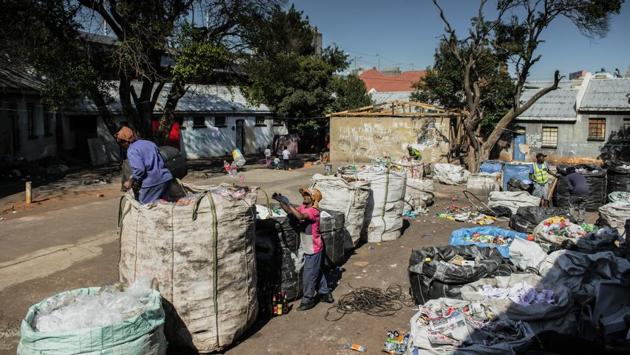
Waste-pickers sort recyclables at an abandoned school. The African National Congress government has lifted more than 2 million people out of poverty, improved access to basic services and rolled out an impressive social-assistance program.South Africa’s high unemployment rate, currently at 27 percent, remains the single biggest obstacle to helping the poor, according to the World Bank. (Waldo Swiegers / Bloomberg)
8/10
 View Photos in a new improved layout
Updated on May 15, 2019 1:02 PM
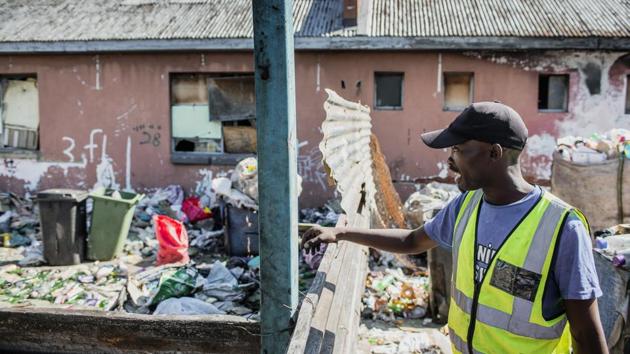
While many wear balaclavas to avoid being recognized as waste picker, Hlatshwayo isn’t ashamed of what he does. He calls it “a back-up plan.” He’s part of an association that’s registering all the waste-pickers in the city and helped organise a march this month to demand the municipality halt any plans to hire private recycling companies. (Waldo Swiegers / Bloomberg)
9/10
 View Photos in a new improved layout
Updated on May 15, 2019 1:02 PM
A waste-picker pushes a trolley of salvaged recyclable material. “There’s a tremendous stigmatization around being a reclaimer, but they are solving our waste problem and created their own jobs in the context of unemployment,” said University of the Witwatersrand academic Melanie Samson. (Waldo Swiegers / Bloomberg)
10/10
 View Photos in a new improved layout
Updated on May 15, 2019 1:02 PM


