From taking over municipal schools and college hostels for establishing quarantine facilities to declaring the entire city as a containment zones, Pune has seen it all since the first Covid-19 (coronavirus) case was reported 100 days ago.
Pune reported its first Covid-19 positive case on March 9, which was also the first to be recorded in the state. After 100 days, the Covid-19 tally in Pune stands at 10,183 cases and 1,10,744 cases (June 15) in Maharashtra.
Over 100 days, the city has seen multiple flu clinics, dedicated Covid-19 hospitals and health centres come up with the civic body putting in all its efforts to tackle the spread of virus.
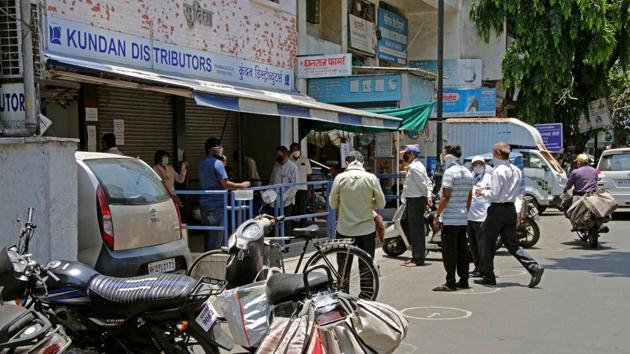
The Covid-19 pandemic has altered the lives of residents, bringing various behavioural changes such as social distancing, wearing masks in public among others. One of the city’s busiest market destination, Tulshibaug, had been out of bounds for two-and-a-half months, a scene Pune had never witnessed. The entire Pune metropolitan region, including Pune and Pimpri-Chinchwad, had been declared a containment zone between April 19 and April 27, putting about 7.5 million people of an entire city under strict lockdown, which was the first of its kind in the country.
Currently, while the worst-affected wards of Bhavani peth and Patil estate slums are showing an improvement, Aundh-Baner wards, which were on the verge of being declared green zones, are now steadily reporting more cases. There are 66 containment zones spread across 9.28 square kilometers, mostly in the central areas of the city.
{{/usCountry}}Currently, while the worst-affected wards of Bhavani peth and Patil estate slums are showing an improvement, Aundh-Baner wards, which were on the verge of being declared green zones, are now steadily reporting more cases. There are 66 containment zones spread across 9.28 square kilometers, mostly in the central areas of the city.
{{/usCountry}}“With time, we decided to go for smaller containment zones which made it easier for us to manage and control the spread of the virus. We focused on flu clinics, mobile clinics and mobile swab collection centres. Pune city fortunately did not face any shortage of beds, personal protective equipment (PPE) kits or any resources till now. We succeeded in bringing down the death rate from 10 per cent to four per cent. We took over college hostels, municipal schools and even signed MOUs with over 10 hospitals to deal with the Covid-19 pandemic,” said Shekhar Gaikwad, Pune municipal commissioner. The Pune Municipal Corporation (PMC) has so far set up 30 Covid care centres, 11 dedicated Covid health centres and 25 dedicated Covid hospitals.
However, the frontline workers are still facing problems of coordination with government bodies. Dr Avinash Bhondwe, Indian Medical Association (IMA) Maharashtra state president, said, “The government keeps bringing in more notifications without keeping us in the loop and doctors along with the common public has to rely on the media for accurate information. Patients suffering from other ailments have been ignored completely.”
The city has also lost three of its police officials and seven PMC staff members to Covid-19. Government bodies at various levels including central, state and local civic bodies announced a collective compensation of Rs one crore for the next of kin of these frontline workers.
Ravindra Shisve, joint commissioner of police, says, “Our anticipation that this will grow into a bigger challenge helped us take charge of the situation. We ensured the wellness and welfare of our staff which is why no one complained of any shortage of masks. The challenge for us was to ensure that there is a check on crime in the city and also see that our staff is not exposed to the virus. Exposure of even one official meant that the entire police station would have to be shut. During this time, while we advocated social distancing, our men worked tirelessly in containment zones.”
The situation also shed light on poor urban planning as the worst-affected cities reported more cases from slums- be it Mumbai’s Dharavi or Pune’s Tadiwala slum or Janata vasahat. Ramchandra Gohad, a town planner, said, “Health and urban planning is linked. The reason for growth of slums in cities also shows the poor execution of government schemes like SRA and MHADA.”