The pandemic has altered all sectors of life, including education, wherein it has created a requirement for institutions to adapt to technology to ensure the flow of knowledge isn’t disrupted.
Covid-19 has also brought into focus the healthcare system of the country, and its shortcomings, highlighting how medical education requires an innovative and prompt response from educators.
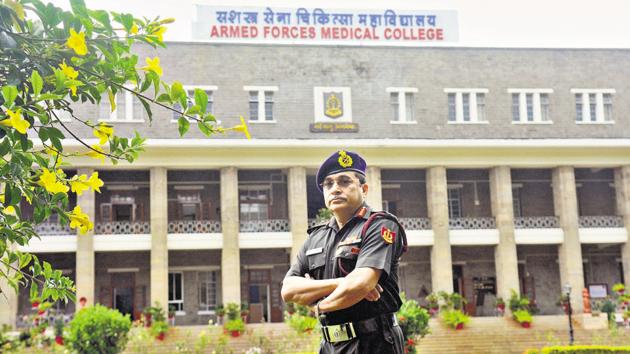
With the National eligibility-cum-entrance test (NEET) scheduled for September 13, one of the premier medical institutes in the country, the Armed Forces Medical College (AFMC) in Pune, is all set to induct a new batch of students in October/November - keeping in mind the Covid-19 guidelines.
“The admission process which includes computer-based tests, interviews, documentation and medical examination, will be undertaken keeping in mind all precautions against the Sars-CoV-2 virus which causes the Covid-19 infection. A detailed standard operating procedure (SOP) has been designed enlisting all the necessary precautions required in the post-Covid world,” said Lt Gen Nardeep Naithani, director and commandant, AFMC.
AFMC being a residential programme requires students to stay on campus for their duration of studies.
{{/usCountry}}AFMC being a residential programme requires students to stay on campus for their duration of studies.
{{/usCountry}}In the post-Covid world, physical distancing is key and AFMC has ensured robust infrastructure is in place to comply with Covid-19 guidelines.
A dedicated team is in place to make sure that SMS – sanitisation, mask and social distancing guidelines - are followed in letter, and spirit, on campus.
“AFMC is concentrating on four verticals - preventive measures, clinical measures, developing testing capability and research - to tackle Covid-19. Preventive measures include IEC and disinfection; clinical verticals involves patient care and formulation of protocols/SOPs; along with developing the testing capacity and research. Hand sanitisation stations have been installed, staff members have been equipped with infra-red temperature monitoring devices at various locations and wearing of masks has been made mandatory,” read a statement from the AFMC on Covid-19 protocols.
On plans to have students back on campus, the Commandant said, “Medical cadets at the beginning of the pandemic, as a preventive measure, were sent back to their hometowns. There is a plan to re-induct medical cadets in a phased manner. Such cadets will be screened, quarantined at a special facility on campus, be provided packed food in the rooms for first 14 days and also given housekeeping and laundry services, among others.”
Such measures at the institute are already up and running as the AFMC inducted a new batch of PG residents (2020-23) into the college in the second week of June.
“All the officers were placed in quarantine for a stipulated time and inducted into AFMC, thereafter,” added Lt Gen Naithani, who is hopeful that with the measures in place, the process of induction of medical cadets in the post-Covid world will reach a state of normalcy.
The institute already has some experience handling candidates during the pandemic, as in the second week of July, AFMC undertook counselling for priority V (civilian) candidates for entry into post-graduation courses in armed forces hospitals.
“Civilian candidates from across the country participated in the counselling, which included a thorough medical examination. This gave us an opportunity to audit our preventive measures and SOPs,” added an official from the AFMC, who is aware of the developments.
The pandemic put the spotlight on the number of doctors and nurses in the country and AFMC is an apex training institute for MBBS, specialist, super-specialist doctors and paramedics.
However, the institute is not looking at expanding its number of seats.
“The college does not envisage increasing the number of seats at this point of time. The implementation of online and distance-learning courses has ensured that teaching reaches beyond the boundaries of AFMC. The online classes have been ‘live’-streamed to various armed forces hospitals across India and hence, expertise has not been restricted to limited numbers,” explained Let Gen Naithani.
AFMC and Covid-19 research
AFMC was part of the principal secretaries advisory panel for developing inventory for scaling of bedded hospitals for Covid scenario in the country.
AFMC is also involved in national capacity building in collaboration with ICMR.
The innovations cell at AFMC has been working in clinical and medical fields like innovative medical equipment (ventilators) to tackle the pandemic.
The Ministry of Defence has begun work on setting up 10 new laboratories across the country, primarily to conduct research on viruses in collaboration with the Indian Council of Medical Research (ICMR). One of these is proposed at AFMC. Dates for setting up of the lab at AFMC are currently under consideration at ICMR.
AFMC is also part of the principal scientific advisor’s initiative on mental health which will be the national digital wellness programme.
On campus
Do
Thorough medical examination for all inducted Cadets and after induction, 14-day mandatory quarantine
‘SMS protocol’– Sanitise, wear a mask and maintain social distancing on campus
Don’t
Socialise on campus or crowd classrooms
Fail to declare if you are witnessing symptoms or have been in contact with a Covid-19 positive patient
Know the Commandant
Lt Gen Nardeep Naithani took over as director and Commandant of AFMC on December 1, 2019.
Prior to the present appointment, he served as MG Medical, HQ Central Command.
He is a graduate of AFMC and was commissioned in the Army Medical Corps on December 27, 1982.
He is a physician and has done his post graduation in Gen Medicine from AFMC.
Lt Gen Naithani was the professor and head of the department of internal medicine from 2012- 2014.
Lt Gen Naithani had commanded Military Hospital, Wellington and Command Hospital (Northern Command) at Udhampur, J&K.
Lt Gen Naithani has commanded Officers Training College, Lucknow wherein he was instrumental in formulation of doctrine on Tactical Combat Casualty Care.
For his distinguished services he has been awarded the COAS commendation twice in 1988 (57 Engr Regt) and 2016 (MH Wellington) and GOC-in-C (SC) commendation in 2013.