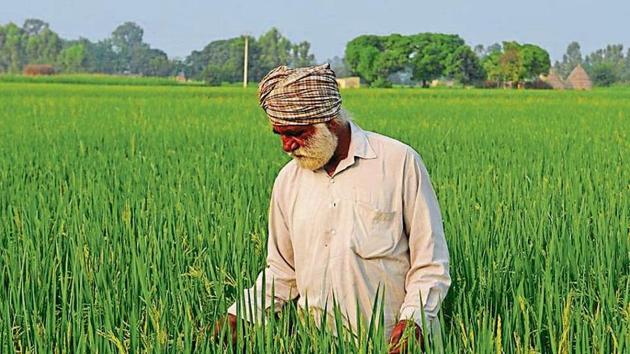
Punjab is expecting to achieve the highest ever productivity of paddy — around 64 quintals per hectare — this time.
But this good news is so far lost in the smoke that fields in the state are emitting due to stubble burning, causing a big outcry in the national capital. Dense smoke has engulfed skies from Lahore to New Delhi for which Punjab and the neighbouring Haryana are being blamed.
“Punjab farmers are on the threshold of achieving a landmark. We are expecting to touch the highest ever paddy production. But no one is talking about it. Instead, our farmers are being rebuked for causing environmental nuisance,” said state agriculture director JS Bains while talking to HT.
He said per hectare production of paddy is likely to be around 64 quintals this year. “It was 61.93 quintal last year and is expected to increase by two quintals this time,” he said.
Despite a fall of at least one lakh hectare in the total area under paddy cultivation in the current kharif season, the production this year is expected to touch the last year’s production of 188 lakh tonne. During the last kharif season, 30.4 lakh hectares was under paddy cultivation, but the area has come down to 29.26 lakh hectares this year.
Currently, state procurement agencies have made arrangements to procure 182 lakh tonne paddy. “In case, more paddy arrives in the mandi, we are prepared to procure it,” said a top official of the state food and civil supplies department. Already, 165 lakh tonne produce has reached the mandis of the state and the procurement will go on till December 15. “We have no time to rejoice, but we want to defend our farmers after the smog has engulfed the region,” said Bains.
Must read | Stubble burning blamed for Delhi pollution: Why farmers carry out the exercise
{{/usCountry}}Must read | Stubble burning blamed for Delhi pollution: Why farmers carry out the exercise
{{/usCountry}}Bir Dalwinder Singh, a paddy farmer from Kalar Majri near Nabha, said, “Despite making our best efforts and achieving a benchmark in productivity, the farmers are looked down upon because they are blamed for environmental crisis. Nobody is there to support him.” He said the minimum support price (MSP) of paddy only includes the cost of cultivation. “It doesn’t include the component of crop residue management, which is a major issue.”
Talking to HT, Punjab Agricultural University (PAU) vice-chancellor BS Dhillon said it is good news that the productivity of paddy has started increasing in Punjab, after remaining stagnant for many years.
He added, “Two non-basmati varieties of our university — PR 126 and PR 121 — have shown good results. These varieties were sown over 69% of the total area under paddy. Plus, scanty rainfall in Punjab also brings good crop, because weather conditions remains under control.”
Speaking on farmers getting brickbats due to smog, despite good productivity, Dhillon said, “It is understandable that peasantry is going through a tough time, but it doesn’t mean farming causes harm to society and environment.”
WHEAT SOWING TO BE DELAYED
Speaking on the impact of stubble burning on the next crop, Dhillon said that due to poor sunshine amid the prevailing smog, wheat sowing will get delayed this time, which can have a negative impact on the productivity.
“The ideal wheat sowing time is around November 10, but due to smog and lack of sunshine, farmers are waiting for conducive weather conditions,” he added.