The glitz and glitter of the festive season hide its dark underbelly, which is manifested in various ailments caused by the polluted air, noisy surroundings, and toxic waste.
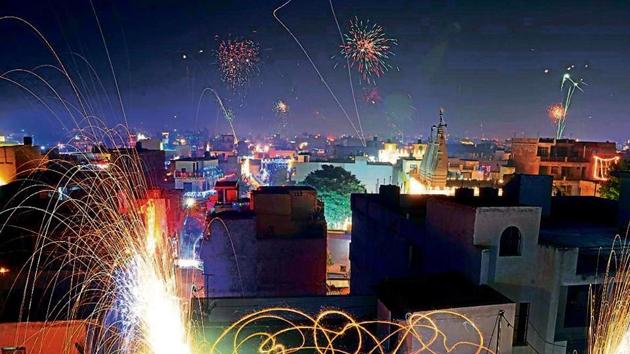
Every year, crackers burnt on Diwali release a massive amount of pollutants in a short time. A cracker is generally made by tightly packing potassium, carbon nitrate and sulfur in several layers of paper. In the beginning, the aim was to create a loud bang, but increasingly crackers also emit a large number of colours. While it is difficult not to admire the riot of colours in the sky, the toxins emitted in the air are harmful for the lungs.
Prafulla Chandra, a senior research fellow at the Indian Institute of Science Education and Research (IISER), Mohali, says Sulfur Dioxide (SO2), when inhaled in high concentration, damages the lung tissues and triggers respiratory ailments.
In 2016, the ambient concentration of SO2 on Diwali night (a 12-hour average from 6:00 pm to 6:00 am) was 118 ug m-3 , which was 23 times higher than the concentrations observed on the pre Diwali night.
Prafulla further warned that SO2 also causes irritation in the nose and mouth as it can form aggressive sulphur containing acids on reacting with moist surfaces inside the body leading to the destruction of the tissues.
In 2016, the ambient concentration of particulate matter (PM2.5) on Diwali night was as high as 1100 ugm-3 , which was five times higher than the concentrations observed on the pre –Diwali night. Particulate matter consists of tiny particles in the air that cause the air to appear hazy and reduce visibility.
The smaller the particles, the deeper they can penetrate into the respiratory system and the more hazardous they are to breathe. Particulate matter was declared as Class 1 cancer-causing agent (carcinogen) in 2013 by the International Agency for Research on Cancer (IARC). PM2.5 particles cause lung irritation, aggravate chronic lung diseases, and cause changes in blood chemistry resulting in clots and cardiovascular diseases.
What doctors say
The annual light and sound festival can have quite an adverse impact on your health. Whether it manifests in the form of respiratory diseases, eye infections, or burns, doctors across hospitals in the tricity witness a sudden surge in the number of patients flocking to them.
Dr A K Janmeja, head of pulmonary medicine, GMCH, Sector 32, told HT, “The rise in air pollution during this period leads to a stark increase in respiratory problems among people, especially those suffering from asthma, bronchitis or other allergies.”
He added that the inflammation caused due to poor air quality makes it doubly difficult for people battling respiratory disorders.
{{/usCountry}}He added that the inflammation caused due to poor air quality makes it doubly difficult for people battling respiratory disorders.
{{/usCountry}}The hospitals also see an increase in the number of accidents caused due to unruly traffic and choked roads, which prompt commuters to throw rules to the winds.
“Every year, we see a surge in the number of accident cases around Diwali,” said Dr Janmeja, adding that doctors work round the clock on the D-day to treat patients suffering from the side-effects of this festival.
Older people are more susceptible to flu or pneumonia during this period. Eye-related injuries and burns are commonplace among patients across all government and private hospitals during Diwali.
But while the Diwali air may not be healthy, the festive cheer does wonders for patients. Dr B S Chavan, head of psychiatry department, GMCH 32, said he had noticed a decline in mental health ailments and stress-related issues during this period.
“People are usually happy during such festivals as they get to spend time with their loved ones. Even if there are minor concerns, they overlook them to join in the festivities”