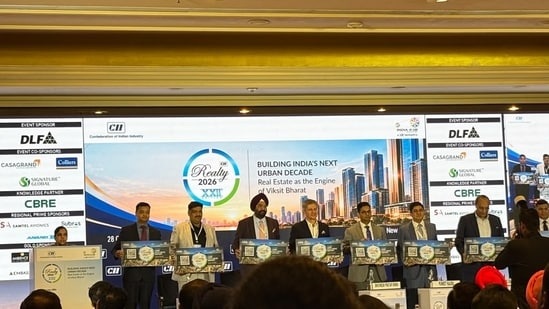
India’s retail real estate market recorded approximately 5.8 million sq ft of space absorption in the first nine months of 2026, registering a year-on-year increase of around 19%, according to a CBRE Research report released at the 22nd edition of CII Realty 2026 in New Delhi on October 28.
Delhi-NCR led retail space absorption during January-September 2026, with approximately 1.9 million sq ft leased, followed by Mumbai at around 1 million sq ft and Hyderabad at approximately 0.9 million sq ft.
Amid inflationary pressures, cautious consumer sentiment and limited supply, retailers focused on calibrated expansion, long-term store performance and profitability. Delhi-NCR, Mumbai and Hyderabad together accounted for approximately 67% of total space absorption during the period.
India added around 1.8 million sq ft of new retail supply in the first nine months of 2026, with Delhi-NCR and Mumbai leading, the report noted.
During the July-September quarter, retail space absorption stood at approximately 2 million sq ft, supported by around 0.9 million sq ft of new supply. Delhi-NCR, Mumbai and Hyderabad collectively accounted for more than 69% of leasing, with fashion and apparel and food and beverage (F&B) leading occupier demand.
Industry leaders and policymakers gathered at the event to discuss investment, housing affordability, regulatory reforms and sustainable urban development under the theme ‘Building India’s Next Urban Decade: Real Estate as the Engine of Viksit Bharat.’
{{/usCountry}}Industry leaders and policymakers gathered at the event to discuss investment, housing affordability, regulatory reforms and sustainable urban development under the theme ‘Building India’s Next Urban Decade: Real Estate as the Engine of Viksit Bharat.’
{{/usCountry}}The report was released in the presence of Bhuvnesh Pratap Singh, director, Department for Promotion of Industry and Internal Trade (DPIIT); Abhinav Joshi, head of research for India, the Middle East and North Africa at CBRE; and Ashwinder R Singh, chairman of the CII Northern Region Committee on Real Estate and vice-chairman and CEO of BCD Group.
Regulatory reforms and ease of doing business
Bhuvnesh Pratap Singh said India aims to reduce the cost of regulation by 70-80% by 2036 through digitisation and automation. As the country progresses towards Viksit Bharat 2047, he said, it is important to ensure that development remains inclusive.
He highlighted measures to improve the ease of doing business, including the removal of more than 47,000 compliance requirements. Relaxed floor area ratio (FAR) norms in certain unplanned areas could also create development opportunities beyond established metropolitan centres.
Simpler building-plan approvals, reduced repetitive documentation, and fewer unnecessary inspections are important to improving regulatory efficiency, he said, urging industry stakeholders to propose specific and practical reforms. Greater use of artificial intelligence, digitisation and startup-led solutions could further support these efforts.
Boman Rustom Irani, Chairman and Managing Director, Rustomjee Group, and Conference Chairman, highlighted the scale of India’s urbanisation, noting that the urban population could grow from approximately 55 crore to 100 crore by 2047. This will create significant demand for housing, infrastructure and jobs. He called for an affordable housing framework that reflects household needs while keeping projects viable, and highlighted public land as a potential resource for affordable homes. Large-scale redevelopment, particularly in cities such as Mumbai, could also unlock urban potential.
Fashion and apparel lead retail leasing
Fashion and apparel brands accounted for 39% of retail leasing during the first nine months of 2026, making them the largest driver of demand. Domestic retailers accounted for 73% of leasing, followed by brands from Europe, the Middle East and Africa (EMEA) at 11%, the report noted.
Continued store expansion, modernisation and growing interest in experience-led formats supported demand.
Also Read: More malls to come up in Delhi than Gurugram and Noida over the next three years
New retail supply
India added approximately 1.8 million sq ft of retail space during the first nine months of 2026. Delhi-NCR contributed around 1.3 million sq ft, while Mumbai added approximately 0.5 million sq ft. Key additions included DLF Midtown Plaza, DLF Summit Plaza and Felix Plaza in Delhi-NCR, along with the Outlet Mall of India in Bhiwandi, Mumbai.
Leasing is expected to remain healthy through the rest of the year, with fashion and apparel continuing to be the largest driver of demand. Café chains and restaurants are expected to support F&B growth, alongside demand from traditional jewellers, lab-grown diamond retailers and entertainment operators, the report noted.
“With limited availability of quality space in prime locations, secondary and peripheral locations are expected to emerge as major retail destinations, driven by the Grade A mall pipeline and improving infrastructure. This is also likely to catalyse the development of new high streets across these markets,” said Ram Chandnani, managing director, leasing services, India, at CBRE.
Industry calls for demand-led development
Addressing a session at the event, Anil Saraf, chairman and managing director of ASF Group of Companies, called for disciplined, demand-led development and cautioned against launching projects without adequately assessing end-user requirements.
He stressed the need to balance investor interest with genuine housing demand, particularly in the middle-income and rental housing segments, as some households increasingly prefer renting to homeownership. Changing migration patterns could also create opportunities beyond established metropolitan centres, he said.
Ashwinder R Singh said India’s real estate market, valued at approximately $500 billion, is projected to reach $1 trillion by 2030. Achieving this target would require the sector to add around $125 billion annually, he said.
He highlighted challenges in affordable housing, noting that sales of homes priced below ₹50 lakh fell 23% in the first quarter, while affordable housing accounted for only 6% of new launches in the previous quarter. “Widening access to first homes and home loans will be crucial to ensuring inclusive growth,” he said.
Pradeep Agrawal, chairman of Signature Global, said listing can improve companies’ access to capital while strengthening governance, compliance and self-regulation.
“The process is similar to RERA registration, which helped build customer trust in the real estate sector,” he said, addressing a session at the CII event.