Walk into almost any modern high-rise, and you'll notice an unusual quirk: the elevator buttons jump straight from the 12th floor to the 14th. While skipping the 'unlucky' number 13 may appease age-old superstitions, real estate regulators see it differently. If a building's on-site floor numbering does not match its government-approved plans, homebuyers could face complications ranging from delays in property registration to tax record mismatches, home loan hurdles and even difficulties when reselling the property.
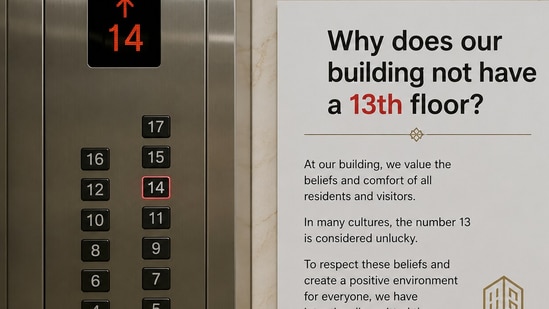
When Fahim Lakdawala bought an apartment in a Mumbai residential project, he believed he was purchasing a home on the 13th floor. However, his first property tax bill listed the apartment as being on the 14th floor. When he sought an explanation, the developer told him that the building had skipped the number 13 because it is considered unlucky. While the apartment was physically and legally on the 13th floor, the developer had renumbered it as the 14th floor, assuring Lakdawala there was nothing to worry about.
An administrative nightmare
Legal experts say developers cannot arbitrarily renumber floors or flats after obtaining sanctioned plans, as any mismatch between approved documents and on-site numbering can create legal and administrative problems for homebuyers.
While MahaRERA declined relief in the case because the project was already complete, it observed that the developer had deviated from the sanctioned plan and held that any future issues arising from the numbering scheme would be the promoter's responsibility to rectify.
{{/usCountry}}While MahaRERA declined relief in the case because the project was already complete, it observed that the developer had deviated from the sanctioned plan and held that any future issues arising from the numbering scheme would be the promoter's responsibility to rectify.
{{/usCountry}}Experts warn that discrepancies between sale agreements, approved plans, property tax records, and society documents can delay property registration and complicate home loan approvals, utility connections, and future resale transactions.
If developers wish to avoid the number 13 due to market preferences or superstition, they should do so at the planning stage by incorporating it into the approved building design rather than renumbering floors after approvals.
"Although MahaRERA declined to grant any relief since the project had already been completed, it observed that the developer had violated the sanctioned plan wherein the 13th floor is shown, but the flat numbers are not numbered as such. Significantly, the MahaRERA directed that if, in future, members owning flats above the 13th floor face any issues arising from the adopted numbering scheme, it would be the Promoter's (developer's) responsibility to rectify the defect. While the order does not define the scope of such \"defect,\" developers should be responsible for ensuring that such nomenclature does not create legal or administrative complications for purchasers," said Trupti Daphtary, an advocate and solicitor based in Mumbai.
"For homebuyers, this order serves as a reminder to verify whether the flat number mentioned in the agreement for sale, approved plans, property tax bills and society records are consistent. Any discrepancy in floor or flat numbering may lead to practical issues in property registration, property tax records, home loans, utility connections, or future resale transactions," said Daphtary.
A developer should not renumber flats or floors in a manner contrary to the sanctioned plans. “Such renumbering may create significant legal and practical issues for flat purchasers in the future, particularly at the time of resale. Banks, financial institutions, and statutory authorities may raise queries or seek clarifications when the numbering in the approved sanctioned plans does not correspond with the actual numbering adopted by the developer," said Sunil M. Kewalramani, proprietor at Sunil M Kewalramani and Associates.
"If a developer wishes to avoid the number ‘13’ due to market preferences or superstitious beliefs, the appropriate course is to address the issue at the planning stage itself. While obtaining approval of the sanctioned plans, the developer may designate the 13th floor for amenities, common facilities, or, wherever permissible under the applicable building regulations, as a refuge floor, instead of arbitrarily renumbering the floors after obtaining approvals," Kewalramani said.
A numbering mismatch may create discrepancies across four critical documents
A mismatch in floor or flat numbering can create inconsistencies across several key records, including the agreement for sale, property tax records, municipal utility connections (such as electricity and water), and housing society records.
If your sale agreement says Flat 1402 (14th Floor), but the official sanctioned plan lists it as Flat 1302 (13th Floor), financial institutions may freeze your application, experts say.
The fire safety or refuge floor or a fire safety zone
It can also create confusion over designated refuge or fire safety floors.
Experts warn that developers cannot convert a planned refuge floor into residential units merely to avoid the number 13, as this could compromise fire safety and violate approved plans. If a developer wishes to skip the number 13, it should do so lawfully during the planning stage by designating that floor for amenities, common areas or, where permitted, a refuge floor, rather than just slapping a ‘14’ sticker on it later.
How to verify your floor before buying
Check the RERA portal: Log onto the state's RERA website, look up your project's registration number, and download the sanctioned building plan.
Count the slabs physically: Don't trust the elevator buttons. Physically count the structural floors from the ground up to verify exactly which slab your apartment sits on.
Demand an indemnity clause: In light of the latest MahaRERA order, ensure your legal counsel inserts a clause stating the promoter (developer) is entirely responsible for rectifying any future legal or tax defects arising from floor numbering discrepancies.