An international team of scientists has confirmed the existence of a sizable cave on the moon, potentially paving the way for future lunar habitats. The cave is located just 400 kilometres from the Apollo 11 landing site in the Sea of Tranquility, where astronauts Neil Armstrong and Buzz Aldrin made their historic moonwalk 55 years ago.
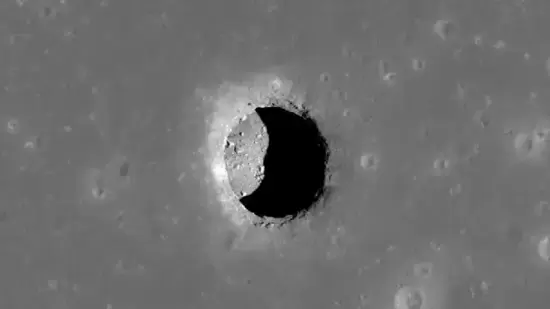
The discovery was made by an Italian-led research team who analysed radar data collected by NASA's Lunar Reconnaissance Orbiter (LRO). Their findings, published Monday in the journal Nature Astronomy, reveal that the Mare Tranquillitatis pit, the deepest known pit on the Moon, leads to a cave approximately 45 meters wide and up to 80 meters long. The cave, which lies about 150 meters beneath the lunar surface, is roughly equivalent in area to 14 tennis courts.
Read: NASA astronauts perform 'moonwalk' in Arizona desert to prepare for Artemis III lunar mission
Lorenzo Bruzzone from the University of Trento in Italy described the cave as “probably an empty lava tube,” suggesting that such features could serve as natural shelters for future lunar explorers. These underground structures could provide protection from the moon’s harsh environment, including cosmic rays, solar radiation, and micrometeorites, while maintaining relatively stable temperatures inside.
“Lunar caves have remained a mystery for over 50 years. So it was exciting to be able to finally prove the existence" of one, Leonardo Carrer and Lorenzo Bruzzone of the University of Trento, wrote in an email, reported Associated Press.
{{/usCountry}}“Lunar caves have remained a mystery for over 50 years. So it was exciting to be able to finally prove the existence" of one, Leonardo Carrer and Lorenzo Bruzzone of the University of Trento, wrote in an email, reported Associated Press.
{{/usCountry}}The research indicates that this cave, along with the more than 200 other pits identified on the moon, likely formed through the collapse of lava tubes—large underground tunnels created by ancient volcanic activity. These lava tubes could offer significant advantages for establishing lunar bases, as they require fewer construction efforts and provide inherent structural protection.
“Lunar orbiters first spotted pits on the moon more than a decade ago,” said Leonardo Carrer, the study's first author. “Many are thought to be skylights that connect to underground caves, such as lava tubes.”
The bottom of the Mare Tranquillitatis pit, previously imaged by the LRO, was known to be strewn with boulders up to 10 meters wide. However, the extent of the pit’s connection to an underground cave was uncertain until now. The new data and computer simulations confirm that the 100-meter-wide pit has a sloping floor leading to the cave, extending tens of meters westwards.