Soon after he returned to his training base in Delhi's Chhatrasal Stadium after winning a bronze medal at Paris Olympics two years back, wrestler Aman Sehrawat sat with his coach Lalit Kumar for a dispassionate review.
"There were a few technical issues. He was still very young, his body was still developing, so there were a few techniques he couldn't implement. But with Los Angeles 2028 on our radar, it was time to start afresh," Lalit said.
As is the tradition in Chhatrasal, the Olympic medallist gets to move from a twin-sharing room to a spacious, single room. Among the first things Aman did while setting up his dwelling was print out the Olympics gold medal and paste it on the wall. 'If it was easy, everyone would do it,' read a caption alongside it. And thus began Aman's journey of rediscovery.
Lalit listed out the areas to work on: leg defence, counterattacks, physicality. He assembled some of his best trainees across weight divisions and made Aman wrestle with them.
"Olympics was a chastening experience. He won the medal but we knew he could achieve much more," the Dronacharya awardee said. "We knew his tendency to concede early points. It doesn't hurt you at the age-group level but elite wrestlers will exploit that weakness. His attacks needed to be sharper. He needed to work on his counters as well. We also thought he needed to up his power, so we intensified his workouts," the coach added.
{{/usCountry}}"Olympics was a chastening experience. He won the medal but we knew he could achieve much more," the Dronacharya awardee said. "We knew his tendency to concede early points. It doesn't hurt you at the age-group level but elite wrestlers will exploit that weakness. His attacks needed to be sharper. He needed to work on his counters as well. We also thought he needed to up his power, so we intensified his workouts," the coach added.
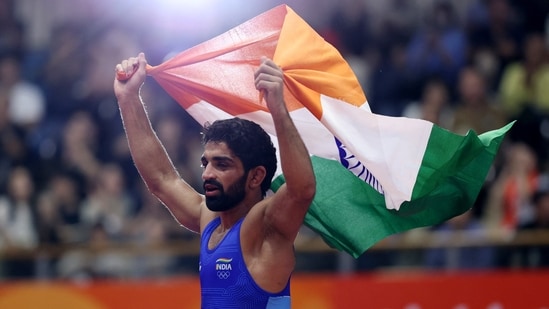
{{/usCountry}}On Saturday, Aman prevailed in a bloodied, bruising final to win his first Asian Games gold. A bronze medallist in the previous Asian Games in Hangzhou, Aman was up against North Korea's reigning world champion Han Chong-song in the 57kg final and survived a series of late leg attacks from his doughty opponent to carve a 11-7 win.
"We were confident of a gold. There was never a doubt. It doesn't matter if he is facing a world champion or an Olympic champion. That's something we have drilled into him very early,' Lalit said.
The North Korean appeared to have the advantage of power but Aman showed better mat awareness. Put on passivity early in the first period, Aman made the first move, going for Han's legs and registering two points. Fifteen seconds into the bout, the referees sought the first of many reviews, a delay that left Aman visibly frustrated. On resumption, he slipped inside Han's defence and went for his left leg, effecting another two-point throw to go into the break 4-1 up.
Both wrestlers stepped up the tempo in the second period with Aman repeatedly targeting Han's left leg. Known for his relentless attacks, particularly in the second half, Aman lived up to his reputation in the face of some stout defence from Han. A cut under his left eye failed to deter him as Aman's single leg takedown left Han in pain. A 6-1 scoreline suggested game over for Han, but he didn't throw in the towel.
"These cuts and bruises have never bothered him. That's part of the game," the coach said. "The final was close, but I am happy that Aman managed to execute what we have been working on."
A gut-wrench leading to a two-point takedown and a leg lace meant Han took the score to 5-7. Aman, now having suffered a mouth bleed, thwarted a series of leg attacks and kept the deficit manageable. With 30 seconds to go, the Indian produced a two-point throw and went 10-7 up. In a last throw of dice, Han challenged the move, lost the appeal and a point was awarded to Aman, who safely negotiated the last few seconds to seal the gold with an 11-7 score.
Han, a silver medallist in Hangzhou, retained the medal.
Aman stormed into the final in the morning on the back of commanding wins in all three bouts. The 23-year-old opened his campaign with a 20-9 demolition of Japan's Yamoto Ogawa before handing Kazakhstan's Nurdanat Aitanov a 12-1 drubbing. He then handed a 14-8 defeat to Tajikistan's Aiaal Belolyubskii.
The other aspect Aman worked on was his weight management. With his height and increased muscle mass, maintaining the 57kg weight is tough, which is why Aman competed in only a handful of international meets this year.
"He mostly competed in 61kg events this year because we didn't want him to lose weight and risk injuries for inconsequential tournaments. Making weight, for him, is a gradual 15-day exercise. That's why he flew to Japan on September 29 while the rest of the squad went on Sept 26," Lalit said.
Antim off-colour
There was no such delight for Antim Panghal who was handed a 1-9 thrashing in the 53kg final. Up against local favourite and 2024 world champion Moe Kiyooka in the final, the Hangzhou bronze medallist was no match for her accomplished opponent who laid bare the gulf in quality.
The Japanese was at her attacking best in the second period, which is where she piled on all her points. After conceding a push-out point in the first period, Kiyooka came into her own in the second giving Antim no breathing room. The Indian, perhaps wary of Kiyooka's pacy counters, didn't even try to get close. Her fate was sealed with a powerful four-point throw in the dying stages. Antim, having been completely outplayed, cut a sorry figure while Miyooka celebrated in front of an ecstatic home crowd.
India thus ended their wrestling campaign with six medals, the same as the last edition but better in terms of standings. In Hangzhou, the wrestlers won one silver and five bronze medals.
In Nagoya, Sujeet Kalkal (65kg) and Aman were the gold medallists while Antim and Greco-Roman wrestler Nitesh Siwach (97kg) won silver. Deepak Punia (97kg) and Greco wrestler Sunil Kumar (87kg) will come home with a bronze each.